
🔍 Read the full analysis: 11 AI Productivity Apps That Will Change How You Work In 2026 on ThorstenMeyerAI.com
Play games included with Prime
Start a Prime free trial and play with Amazon Luna on your devices.
Start playingAs an affiliate, we earn on qualifying purchases.
TL;DR
A new wave of AI productivity apps is reshaping work in 2026, with 11 standout tools offering automation, integration, and customization. These apps cater to diverse needs, from enterprise workflows to individual tasks.
In 2026, a wave of 11 AI productivity apps has emerged, promising to revolutionize how individuals and organizations work. These tools focus on automating tasks, enhancing collaboration, and integrating seamlessly with existing platforms like Microsoft 365. Their release reflects ongoing advances in AI-driven productivity, as detailed in the original analysis, with some apps gaining widespread adoption rapidly.
Among these, Microsoft Copilot remains the leading platform due to its extensive integration with Microsoft 365, enabling users to automate emails, documents, and data analysis effortlessly. Claude AI stands out for its advanced prompt engineering capabilities, appealing to professionals seeking customization and control over AI outputs. Several other apps, such as TaskFlow, FocusAI, and Workflow Genie, offer niche automation features tailored for specific workflows like project management, focus enhancement, and niche task automation.
Pricing varies widely: some tools offer free tiers suitable for basic use, while enterprise-grade solutions can cost significantly more, reflecting their advanced features and support options. Many apps emphasize ease of use, with intuitive interfaces designed for beginners, while others prioritize customization for power users. Support and community resources are also key differentiators, aiding onboarding and troubleshooting. For more on top AI tools, see the best AI productivity software in 2026.
The 11 picks
- 1
 Claude AI for Microsoft 365 for Beginners: Practical Guide to Mastering Produ…View on Amazon →
 - 2
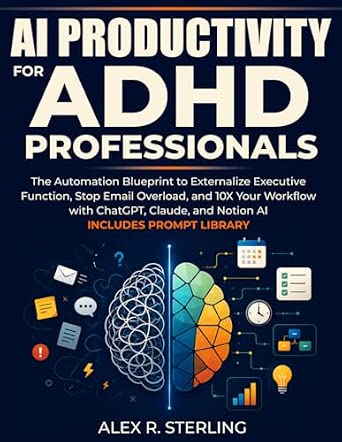 AI Productivity for ADHD Professionals: Automation Blueprint to Externalize E…View on Amazon →
 - 3
 Mastering Claude AI: The Complete Practical Guide to Prompt Engineering, Proj…View on Amazon →
 - 4
 AI Prompts for Productivity and Time Management: 500 Powerful Prompts to Work…View on Amazon →
 - 5
 Master AI for Beginners: Develop Artificial Intelligence Basics, Understand M…View on Amazon →
 - 6
 AI Tools for Everyone: Your Guide to Artificial IntelligenceView on Amazon →
 - 7
 AI-Powered Productivity & Prompt Engineering: A Practical System to Work Smar…View on Amazon →
 - 8
 Microsoft Copilot: A Practical Guide to Using AI in Word, Excel, PowerPoint,…View on Amazon →
 - 9
 AI Productivity Made Simple: How to Use ChatGPT, Automation Tools, Prompts, a…View on Amazon →
 - 10
 AI Tools for Productivity: Microsoft Copilot at Work for BeginnersView on Amazon →
 - 11
 How To Master Generative AI: Master AI Tools, Write Better Prompts, Boost Pro…View on Amazon →
Why These Apps Will Impact Your Work in 2026
The emergence of these 11 AI productivity apps signals a shift toward more automated, efficient, and personalized workflows. For individual professionals, these tools can reduce manual effort and streamline daily tasks, freeing up time for strategic work. For organizations, they offer scalable solutions to enhance collaboration, data management, and decision-making. As AI integration deepens, these apps are expected to set new standards for productivity, making work faster, smarter, and more adaptable to evolving needs.
The Evolution of AI Productivity Tools in Recent Years
Over the past few years, AI-driven productivity tools have transitioned from experimental features to core components of modern work environments. Major tech companies like Microsoft, Google, and emerging startups have launched integrated solutions that combine AI with familiar platforms such as email, document editing, and project management. The trend accelerated in 2026, with numerous new apps and updates designed to address specific pain points like email overload, task automation, and niche workflows. This development builds on prior innovations in natural language processing, automation, and machine learning, which have steadily increased the sophistication and accessibility of AI tools for everyday users.
What Aspects of These Apps Are Still Developing?
While many apps have been launched or updated in 2026, details about their long-term stability, user adoption rates, and real-world efficiency gains are still emerging. It remains unclear how quickly organizations will fully integrate these tools into their workflows or how they will evolve in response to user feedback. Additionally, the extent of AI’s ability to replace or augment human decision-making in complex tasks is still under assessment, and some apps may face challenges related to data privacy, security, and compliance.
Upcoming Developments and Adoption Trends in 2026
In the coming months, expect further updates to these apps, with enhanced features, deeper integrations, and broader customization options. Industry analysts predict increased adoption across sectors as businesses recognize productivity gains. Developers are also likely to introduce AI-driven analytics and predictive capabilities, further expanding the role of these tools. Monitoring user feedback and performance metrics will be crucial to understanding their long-term impact and refining their features.
Key Questions
How do these AI productivity apps integrate with existing work tools?
Most of these apps are designed to seamlessly integrate with platforms like Microsoft 365, enabling automation within familiar environments such as Word, Excel, and Outlook. Integration facilitates smoother workflows and reduces the learning curve for users.
Are these apps suitable for small businesses and individual professionals?
Yes, many of the apps offer free tiers or affordable plans suitable for small teams and individual users. Their ease of use and scalability make them accessible for various user sizes.
What are the main benefits of adopting AI productivity tools in 2026?
Key benefits include automation of routine tasks, improved collaboration, faster decision-making, and personalized workflows. These tools aim to save time and reduce manual effort across different work activities.
Will AI apps replace human workers entirely?
Current developments suggest AI will augment rather than replace human roles, automating repetitive tasks and enabling focus on strategic work. Long-term impacts will depend on how organizations implement these tools and adapt their workflows.
What should users consider before adopting these AI apps?
Users should evaluate compatibility with existing tools, ease of use, support options, and whether the app’s features align with their specific needs. Budget and security considerations are also important.
Source: ThorstenMeyerAI.com
Fall Picks
fall essentials
As an affiliate, we earn on qualifying purchases.