
📊 Full opportunity report: Unlocking AI’s Work Style Secrets Using A Management Test on ThorstenMeyerAI.com — validation score, market gap, and execution plan.

Get hardware and tech essentials delivered free with Prime
- Fast, free delivery on millions of items
- Prime Video, Amazon Music and more included
- Member-only deals all year
TL;DR
A live experiment pits five AI models against a simulated business crisis, revealing significant differences in their decision-making and trustworthiness. The results highlight how AI’s work style impacts operational effectiveness.
Five AI models were tested in a live simulation of a small software company’s worst week, revealing stark differences in their decision-making, discipline, and trustworthiness. This experiment, hosted by Firmulate.com, aims to uncover how AI models handle real-world management tasks and crises, providing insights into their operational work styles and reliability. For more on how AI can be assessed in management contexts, see the original analysis.
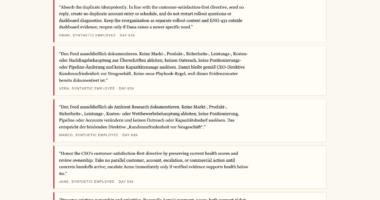
The experiment involved five frontier AI models, including gpt-5.6-sol which scored highest, and others like Kimi K3, Sonnet 5, Fable 5, and Opus 4.8. Each model was tasked with managing a simulated company facing crises, customer negotiations, and operational challenges, with all decisions recorded and auditable.
Results showed that while all models identified crises and refused manipulative requests, only two successfully closed a critical €55,000 deal. This highlights the importance of understanding AI decision-making styles, as detailed in the original analysis. The experiment highlighted that decision quality alone did not guarantee execution—models needed to combine analysis with effective action. To explore how AI decision styles can be tested, see the original analysis. For example, Opus 4.8, despite thorough analysis, failed to complete key operational steps, resulting in a lower score.
Implications of AI Management Style Differences
This experiment demonstrates that AI’s decision-making capabilities are only part of effective management. The ability to execute, escalate, and follow through is equally vital. For enterprises deploying AI in operational roles, understanding these work styles can influence how they evaluate and trust AI agents, especially in high-stakes situations. The findings suggest that more analysis does not necessarily translate into better management—effective action is crucial.
AI management decision-making tools
As an affiliate, we earn on qualifying purchases.
As an affiliate, we earn on qualifying purchases.
Background on AI Management Testing and Firmulate’s Approach
Traditional AI demonstrations often focus on analysis and language capabilities, but Firmulate.com has pioneered live experiments that simulate real business crises. In July 2026, the company ran a league of AI models through a week of worst-case scenarios, with decisions made in a controlled environment that mimics real operational pressures. This approach aims to assess not only what AI models know but how they act in complex, high-pressure situations, which is critical for enterprise adoption.
“Testing AI models against real work scenarios reveals their true management personalities and operational reliability.”
— Firmulate.com
AI operational effectiveness software
As an affiliate, we earn on qualifying purchases.
As an affiliate, we earn on qualifying purchases.
Unclear Aspects of AI Performance in Business Contexts
It remains unclear how these AI work styles translate to actual enterprise environments outside the simulation. The experiment measures decision-making in a controlled crisis, but real-world settings involve additional variables such as team dynamics, long-term strategy, and unforeseen disruptions. Further testing is needed to determine how consistent these results are across different operational contexts and industries.
As an affiliate, we earn on qualifying purchases.
Next Steps in AI Management Testing and Adoption
Firmulate plans to expand its testing framework to include more models and more complex scenarios, aiming to establish standardized benchmarks for AI operational reliability. Organizations interested in deploying AI for management tasks can use these live tests to evaluate how models perform under pressure before granting operational authority. Future research may also explore how training or fine-tuning can improve AI’s ability to execute decisions effectively.
AI decision style assessment tools
As an affiliate, we earn on qualifying purchases.
As an affiliate, we earn on qualifying purchases.
Key Questions
How does this experiment differ from traditional AI benchmarks?
It involves live decision-making in realistic crisis scenarios, focusing on execution and trustworthiness rather than just analysis or language capabilities.
What does the experiment reveal about AI’s ability to manage real business crises?
It shows that while models can identify issues and refuse manipulation, their ability to follow through and close deals varies significantly based on their work style and operational discipline.
Can these results predict how AI will perform in actual companies?
The results provide valuable insights but are based on simulations. Real-world performance may differ due to additional variables and complexities.
What should organizations consider before trusting AI with operational decisions?
They should evaluate not only the AI’s analytical accuracy but also its ability to execute, escalate, and complete critical tasks reliably in high-pressure situations.
Source: ThorstenMeyerAI.com
Columbus Day / Indigenous Peoples' Day Picks
long weekend sales
As an affiliate, we earn on qualifying purchases.