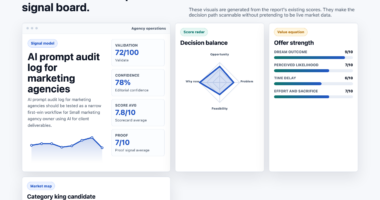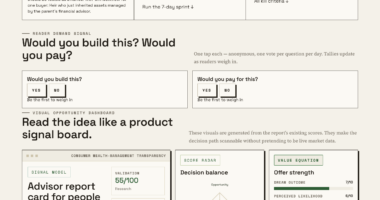

📊 Full opportunity report: Disk Is the Contract: Inside Threlmark’s Local-First Architecture on ThorstenMeyerAI.com — validation score, market gap, and execution plan.

Get hardware and tech essentials delivered free with Prime
- Fast, free delivery on millions of items
- Prime Video, Amazon Music and more included
- Member-only deals all year
TL;DR
Threlmark introduces a local-first, file-based architecture where disk-stored JSON files serve as the definitive data source. This design enables portability, interoperability, and resilience without relying on a central database.
Threlmark has revealed a novel architecture that uses on-disk JSON files as the definitive source of project data, foregoing traditional server-based or cloud storage. This approach emphasizes simplicity, portability, and resilience, making the disk the contract for all project artifacts.
The core design decision is that there is no server of record; all tools and UI components access the same files directly on disk, with the directory layout serving as a formal contract. Files include a manifest, dependency graph, project metadata, lane configurations, individual roadmap cards, and shared artifacts, all stored as separate JSON files. This structure allows any external tool to read or modify project data simply by reading and writing files, supporting interoperability across different systems and languages.
To ensure safety and consistency, Threlmark employs atomic file writes using temporary files and rename operations, preventing corruption during crashes. It also uses a read-merge-write pattern that preserves unknown fields for forward compatibility, allowing tools to evolve without breaking existing integrations. The system automatically reconciles lane ordering with actual items, ensuring the project view remains consistent even when external modifications occur.
Disk is the contract: inside a local-first roadmap hub
A Next.js app on top of plain JSON files — no database, no cloud, no accounts. The key decision: the on-disk layout IS the API. Everything else cascades from taking that seriously.
There is no server-of-record — the files are the record
The UI and any external tool reach the same files through the same discipline. The data root defaults to ~/.threlmark — home-based, because it’s a shared hub every one of your apps points at.
Inspectable
Every artifact is a file you can cat, diff, grep, commit.
Portable · no lock-in
Back up with cp, sync with Dropbox / git, migrate trivially.
Interoperable
Any tool in any language joins by reading / writing files.
Restartable
No in-memory state to lose — stateless over the files.
Two disciplined patterns instead of a database
“Just use files” is easy to get wrong. These two patterns — ported from a battle-tested sibling app — are what make file-based state sound rather than reckless.
Atomic writes
Write to a temp file in the same dir, then rename() over the target. Rename is atomic on one filesystem — a crash mid-write leaves the complete old file or the complete new one, never a half.
The board heals itself
A single roadmap.json array races when two tools write at once. One file per card makes writes collision-free. Lane order lives in board.json and reconciles on read.
board.json. It writes an item file — the board fixes itself on Threlmark’s next read. Unknown keys are preserved, so the contract is forward-compatible.The numbers can’t drift from the files
Anything computable from item state is computed — so the displayed numbers can never disagree with the underlying JSON. Priority is the clearest example: it’s calculated on read, never persisted.
priority — computed on read
Impact weighted heaviest; effort the only axis that subtracts. Reused verbatim from the original tool, so imported cards rank identically.
A handoff is a first-class flow event
The genuinely 2026-shaped part: most building is done by AI agents, so Threlmark closes the loop. Watch a card go from ranked to Done without anyone dragging it.
Handoff → report → self-move
The brief carries a reporting protocol. The agent reports through REST or the filesystem — and a done report moves the card itself.
POST /api/projects/:id/
items/:itemId/report
Direct call. Applied immediately.
drop reports/<file>.json
→ ingested on read
Robust even if the server’s down at finish time.
A small formula, and an honest hosting caveat
Because items are globally addressable (<projectId>/<itemId>), the Portfolio ranks everything together by a status-weighted score — finishing beats starting, blockers get a boost.
Portfolio ranking — status-weighted
In-flight work floats to the top; bottlenecks cost the most, so blockers get nudged up.
Static read-only demo
Seeded data, writes to localStorage. Try-before-you-clone.
Personal Node instance
Password-gated, persistent backed-up THRELMARK_DATA_DIR.
Multi-tenant SaaS
Add accounts + per-tenant isolation. A separate build.
src/lib/*/store.ts is the natural seam — the same boundary that keeps the local tool simple is the one you’d extend for multi-tenancy. The architecture doesn’t fight that future; it just doesn’t pay for it until you need it.
Why Disk-Based Data Matters for Project Management
This architecture matters because it enables true portability and interoperability, allowing users to back up, migrate, or integrate their project data with other tools easily. It also enhances resilience; since all state is stored in files, there is no single point of failure or reliance on external servers. This approach supports a decentralized workflow and simplifies collaboration, especially in environments where cloud services are restricted or undesirable.
Furthermore, the design aligns with principles of simplicity and transparency, giving users full visibility into their project data and control over it. It challenges the traditional notion of centralized databases, showing that a robust, scalable project management system can be built entirely on local files.
JSON file editor for project management
As an affiliate, we earn on qualifying purchases.
As an affiliate, we earn on qualifying purchases.
The Evolution of Threlmark’s Architectural Philosophy
Threlmark’s architecture builds on previous projects emphasizing open, portable data formats and stateless design. Historically, many project tools rely on centralized servers or cloud storage, which can introduce lock-in and complexity. Threlmark’s approach reverses this trend by making disk storage the central element, inspired by principles from version control and local-first design. The system’s reliance on JSON files echoes practices seen in other local-first apps, but Threlmark extends this idea into multi-project management, integrating AI agents and external tools seamlessly.
This development follows ongoing efforts to create more resilient, user-controlled workflows that are less dependent on cloud infrastructure, aligning with broader trends toward decentralization and data portability in software tools.
“The on-disk layout is the API, and it’s the contract that everything adheres to. This design makes the system portable, restartable, and inherently collaborative without a server.”
— Thorsten Meyer, creator of Threlmark
As an affiliate, we earn on qualifying purchases.
Unresolved Questions About Threlmark’s File-Based System
It is not yet clear how well this architecture scales with very large projects or numerous concurrent external modifications. The performance implications of frequent file reads and writes in complex workflows remain to be tested, and user adoption strategies are still evolving. Additionally, the extent of support for real-time collaboration and conflict resolution across multiple users is still under development.
local-first project management tools
As an affiliate, we earn on qualifying purchases.
As an affiliate, we earn on qualifying purchases.
Next Steps for Threlmark’s Local-First Architecture
Threlmark plans to further refine its file-based system, including performance optimizations and enhanced conflict management. Future releases may introduce more advanced external tool integrations and real-time collaboration features. Community feedback and testing will shape the evolution of this architecture, with broader adoption anticipated as the system matures.
JSON-based project tracking software
As an affiliate, we earn on qualifying purchases.
As an affiliate, we earn on qualifying purchases.
Key Questions
How does Threlmark ensure data safety without a server?
It employs atomic file writes using temporary files and renaming, preventing corruption even during crashes, and uses tolerant merge strategies to preserve data integrity.
Can external tools modify project data safely?
Yes, since each artifact is stored as a separate JSON file, any tool that reads and writes these files can participate without locking or coordination, provided it follows the established file structure and conventions.
What are the limitations of this disk-based approach?
Potential limitations include scalability concerns with very large projects, handling concurrent modifications from multiple users, and ensuring real-time synchronization in collaborative environments, which are still being addressed.
Will this architecture support cloud or server-based features in the future?
While the current design emphasizes local-first principles, future iterations might include optional cloud synchronization or server components, but the core philosophy remains focused on disk as the primary contract.
Source: ThorstenMeyerAI.com
Halloween Picks
halloween
As an affiliate, we earn on qualifying purchases.