
📊 Full opportunity report: The Free-Download Question: When Running Your Own Model Actually Beats Paying on ThorstenMeyerAI.com — validation score, market gap, and execution plan.
TL;DR
Open-weight AI models now rival proprietary models in capability and cost. For sustained, large-scale use, owning hardware and running models locally can be cheaper than paying per-token API fees. This shift affects enterprise and regional AI strategies.
Recent developments indicate that running open-weight AI models locally can now be more cost-effective than paying for API-based services at scale, challenging the traditional notion that cloud APIs are always cheaper for large-volume use. This shift is driven by improvements in open models’ performance, hardware affordability, and efficiency, making local inference a viable alternative for many organizations.
Open-weight AI models have significantly closed the performance gap with proprietary models, with some now within 5 to 15 points on key benchmarks and capable of matching top-tier models on certain tasks. For example, DeepSeek V4 Pro achieves 80.6% on SWE-bench Verified, at roughly one-seventh the cost of GPT-5.5, and models like GLM-5.1 outperform some commercial models on benchmark tests.
Hardware advancements, particularly Apple Silicon’s unified-memory architecture, have lowered the barrier for local inference. A Mac Studio with 192GB of unified RAM can run large models like 70-billion-parameter variants without thrashing, and mixture-of-experts architectures further optimize memory and processing costs. These improvements make owning and operating models on-premises more feasible for small operators and enterprises alike.
Cost comparisons show that below certain usage volumes, API services remain cheaper because they eliminate operational overhead. However, at higher, predictable volumes, owning hardware and models can be more economical, especially as open models approach the performance of proprietary ones and hardware costs continue to decline. The key is understanding the crossover point, which is shifting favorably toward local inference.
The free-download question: when running your own actually beats paying
“Why pay for on-prem when you could run Qwen free?” The download is free — running it well is not. The honest comparison is total cost of ownership vs. per-token API. And there’s a real, moving crossover.
“Free” means the download, not the running
When someone says an open model is free, they mean the weights. They’re not counting the hardware, power, ops time, the quality gap, or depreciation. For most workloads, those are the entire cost.
- Hardware — the machine to hold & run it
- Electricity — sustained inference draws real power
- Ops time — updates, queue health, tuning, 2 a.m. breakage
- The harness — context, persistence, retries (not optional)
- Quality gap — 6–12 mo behind frontier on hardest tasks
- Depreciation — frontier hardware dates in ~3 years
Where owning beats renting
Below some usage level the API wins decisively. Above some sustained, predictable volume, owned hardware wins — and the meter never restarts. Drag the volume; toggle the task and sovereignty needs.
API vs. own-hardware — monthly cost balance
An illustrative model, not a quote. The point is the shape: a real crossover that moves with your inputs.
Two regional pools, a 5–25× price gap
The “you trade away too much capability” objection got much weaker. Open weights have closed to within 5–15 points of the closed frontier — and on some tasks drawn level.
What you own when you own the inference
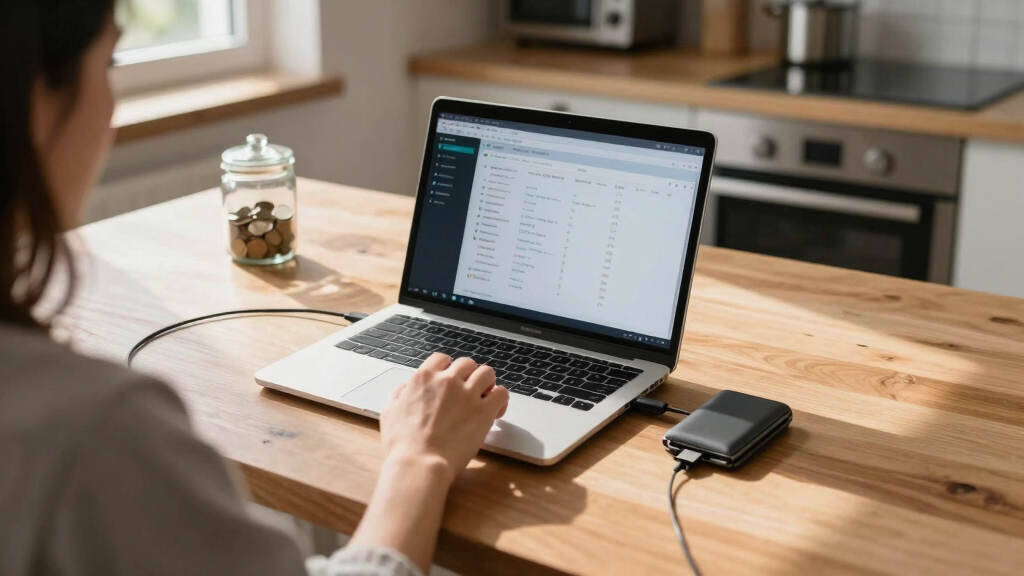
Apple Silicon’s unified memory rewired the math — a 192GB Mac Studio holds a 70B model in memory; MoE models (e.g. 35B total / ~3B active) make frontier-adjacent capability runnable on a desk. But owning inference means owning all of this:
The true-cost line items the “free” framing skips
Lived from a small Mac fleet running Qwen on MLX for a high-volume publishing pipeline: at sustained volume it pays for itself against the per-token meter — but every item below is real.
Hardware capex
The fleet up front. Depreciates — dates in ~3 years even if no invoice shows it.
Electricity
Sustained inference draws real power. At fleet scale it’s a monthly bill, not a rounding error.
Operational burden
Model updates, quantizations, queue health, throughput tuning, 2 a.m. breakage you now own.
The harness
Context, persistence, retries, tool routing. Not optional — the model is only half the system.
No per-token meter
The payoff: once owned, inference cost stops scaling with use. The meter never restarts.
Data never leaves
Nothing sent to strangers. Sovereignty is structural, not a contractual promise.
The crossover zone is real — and growing
The “just run Qwen” dismissal and the “you need a vendor” reflex are both too simple. The local path wins in a specific, identifiable zone — and that zone is bigger than a year ago.
Which way it tips
Cost-Effectiveness of Local AI Deployment in 2026
This development challenges the long-held assumption that cloud API services are always the most economical choice for AI deployment at scale. With open models nearing proprietary performance levels and hardware costs dropping, organizations can now consider owning and operating their own models as a financially viable strategy. This has implications for regional AI sovereignty, data privacy, and operational independence, especially for smaller operators and regional players seeking to reduce reliance on US or Chinese cloud services.
Apple Silicon Mac Studio for AI inference
As an affiliate, we earn on qualifying purchases.
As an affiliate, we earn on qualifying purchases.
Evolution of Open-Weight Models and Hardware Advances
Over the past year, open-weight models have rapidly advanced, with some now matching or surpassing the performance of commercial models on key benchmarks. Benchmarks like SWE-bench Verified and Artificial Analysis’s Intelligence Index show open models like DeepSeek V4 Pro and GLM-5.1 closing the gap, with costs significantly lower than proprietary options. Hardware innovations, particularly Apple Silicon’s unified memory, have also made local inference more practical and affordable, enabling models with billions of parameters to run efficiently on consumer-grade hardware.
Previously, the main barrier was performance lag and hardware costs, but recent improvements have shifted the landscape, making local inference a realistic alternative for many use cases, especially when sustained, predictable workloads are involved.
“The gap between ‘free to download’ and ‘cheap to operate’ is where serious decisions about open versus closed AI are made.”
— Thorsten Meyer
high RAM desktop computer for AI models
As an affiliate, we earn on qualifying purchases.
As an affiliate, we earn on qualifying purchases.
Remaining Uncertainties About Cost and Capability
While open models have closed much of the performance gap, they still lag slightly behind the very latest frontier models on some complex, long-horizon tasks. The exact crossover point varies depending on workload and hardware costs, and future improvements in both open models and hardware could further shift this balance. Additionally, operational complexities and the need for sophisticated harnessing of models remain significant considerations that are not yet fully quantified.
As an affiliate, we earn on qualifying purchases.
Upcoming Developments in Open Models and Hardware Efficiency
Expect continued improvements in open-weight models, reducing the performance gap further and lowering costs. Hardware innovations, particularly in memory and processing efficiency, will likely make local inference even more accessible for small to medium-sized operators. Meanwhile, organizations are expected to reassess their AI infrastructure strategies, balancing costs, control, and performance as these technologies evolve.
open-weight AI model hardware setup
As an affiliate, we earn on qualifying purchases.
As an affiliate, we earn on qualifying purchases.
Key Questions
Can small businesses afford to run their own AI models now?
Yes, recent hardware improvements and open-weight models make local inference financially viable for small businesses, especially for predictable, high-volume workloads.
Will open models fully replace proprietary models in the near future?
While open models are closing the performance gap, proprietary models still excel in the most demanding tasks. The landscape is likely to be a mix for some time.
What are the main challenges in switching to local inference?
Operational complexity, the need for sophisticated harnessing, and initial hardware costs are key challenges, though they are becoming easier to manage.
How does hardware choice impact the economics of running models locally?
Hardware with unified memory and sparse activation architectures, like Apple Silicon, significantly reduces costs and complexity, making local inference more feasible.
Source: ThorstenMeyerAI.com