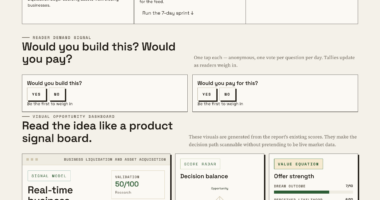
📊 Full opportunity report: Recovery-percentile tracker for orthopedic surgery patients on IdeaNavigator AI — validation score, market gap, and execution plan.

Get hardware and tech essentials delivered free — and shop member deals
- Fast, free delivery on millions of items
- Access to Prime Big Deal Days deals on October 6–7
- Prime Video, Amazon Music and more included
TL;DR
A pilot program is underway to test a recovery-percentile tracker for orthopedic surgery patients, aiming to reduce post-op calls and provide objective recovery benchmarks. The trial involves 15 knee-replacement patients over two weeks.
A pilot study is currently underway to evaluate a recovery-percentile tracker designed for orthopedic surgery patients, aiming to help office staff better assess post-op recovery and reduce patient call volume. The tracker provides patients with an objective benchmark of their recovery progress, which could streamline communication and improve patient reassurance.
The recovery-percentile tracker is a digital tool that allows patients to log daily data on pain, swelling, range of motion, and walking milestones following procedures such as knee replacements. These data points are then plotted against anonymized recovery curves for the same surgery, providing patients with a percentile ranking of their recovery status.
The pilot involves 15 knee-replacement patients at a single orthopedic practice, who will log their recovery metrics daily for two weeks. The primary goal is to determine whether use of the tracker reduces the number of ‘is this normal?’ calls received by office staff, compared to a control group not using the tool.
According to the developers, the tracker is intended as a minimal viable product (MVP) that can be scaled to other procedures and practices if proven effective. The subscription-based model charges per seat to surgeon offices, aiming to improve post-op care efficiency and patient satisfaction.
Potential to Transform Post-Operative Care Efficiency
If successful, this recovery-percentile tracker could significantly reduce the workload for orthopedic office staff by providing patients with a clear, data-backed understanding of their recovery progress. This could lead to fewer unnecessary calls, faster reassurance, and better resource allocation within busy practices. Additionally, it introduces an objective, quantifiable measure into post-op care, which has traditionally relied on subjective patient reports.
Beyond operational benefits, the tracker might enhance patient engagement and satisfaction by empowering them with personalized recovery insights. As outpatient orthopedic procedures continue to rise, scalable solutions like this could become integral to post-surgical management.
As an affiliate, we earn on qualifying purchases.
Growing Need for Post-Op Recovery Monitoring Tools
The volume of outpatient orthopedic surgeries, such as knee replacements, has increased steadily over recent years, driven by advances in minimally invasive techniques and patient demand. However, post-operative care remains resource-intensive, with staff often overwhelmed by patient questions about recovery norms.
Currently, most practices rely on subjective assessments and patient self-reporting without objective benchmarks. This gap leads to frequent calls and visits for reassurance, straining staff and delaying care for patients who may need intervention. The development of digital tracking tools aims to address this challenge by providing standardized recovery data.
The concept of recovery percentiles is inspired by similar approaches in other medical fields, but it is still in early testing stages within orthopedics. The pilot study is among the first efforts to validate such a tool in a real-world clinical setting.
“The recovery-percentile tracker has the potential to provide patients with an objective view of their progress, which could reduce unnecessary calls and improve overall care.”
— an anonymous researcher
orthopedic recovery monitoring device
As an affiliate, we earn on qualifying purchases.
As an affiliate, we earn on qualifying purchases.
Effectiveness and Adoption Still Under Evaluation
It is not yet confirmed whether the tracker will significantly reduce call volume or improve patient outcomes. The pilot is ongoing, and results are expected after the two-week logging period. Broader adoption depends on the pilot’s success and feedback from participating practices.
Additionally, questions remain about patient engagement levels, data privacy considerations, and how easily the tool can be integrated into existing workflows.
As an affiliate, we earn on qualifying purchases.
Next Steps in Validation and Scaling Efforts
Following the pilot, researchers plan to analyze data to assess whether the tracker reduces patient calls and improves recovery monitoring. If positive, plans include expanding testing to additional practices and procedures, refining the app based on user feedback, and exploring integration with electronic health records.
Further studies will be needed to confirm long-term benefits and cost-effectiveness before wider commercial rollout.
As an affiliate, we earn on qualifying purchases.
Key Questions
How does the recovery-percentile tracker work?
Patients log daily data on pain, swelling, range of motion, and walking milestones. The app then plots their progress against anonymized recovery curves, providing a percentile ranking of their recovery status.
Will this tool replace in-person assessments?
No, it is intended as a supplementary tool to help patients and staff better understand recovery progress and prioritize in-person evaluations when necessary.
Is patient data privacy protected?
The system uses anonymized data for benchmarking, and patient logs are stored securely in compliance with healthcare privacy regulations.
When will this tracker be available for wider use?
Wider deployment depends on the results of the current pilot. If successful, developers plan to expand testing and refine the platform over the next several months.
Source: IdeaNavigator AI
Fall Picks
fall essentials
As an affiliate, we earn on qualifying purchases.