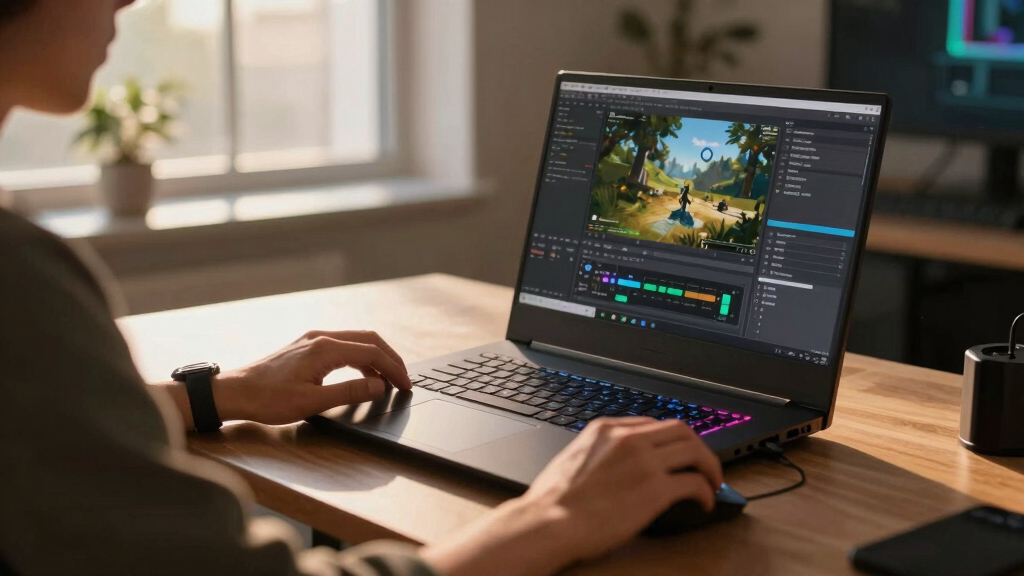

Choosing the best gaming laptops for game development involves balancing powerful hardware with portability and affordability. The top pick, the ASUS ROG Strix G16, offers a strong blend of high-end graphics and processing power, ideal for demanding development tasks. Meanwhile, the acer Nitro V with an i5 processor provides solid performance at a lower price, perfect for those on a budget. Other options focus on portability or feature-rich configurations, but each involves tradeoffs in either price, size, or raw power. Continue reading for a detailed breakdown of these models and how to pick the right one for your needs.
Key Takeaways
- High-end GPUs like the NVIDIA RTX 5060 significantly improve rendering and game testing speeds, justifying higher prices.
- Processors matter; upgrading from an i5 to an i7 or Ryzen 7 yields noticeable gains in compiling and multitasking for development.
- RAM is critical; 16GB is the minimum for smooth multitasking, but 32GB can future-proof your setup for larger projects.
- Display quality and refresh rate influence workflow—165Hz screens reduce eye strain during long coding sessions.
- Portability varies—lighter models are easier to carry but may sacrifice some performance or expandability.


More Details on Our Top Picks
MALLRACE Light Gaming Laptop, AMD Ryzen 7 Laptop(Up to 4.3GHz,8C/16T with 16GB DDR4 RAM 512GB SSD, AMD Radeon Graphics,WiFi 6,15.6 inch IPS Display,Webcam, Windows 11 Laptop Computer for Video Editing
This MALLRACE Ryzen 7 laptop stands out for delivering solid multitasking power with an 8-core AMD Ryzen 7 processor that boosts up to 4.3GHz, making it suitable for light game development and productivity tasks. Compared with the KAIGERR Ryzen 3, it offers better processing capabilities for handling game assets and code compilation, though it sacrifices some graphics performance. Its 16GB DDR4 RAM and expandable storage up to 4TB provide ample room for project files, while the 15.6-inch IPS display ensures clear visuals. The inclusion of WiFi 6 and a privacy webcam switch enhances connectivity and security. However, its integrated Radeon graphics may struggle with demanding 3D rendering, and the display resolution is standard Full HD, which limits detail for complex visual work. This pick makes the most sense for hobbyists or students who need a capable, portable machine without breaking the bank.
Pros:- Powerful AMD Ryzen 7 processor for multitasking and code compiling
- Expandable storage up to 4TB for large project files
- Lightweight at 1.65 kg for portability
- Rich 15.6-inch IPS display with vivid visuals
Cons:- Integrated AMD Radeon graphics may limit high-end rendering
- Standard Full HD resolution restricts detailed visual editing
- Lacks dedicated GPU for intensive 3D modeling
Best for: Budget-conscious students or hobbyist game developers needing versatile multitasking with decent display quality
Not ideal for: Professional developers or 3D artists who require dedicated high-end graphics and color accuracy
- Processor:AMD Ryzen 7 5700U, up to 4.3GHz
- RAM:16GB DDR4
- Storage:512GB SSD, expandable to 4TB
- Graphics:AMD Radeon integrated
- Display:15.6-inch IPS FHD
- WiFi:WiFi 6
Bottom line: This laptop suits entry-level game developers or students who need a capable, portable machine with good processing power on a budget.
ASUS ROG Strix G16 (2025) Gaming Laptop, 16” FHD+ 16:10 165Hz/3ms Display, NVIDIA® GeForce RTX™ 5060 Laptop GPU, Intel® Core™ i7 Processor 14650HX, 16GB DDR5, 1TB Gen 4 SSD, Wi-Fi 7, Windows 11 Home
This ASUS ROG Strix G16 makes a compelling case for developers needing serious graphics and processing muscle, with an Intel Core i7-14650HX CPU and an NVIDIA GeForce RTX 5060 GPU that handles complex game development tasks like real-time rendering and physics simulations. When compared to the KAIGERR LX16PRO, it offers a much higher-end GPU and faster DDR5 memory, essential for demanding visual work. Its 16-inch 165Hz display ensures smooth editing and testing, while the 1TB PCIe Gen 4 SSD guarantees quick load times for large assets. The inclusion of Wi-Fi 7 supports ultra-fast online collaboration. Its main tradeoffs are its higher price and bulkier design, making it less portable. Its advanced cooling system keeps performance steady during intensive workloads. This is best suited for professional developers or indie studios focused on AAA-quality game projects.
Pros:- High-end Intel Core i7 processor for demanding tasks
- NVIDIA RTX 5060 GPU for real-time rendering
- 165Hz high-refresh display for smooth visual editing
- Fast 1TB PCIe Gen 4 SSD for large project storage
Cons:- Premium price point
- Relatively bulky for portability
- Limited battery life during intensive tasks
Best for: Professional game developers or serious hobbyists with high-performance demands and budget flexibility
Not ideal for: Casual developers or those on a tight budget who only need basic coding and testing capabilities
- Processor:Intel Core i7-14650HX, up to 4.9GHz
- RAM:16GB DDR5
- Storage:1TB PCIe Gen 4 SSD
- Graphics:NVIDIA GeForce RTX 5060
- Display:16-inch FHD+ 165Hz
- WiFi:Wi-Fi 7
Bottom line: This laptop is ideal for serious game developers who need top-tier graphics and processing performance and are willing to invest accordingly.
acer Nitro V Gaming Laptop | Intel Core i5-13420H Processor | NVIDIA GeForce RTX 4050 Laptop GPU | 15.6″ FHD IPS 165Hz Display | 8GB DDR5 | 512GB Gen 4 SSD | Wi-Fi 6 | Backlit KB | ANV15-52-586Z
This acer Nitro V combines decent gaming and development specs with an Intel Core i5-13420H CPU and an NVIDIA GeForce RTX 4050 GPU, making it suitable for beginners or those testing smaller projects. Compared to the KAIGERR LX16PRO, it offers slightly better GPU performance for light rendering tasks, but with less RAM and storage capacity. Its 15.6-inch 165Hz display provides smooth visuals for editing and testing, while the 8GB DDR5 RAM is sufficient for basic game development workflows. The 512GB SSD supports quick file access. It’s less powerful than higher-end options but offers a balanced entry point. Its main drawback is limited RAM for large-scale projects, and the battery life is around 5 hours under load. Ideal for learners or hobbyists focusing on 2D or simple 3D prototypes.
Pros:- Solid entry-level CPU and GPU for light development
- Fast 165Hz display for smooth visuals
- Affordable price point
- Good connectivity with Wi-Fi 6
Cons:- Limited RAM (8GB) for larger projects
- Restricted storage (512GB SSD)
- Average battery life for demanding tasks
Best for: Beginners, students, or hobbyist developers starting with smaller projects
Not ideal for: Professional developers or those working on large, resource-intensive games requiring high-end graphics and memory
- Processor:Intel Core i5-13420H, up to 4.5GHz
- RAM:8GB DDR5
- Storage:512GB PCIe Gen 4 SSD
- Graphics:NVIDIA GeForce RTX 4050
- Display:15.6-inch FHD IPS 165Hz
- WiFi:Wi-Fi 6
Bottom line: This machine suits newcomers or hobbyists testing basic game prototypes without the need for high-end graphics or extensive multitasking.
acer Nitro V Gaming Laptop | Intel Core i7-13620H Processor | NVIDIA GeForce RTX 4050 Laptop GPU | 15.6″ FHD IPS 165Hz Display | 16GB DDR5 | 1TB Gen 4 SSD | Wi-Fi 6 | Backlit KB | ANV15-52-76NK
This acer Nitro V with an Intel Core i7-13620H and NVIDIA RTX 4050 GPU surpasses the 13420H model for demanding development tasks, including real-time rendering and multi-threaded compiling. Compared with the ASUS ROG Strix G16, it offers a slightly lower GPU but still delivers excellent performance for game development. Its 16GB DDR5 RAM and 1TB SSD support large asset libraries and fast workflows. The 15.6-inch 165Hz display aids in visual precision, and Wi-Fi 6 ensures stable online collaboration. Its main tradeoffs are its slightly heavier weight and price, but it provides an excellent balance of power and affordability for serious developers. The machine’s cooling system maintains steady performance during prolonged workloads.
Pros:- Powerful i7-13620H CPU for multitasking
- Excellent RTX 4050 GPU for rendering and testing
- Fast DDR5 RAM and spacious 1TB SSD
- Vivid 15.6” 165Hz display for precise editing
Cons:- Higher price compared to lower-tier models
- Slightly heavier for portability
- Limited battery life under heavy load
Best for: Experienced indie developers or small studios working on resource-intensive projects
Not ideal for: Casual hobbyists or learners with limited budgets who don’t need high-end specs
- Processor:Intel Core i7-13620H, up to 4.9GHz
- RAM:16GB DDR5
- Storage:1TB PCIe Gen 4 SSD
- Graphics:NVIDIA GeForce RTX 4050
- Display:15.6-inch FHD IPS 165Hz
- WiFi:Wi-Fi 6
Bottom line: This laptop offers a compelling mix of performance and value for developers tackling demanding game development tasks.
KAIGERR Gaming Laptop, AMD Ryzen 4300U(Up to 3.7GHz), 16GB DDR4 512GB SSD Laptop Computer, 16.0inch Windοws 11 Laptop, 1920P FHD Display, WiFi 6, USB3.2, Type_C
This KAIGERR Ryzen 4300U laptop provides a balanced mix for entry-level game development, with a 4-core Ryzen 4300U CPU that peaks at 3.7GHz, suitable for basic coding and testing. When compared with the acer Nitro V i5-13420H, it offers comparable graphics performance via its UHD integrated GPU but lags in processing power. Its 16GB DDR4 RAM and 512GB SSD support moderate multitasking and storage needs. The 16-inch display with a 1920p resolution offers clear visuals for simple projects. Its main limitations are the lower processing power and integrated graphics, which may struggle with complex rendering tasks. The battery life of around 8 hours is a plus for mobility. This makes it a good choice for students or hobbyists starting out.
Pros:- Decent AMD Ryzen 4300U CPU for basic tasks
- Vivid 16-inch display with 1920p resolution
- Long battery life (~8 hours)
- Affordable for entry-level users
Cons:- Limited processing power for complex projects
- UHD integrated graphics restrict high-end rendering
- Not suitable for large assets or intensive testing
Best for: Beginners or students focusing on small-scale projects or learning game development basics
Not ideal for: Professional developers or those working on larger, graphics-intensive projects
- Processor:AMD Ryzen 4300U, up to 3.7GHz
- RAM:16GB DDR4
- Storage:512GB SSD
- Graphics:UHD integrated
- Display:16-inch 1920p FHD
- WiFi:Wi-Fi 6
Bottom line: Ideal for newcomers or students starting with small projects and basic game development workflows.
KAIGERR 2026 New Gaming Laptop, 16.0inch Laptop Computer with AMD Ryzen 7 H255(8C/16T, Up to 4.9GHz), 16GB DDR5 512GB NVMe SSD Windows 11 Laptop, Radeon RX Vega 8 Graphics,WiFi 6, Backlit KB
This model stands out for its powerful AMD Ryzen 7 H255 processor reaching up to 4.9GHz, making it suitable for demanding game development tasks alongside gaming. Compared with the KAIGERR Light Gaming Laptop, it offers slightly higher processing speeds, though at a similar weight. The dual-fan cooling system excels in managing heat during long development sessions, helping maintain peak performance. Its 16GB DDR5 RAM and upgrade potential to 64GB support multitasking, while the 512GB NVMe SSD ensures quick load times. The vivid 16.0″ IPS display with high refresh rate enhances visual clarity, ideal for detailed graphics work. However, the higher power means it may run louder under load and lacks the portability of lighter options. This pick makes the most sense for developers needing serious horsepower without sacrificing portability, but it might be overkill for light coding or casual users.
Pros:- Exceptional processing power with up to 4.9GHz AMD Ryzen 7 H255
- Advanced dual-fan cooling system reduces thermal throttling
- High-quality 16.0″ IPS display with vivid colors and high refresh rate
- Upgradeable RAM up to 64GB for future-proofing
Cons:- Louder operation under heavy load due to cooling system
- Slightly heavier at 1.75kg, less portable for on-the-go use
Best for: Game developers who require a high-performance machine capable of handling intensive rendering and multitasking.
Not ideal for: Beginners or casual hobbyists focusing on simple game projects, as its price and specs may be more than needed.
- Processor:AMD Ryzen 7 H255, up to 4.9GHz
- RAM:16GB DDR5 (upgradable to 64GB)
- Storage:512GB NVMe SSD
- Display:16.0 inch IPS, 1920×1200
- Graphics:Radeon RX Vega 8
- Weight:1.75 Kilograms
Bottom line: This laptop suits professional game developers seeking top-tier performance balanced with good display quality and upgradeability.
KAIGERR Light Gaming Laptop, 16.0inch Laptop Computer with AMD Ryzen 7 7735HS(8C/16T, Up to 4.7GHz), 16GB RAM 512GB NVMe SSD Windows 11 Laptop, Radeon RX Vega 8 Graphics,WiFi 6, Backlit KB
This model makes the list for its balance of decent specs and affordability, featuring the AMD Ryzen 7 7735HS processor up to 4.7GHz that handles game development tasks reasonably well. When compared to the KAIGERR RX16 with the Ryzen 7 H255, it offers slightly lower maximum clock speeds and a less robust cooling system, but it remains capable for lighter development workflows. Its 16GB DDR5 RAM and 512GB NVMe SSD support multitasking and fast data access, while the 16.0″ LCD screen with 1920×1200 resolution provides clear visuals. The integrated Radeon RX Vega 8 graphics are suitable for moderate rendering and testing. The main tradeoff involves reduced thermal management and slightly lower processing headroom, which may limit performance during very intensive tasks. This is ideal for hobbyists or new developers starting out without needing top-tier hardware.
Pros:- Capable AMD Ryzen 7 7735HS processor up to 4.7GHz
- Efficient dual-fan cooling system improves thermal performance
- Good display with 1920×1200 resolution and high refresh rate
- Affordable price point for entry-level development
Cons:- Lower maximum clock speeds compared to higher-end Ryzen models
- Less effective cooling may lead to thermal throttling during prolonged intensive tasks
- Weight of 1.75kg slightly reduces portability
Best for: Beginners or students learning game development who want a capable yet affordable machine.
Not ideal for: Experienced developers working on complex, high-fidelity projects that demand the highest specs and thermal management.
- Processor:AMD Ryzen 7 7735HS, up to 4.7GHz
- RAM:16GB DDR5
- Storage:512GB NVMe SSD
- Display:16.0 inch LCD, 1920×1200
- Graphics:Radeon RX Vega 8
- Weight:1.75 Kilograms
Bottom line: This laptop offers a reasonable mix of performance and price, perfect for newcomers to game development on a budget but less suited for demanding projects.

How We Picked
Our evaluation focused on performance, build quality, and usability tailored for game development. We prioritized laptops with powerful CPUs and GPUs capable of handling resource-intensive tasks like 3D rendering, simulation, and compiling. Battery life and portability were considered, but only if they didn’t significantly compromise performance. Cost-to-value ratio also played a role, ensuring each model offers features relevant to developers without unnecessary extras. The ranking reflects a balance between raw power, user experience, and future-proofing, making these options suitable for serious game development work.Factors to Consider When Choosing Best Gaming Laptops For Game Development
When selecting a gaming laptop for game development, it’s essential to consider several factors that directly impact your productivity and experience. The right balance between hardware specs, portability, and price can make or break your workflow. Understanding these key elements helps avoid common pitfalls like overspending on unnecessary features or underinvesting in critical components.Processing Power (CPU)
For game development, a fast, multi-core processor like an Intel Core i7 or AMD Ryzen 7 is highly recommended. These CPUs handle compiling code, running complex simulations, and multitasking more efficiently than entry-level options. Investing in a higher-end CPU can significantly reduce wait times and improve your overall workflow, especially when dealing with large projects. However, premium CPUs come at a higher cost, so consider your project scope and budget before choosing the top-tier options.
Graphics Capabilities (GPU)
A robust GPU such as an NVIDIA GeForce RTX 4050 or 5060 is vital for real-time rendering, testing, and working with 3D assets. While integrated graphics might suffice for basic coding, they fall short for demanding development tasks. Higher-end GPUs speed up rendering times and enable smoother visual debugging, making them a worthwhile investment for serious developers. Be mindful that more powerful GPUs tend to increase battery drain and cost, so balance your needs accordingly.
Memory (RAM)
Minimum of 16GB RAM is needed for smooth multitasking during game development, but 32GB offers more breathing room for large assets, multiple applications, and future projects. Insufficient RAM can cause lag and slowdowns, especially when working with complex scenes or multiple tools simultaneously. Upgrading RAM is often one of the most cost-effective ways to boost performance without overhauling your entire system.
Display Quality
A high-quality display with at least a 165Hz refresh rate and good color accuracy reduces eye strain during long coding or testing sessions. An IPS panel ensures better viewing angles and color consistency, which is helpful when working on visual assets. A larger screen size, like 16 inches, can improve productivity by providing more workspace, but it may compromise portability. Consider your typical workflow environment when choosing screen specs.
Portability and Battery Life
If you plan to work on the go, prioritize lightweight models with decent battery life. However, increased portability often means sacrificing some performance or expanding options like multiple ports. Larger, more powerful laptops tend to be heavier and have shorter battery spans, making them less ideal for frequent travel. Evaluate how often you’ll need mobility versus raw power to select the best fit.
Build Quality and Expandability
Durability and ease of maintenance matter, especially for portable setups. Look for laptops with sturdy chassis and accessible internals for upgrades like RAM or storage. Cheaper models may skimp on build quality, leading to issues over time. Investing in a well-built machine ensures long-term reliability, especially when running intensive development tasks frequently.
Frequently Asked Questions
Is a gaming laptop with a high-refresh-rate screen necessary for game development?
While a high-refresh-rate screen like 165Hz enhances visual clarity and reduces eye strain during extended coding or testing sessions, it isn’t strictly necessary for game development. The main benefit is smoother visuals when testing games or working with fast-paced assets. If your primary focus is coding and asset creation, a good-quality display with accurate color reproduction may be more important. However, for real-time testing, a higher refresh rate can improve your overall experience.
Can I use a gaming laptop for professional game development work, or do I need a desktop?
Gaming laptops are capable of handling most game development tasks, especially models with powerful CPUs and GPUs. They offer portability that desktops simply can’t match, making them ideal for working remotely or in different locations. However, desktops typically provide better upgrade options, thermal management, and often better performance for the price. For most freelance or mobile developers, a high-end gaming laptop strikes a good balance, but for very large projects or studio work, a desktop setup might be preferable.
How much should I expect to spend on a laptop suitable for game development?
Expect to invest at least $1,200 for a capable gaming laptop with a decent CPU, GPU, and 16GB of RAM. Premium models with RTX 5060 GPUs, 32GB RAM, and high-refresh-rate displays can cost upwards of $2,000 or more. Spending more generally provides better performance, longevity, and future-proofing, but it’s important to match your budget with your project needs. Consider whether you prioritize raw power, portability, or a balance of both to determine your ideal spending range.
Is it worth upgrading the RAM or storage later on?
Upgrading RAM and storage can extend the lifespan of your gaming laptop and improve performance, especially if your initial configuration is on the lower end. Many gaming laptops allow for easy upgrades, making this a cost-effective way to future-proof your system. For instance, adding extra RAM can significantly boost multitasking capabilities, while larger SSDs provide more space for large projects and fast load times. However, always check if your model supports upgrades before purchasing.
What should I avoid when buying a gaming laptop for game development?
Avoid laptops with underpowered CPUs or GPUs, as they will struggle with demanding tasks like rendering or compiling large projects. Similarly, models with less than 16GB RAM can hinder multitasking and slow down your workflow. Overly cheap models often cut corners on build quality and thermals, leading to overheating and reduced longevity. Also, steer clear of overly bulky or heavy laptops if portability is a priority, as they can become impractical for frequent travel or remote work.
Conclusion
For those seeking the best overall balance of power and portability, the ASUS ROG Strix G16 stands out as the top choice, suitable for experienced developers who need high-end specs. Budget-conscious buyers or students will appreciate the acer Nitro V with i5, which offers solid performance at a lower price point. The KAIGERR Ryzen 7 7735HS is ideal for users who want a lightweight yet capable machine for both development and light gaming. For beginners or casual developers, models like the MALLRACE Light Gaming Laptop provide enough power without overwhelming complexity. Ultimately, your choice should align with your project scope, mobility needs, and budget.