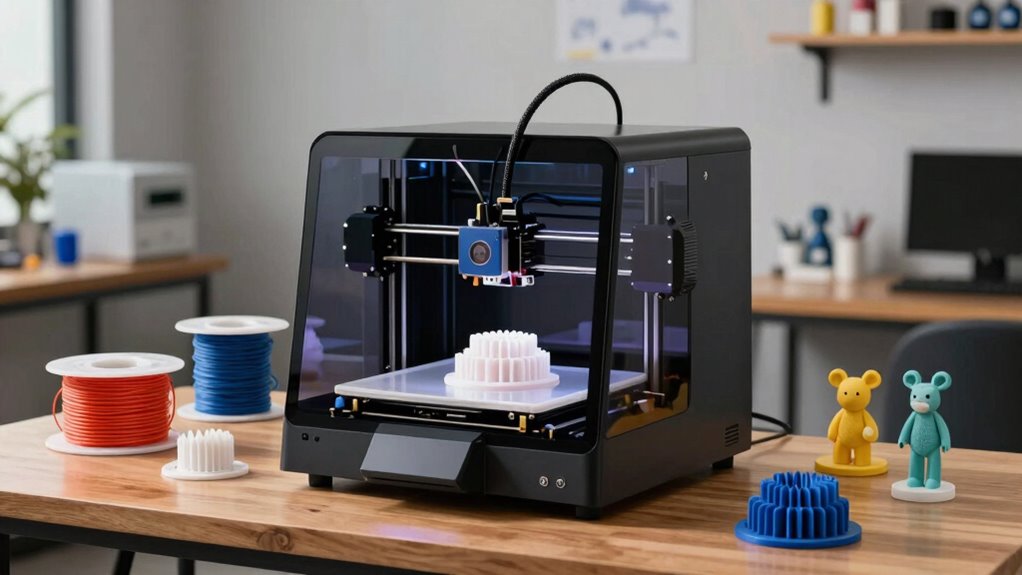

3D printers open new possibilities for your small product business by enabling you to quickly prototype, customize, and produce on demand. You can experiment with innovative materials, tailoring products to specific customer needs while reducing waste and costs. This technology accelerates your product development and helps you stay ahead of trends. With 3D printing, you gain a competitive edge through flexibility and creativity. Keep exploring to discover how you can fully harness these advantages to grow your business.

Get hardware and tech essentials delivered free with Prime
- Fast, free delivery on millions of items
- Prime Video, Amazon Music and more included
- Member-only deals all year
Key Takeaways
- Enables rapid prototyping and quick product iterations, reducing time-to-market for small businesses.
- Allows customization and personalization of products to meet specific customer demands.
- Facilitates testing of new materials, improving product quality and sustainability.
- Reduces costs by eliminating the need for expensive molds and tooling.
- Supports innovative design exploration, giving small businesses a competitive edge.
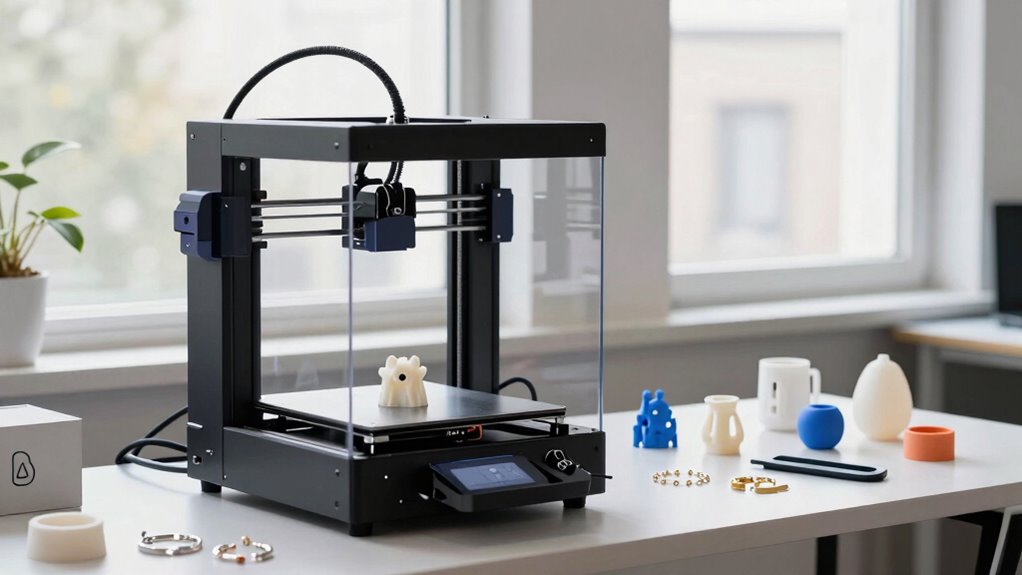
Small product businesses are increasingly turning to 3D printers as a game-changing tool that streamlines production and sparks innovation. With 3D printing technology, you gain the ability to experiment with material innovation, allowing you to select and test new materials that improve the quality, durability, and functionality of your products. Instead of relying solely on traditional manufacturing methods, you can explore plastics, resins, composites, or even biodegradable materials, tailoring each choice to meet your specific needs. This flexibility not only enhances your product offerings but also reduces costs associated with inventory and waste, making it easier to adapt to market demands.
One of the most attractive benefits for small businesses is the capacity for design customization. 3D printing allows you to create highly intricate, personalized designs that would be difficult or expensive to produce through conventional means. You can easily modify prototypes or final products without the need for costly molds or tooling, enabling rapid iteration and refinement. This capability means you can respond swiftly to customer feedback, offering bespoke options that set your business apart from competitors. Whether it’s personalized packaging, unique product features, or tailored accessories, 3D printing makes customization more accessible and scalable.
By integrating 3D printing into your workflow, you also open the door to innovative product development. You can prototype ideas quickly, identify flaws early, and optimize designs before committing to larger production runs. This accelerates your time-to-market, giving you a competitive edge. Additionally, with the ability to produce small batches or even one-off items, you avoid the risk of overproduction and excess inventory, which is especially advantageous for small businesses operating with limited resources. Material innovation and the ability to test new substances can significantly improve your product’s performance and appeal. Incorporating 3D printing technology into your operations can also help you stay ahead of industry trends and adapt more efficiently to changes in consumer preferences. Staying informed about the latest technological advancements in 3D printing can further boost your business’s innovation potential.
Furthermore, 3D printers foster a culture of creativity and experimentation within your business. You’re empowered to push boundaries, explore new concepts, and bring ideas to life that might have been impractical or too costly before. The combination of material innovation and design customization means you’re not confined to off-the-shelf solutions—you can develop unique, innovative products that resonate with your target audience. As a result, your business can evolve more dynamically, responding to trends and customer desires with agility.
Ultimately, 3D printing technology offers small product businesses a versatile platform for innovation, efficiency, and differentiation. By leveraging material innovation and design customization, you can produce more personalized, high-quality products faster and at a lower cost. This technology isn’t just a production tool; it’s a strategic asset that empowers your business to grow, adapt, and stand out in a competitive market.
As an affiliate, we earn on qualifying purchases.
Frequently Asked Questions
What Is the Initial Investment Cost for a Small Business 3D Printer?
You can expect the initial investment for a small business 3D printer to range between $200 and $2,000. Budget models might have lower material durability and require more frequent printer maintenance, but higher-end options offer better durability and reliability. Consider your specific needs and the types of materials you’ll use; opting for a durable, well-maintained printer guarantees consistent quality and reduces long-term costs.
How Long Does It Take to Master 3D Printing Techniques?
You might think mastering 3D printing takes years, but the truth is, your learning curve can be quite manageable. With consistent practice and focused skill development, you can grasp basic techniques in a few weeks. Advanced mastery, like fine-tuning print quality and troubleshooting, may take a few months. Staying patient and experimenting regularly accelerates your progress, turning you into a confident 3D printing pro faster than you might expect.
Are There Any Legal Restrictions on Printing Certain Products?
Yes, there are legal restrictions on printing certain products. You need to be aware of intellectual property rights, as copying copyrighted designs or patented items can lead to legal trouble. Additionally, regulatory compliance is essential, especially for items like medical devices, firearms, or food-related products. Always research applicable laws and obtain necessary permissions before printing to avoid infringement or penalties. Staying informed helps you operate legally and protect your business.
What Are the Most Cost-Effective 3D Printing Materials for Small Businesses?
You’ll find that PLA is your go-to for cost-effective 3D printing—it’s cheap, easy to use, and has decent durability. Yet, it’s gentle on the environment, unlike ABS, which is more durable but produces fumes and plastic waste. If you need a balance, PETG offers good durability with a lower environmental impact. Think about your product’s needs and choose the material that hits the sweet spot for both cost and sustainability.
How Can Small Businesses Protect Their 3D Printed Designs From Copying?
To protect your 3D printed designs from copying, you can implement design encryption by embedding unique identifiers or patterns that are hard to replicate. Additionally, actively enforce copyright by registering your designs and monitoring online platforms for infringements. Using watermarks or digital signatures can also deter unauthorized copying. These steps help safeguard your intellectual property and maintain your competitive edge in the market.
desktop 3D printer with customizable materials
As an affiliate, we earn on qualifying purchases.
As an affiliate, we earn on qualifying purchases.
Conclusion
With 3D printers, you can quickly turn ideas into tangible products, reducing costs and speeding up production. Did you know that the global 3D printing market is expected to reach $34.8 billion by 2024? This growth highlights how accessible and valuable this technology has become for small businesses like yours. Embracing 3D printing means staying competitive, innovative, and ready to meet your customers’ unique needs with customized products.
professional 3D printer for prototyping
As an affiliate, we earn on qualifying purchases.
As an affiliate, we earn on qualifying purchases.
3D printing filament for small business
As an affiliate, we earn on qualifying purchases.
As an affiliate, we earn on qualifying purchases.
Halloween Picks
halloween
As an affiliate, we earn on qualifying purchases.