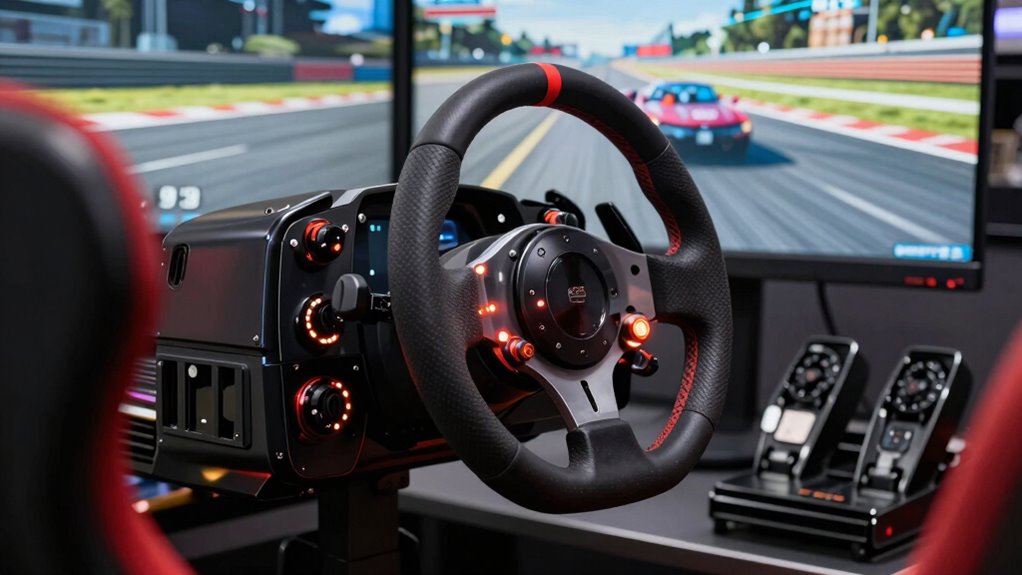

Upgrading your pedals adds a realistic feel and precise control, making sim racing instantly more immersive and addictive. It sharpens your responsiveness, boosts confidence, and motivates you to improve each lap. With calibrated pedals, you’ll experience better feedback and natural handling, encouraging longer, more engaged sessions. This first upgrade creates a foundation for mastery and keeps you coming back for more. If you explore further, you’ll discover how each enhancement deepens your racing experience even more.

Get hardware and tech essentials delivered free with Prime
- Fast, free delivery on millions of items
- Prime Video, Amazon Music and more included
- Member-only deals all year
Key Takeaways
- The initial hardware upgrade creates a more immersive and realistic racing experience, boosting engagement and motivation.
- Improved pedal calibration enhances control and confidence, encouraging longer and more focused racing sessions.
- Ergonomic setups reduce fatigue, allowing for extended play and increasing the likelihood of addictive gameplay.
- Upgraded hardware delivers seamless, responsive feedback that makes racing more satisfying and encourages skill development.
- The enhanced realism and immersion turn casual racing into an addictive pursuit of mastery and personal bests.
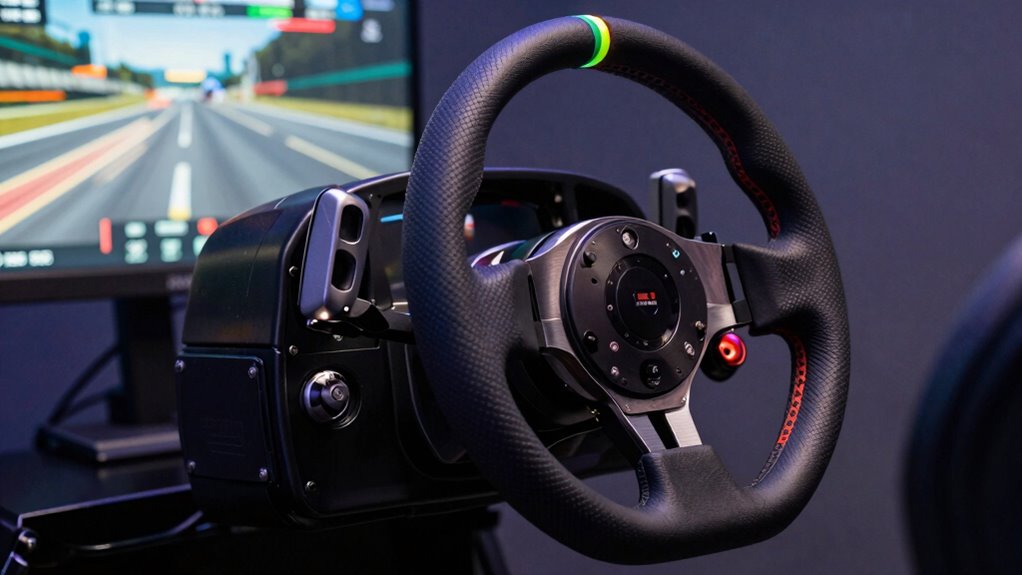
Upgrading your sim racing hardware can substantially boost your performance and enjoyment on the virtual track. The first upgrade you choose can be a game-changer, pulling you deeper into the racing experience and making every lap more engaging. One of the most impactful upgrades is integrating VR into your setup. VR integration transforms your racing into a truly immersive experience, letting you feel like you’re sitting behind the wheel of a real car. With a headset on, you get a 360-degree view of the track, which sharpens your spatial awareness and reaction times. Instead of glancing at multiple screens, you’re completely immersed in the environment, making every turn, brake, and acceleration feel more natural and intuitive. This heightened sense of presence often leads to quicker reflexes and more precise control, fueling your desire to race even more.
VR immersion enhances realism, sharpens reflexes, and makes every race more natural and engaging.
Alongside VR, paying attention to pedal calibration is crucial. Proper pedal calibration ensures your inputs are accurately reflected in the game, providing a more realistic driving feel. You want your brake, accelerator, and clutch pedals to respond precisely as they would in a real car. When pedals are miscalibrated, you might find yourself applying too much or too little pressure, which can throw off your timing and control. Take the time to set your pedal inputs correctly, adjusting the sensitivity and dead zones until they match your driving style. This not only improves your lap times but also makes the experience more satisfying and authentic. Additionally, hardware setup can significantly impact your comfort during extended racing sessions, helping to prevent fatigue and maintain focus. Proper hardware positioning and ergonomic design can enhance comfort and reduce strain, allowing for longer, more focused racing sessions. Improving your overall hardware ergonomics can also contribute to better control and reduce the likelihood of injury or discomfort.
Once you’ve integrated VR and fine-tuned your pedal calibration, you’ll notice your racing sessions become more addictive. The combination creates a seamless flow that keeps you glued to the virtual wheel. You’ll find yourself eagerly looking forward to each session, chasing that next perfect lap or trying to beat your best time. The sense of immersion makes it difficult to go back to standard setups, as the realism makes every race feel like a real-world event. Plus, the feedback from a well-calibrated pedal setup enhances your confidence in your control, encouraging you to push harder and refine your skills. Additionally, proper hardware setup can prevent discomfort during long sessions, helping you stay focused and safe while racing. Maintaining an optimal hardware configuration ensures that you stay comfortable and alert, which is crucial for consistent performance.
In short, the first hardware upgrade—especially incorporating VR and calibrating your pedals—can turn casual racing into an addictive pursuit. You’ll experience a new level of realism and engagement that keeps pulling you back for more, eager to improve and master every aspect of your virtual driving. That initial upgrade isn’t just about better visuals or controls; it’s about unlocking a more compelling, immersive racing world that you won’t want to leave.
As an affiliate, we earn on qualifying purchases.
Frequently Asked Questions
What Are the Best Brands for Sim Racing Hardware Upgrades?
You should consider brands like Fanatec, Logitech, and Thrustmaster for sim racing hardware upgrades. They offer top-tier equipment that enhances virtual realism and creates an immersive experience. These brands are known for their quality, durability, and realistic force feedback, making your racing sessions more engaging. Upgrading with their gear can transform your setup, drawing you deeper into the game and boosting your overall performance and enjoyment.
How Much Does a Typical Sim Racing Hardware Upgrade Cost?
A typical sim racing hardware upgrade costs around $300 to $1,500. For example, investing in a quality motion platform and virtual reality headset can substantially enhance your experience. You might start with a high-end wheel and pedals, then add a motion platform for realistic movement. These upgrades make racing more immersive, but they also increase your overall spending as you seek the ultimate setup.
Can Upgrading Hardware Improve Overall Racing Skills?
Upgrading your hardware can definitely improve your overall racing skills by enhancing virtual realism and motion simulation. When you invest in better equipment, you experience more accurate feedback and immersive gameplay, which sharpens your reactions and decision-making. This heightened sense of realism helps you develop better racing instincts, ultimately making you faster and more consistent on the track. So, yes, hardware upgrades can markedly boost your racing performance.
Are There Beginner-Friendly Sim Racing Hardware Options?
Yes, there are beginner-friendly sim racing hardware options. You might start with a simple steering wheel and pedal set designed for newcomers, which are easy to set up and use. As you progress, consider exploring virtual reality headsets for immersive experiences and customizing your wheel setups to enhance comfort and control. These options make it easier to learn the basics and enjoy racing without feeling overwhelmed.
How Often Should One Upgrade Their Sim Racing Equipment?
Think of your sim racing gear as a race car needing regular pit stops for upgrades. You should consider upgrading every 1-2 years, especially when new virtual reality options and force feedback advancements enhance realism. If your current setup feels outdated or struggles to keep up with your skills, it’s time for an upgrade. Remaining current ensures you enjoy immersive, cutting-edge experiences that keep the thrill alive and your skills sharp.
As an affiliate, we earn on qualifying purchases.
Conclusion
Once you experience that first upgrade, it’s like opening a door to a whole new universe of precision and excitement. Your sim racing setup transforms from a simple machine into a thrilling rollercoaster ride you can’t resist. Every turn and acceleration feels more real, pulling you deeper into the game. Just like a magnet drawing metal, that upgrade pulls you back for more, igniting a passion that keeps you racing long after the race ends.
sim racing wheel and pedal combo
As an affiliate, we earn on qualifying purchases.
As an affiliate, we earn on qualifying purchases.
ergonomic racing chair for sim racing
As an affiliate, we earn on qualifying purchases.
As an affiliate, we earn on qualifying purchases.
Fall Picks
fall essentials
As an affiliate, we earn on qualifying purchases.