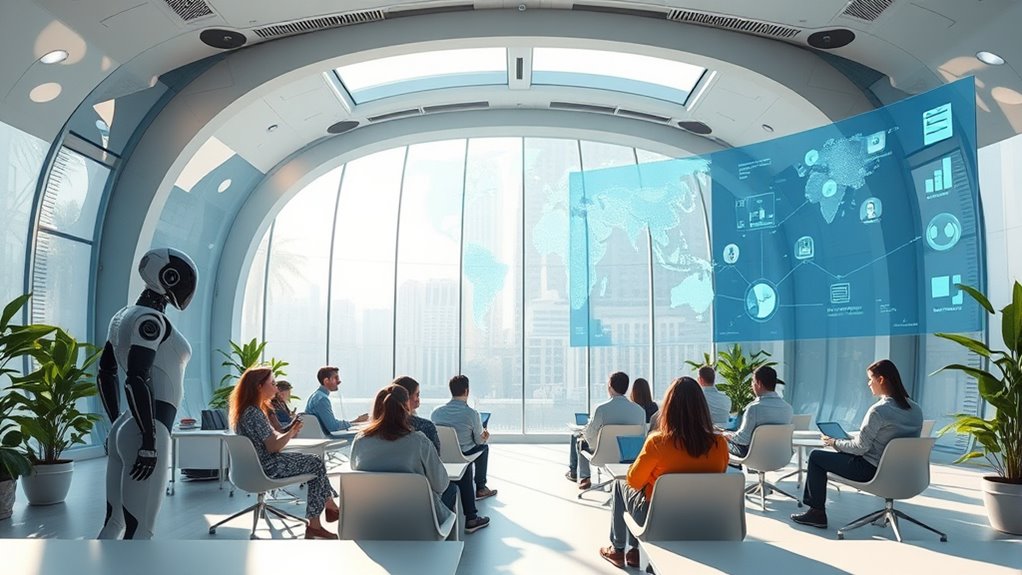

In a post-labor future, you should focus on developing adaptable skills like critical thinking, ethical reasoning, and emotional intelligence that machines can’t replicate. Embrace technical proficiency in data analysis, AI, and emerging tech, but also prioritize human-centered qualities such as creativity and empathy. Understanding ethical issues, societal impacts, and interdisciplinary knowledge will help you navigate responsible innovation. Keep exploring these themes to stay prepared for a future where technology and humanity work hand in hand.
Key Takeaways
- Emphasize adaptable, critical thinking, and moral reasoning skills to navigate an AI-driven, post-labor society.
- Incorporate ethics, privacy, bias, and societal impact discussions into technical and interdisciplinary education.
- Develop human-centric skills like creativity, emotional intelligence, and ethical judgment to complement automation.
- Foster interdisciplinary learning that combines technology, philosophy, and social sciences for responsible innovation.
- Promote continuous learning, moral responsibility, and active societal engagement to adapt to ongoing technological changes.

As automation and artificial intelligence continue to transform the workforce, traditional jobs are becoming less central to economic stability. You might find yourself questioning what skills and knowledge will truly matter in this new landscape. The key shifts aren’t just about technical proficiency but also about understanding how AI integration impacts society and the ethical considerations it raises. Preparing for a post-labor future means rethinking education to focus on adaptable skills, critical thinking, and moral reasoning.
In this evolving environment, you’ll need to grasp how AI integration influences various industries. Learning about emerging technologies, data analysis, and machine learning isn’t just for specialists anymore; it’s vital for everyone. These skills will help you collaborate effectively with AI systems, understand their capabilities, and leverage them ethically. But it’s not only about technical know-how. You must also develop a strong foundation in ethical considerations surrounding AI deployment. Questions about privacy, bias, accountability, and the societal implications of automation will be central to your understanding of responsible innovation. Education should equip you with the tools to navigate these complex issues thoughtfully and critically.
Furthermore, as automation takes over routine tasks, you’ll need to cultivate uniquely human skills that AI can’t replicate. Creativity, emotional intelligence, adaptability, and ethical judgment will become the pillars of your professional and personal development. You’ll be expected to bring empathy and moral insight into decision-making processes, especially when AI systems are involved. Learning how to balance technological advancements with ethical responsibility will be vital in shaping a fair and equitable future.
The importance of interdisciplinary education also grows in this framework. Combining technical knowledge with insights from philosophy, sociology, and ethics will help you understand the broader societal impacts of AI integration. This holistic approach ensures that technological progress aligns with human values, fostering responsible innovation. Schools and training programs should emphasize collaboration across disciplines, encouraging you to think beyond technical limitations and consider the ethical frameworks guiding AI use.
Additionally, understanding the role of contrast ratio in projectors can serve as a metaphor for recognizing how nuanced distinctions impact perceptions, much like the subtle ethical differences that influence responsible AI deployment. Ultimately, in a post-labor world, education isn’t just about acquiring specific skills but about fostering a mindset geared toward continuous learning, moral responsibility, and societal contribution. You’ll need to stay adaptable, question assumptions, and actively participate in shaping how AI and automation are integrated into daily life. By focusing on ethical considerations and broadening your understanding of AI’s role in society, you can help make certain that technological progress benefits everyone and aligns with human values. This shift in education prepares you not just for a changing job market but for a future where informed, ethical engagement with technology is essential for societal well-being.
Frequently Asked Questions
How Will AI Change Traditional Teaching Roles and Educator Responsibilities?
AI will transform your teaching roles by automating routine tasks, allowing you to focus on personalized learning and student engagement. You’ll need to understand AI ethics to guarantee fair and responsible use of technology. Your responsibilities will shift towards guiding critical thinking and emotional support, while leveraging AI tools to tailor lessons to individual needs. Embracing these changes helps you prepare students for a future where AI and human skills coexist seamlessly.
What New Skills Will Students Need to Succeed in a Post-Labor Economy?
In a world shifting like sands beneath your feet, you’ll need skills that machines can’t replicate. Cultivate emotional intelligence to navigate human complexities and develop cross-cultural competence to bridge global divides. These abilities will be your compass in a post-labor economy, helping you connect deeply, adapt swiftly, and collaborate across boundaries. By mastering these skills, you’ll thrive in a future where human connection becomes your greatest asset.
How Can Education Foster Creativity Without Focusing on Labor Market Outcomes?
You can foster creativity by encouraging creative exploration and nurturing intrinsic motivation. Provide open-ended projects, diverse experiences, and opportunities for self-directed learning that spark curiosity. Focus on passion and personal growth rather than just outcomes, so students develop a love for discovery. When you create a supportive environment that values imagination and self-expression, you help students access their innate creative potential beyond labor market demands.
Will There Be a Need for Standardized Testing in a Post-Labor Educational System?
In a post-labor educational system, you likely won’t need traditional standardized assessments. Instead, you’ll focus on competency benchmarks that measure real understanding and skills. These assessments will be more personalized and dynamic, emphasizing mastery over rote memorization. By shifting away from standardized testing, you can foster deeper learning, creativity, and critical thinking, preparing learners for a future where adaptability and problem-solving are more valuable than traditional exams.
How Can Education Address Increasing Socio-Economic Inequalities in This Future?
You can address increasing socio-economic inequalities by ensuring equal access to resources for all students and fostering strong community engagement. By providing equitable technology, learning materials, and support, you give everyone a fair chance to succeed. Building partnerships with local organizations encourages community involvement, creating a supportive environment that helps bridge gaps and promotes social mobility. These strategies enable you to create a more just and inclusive educational future.
Conclusion
As you prepare for a post-labor future, remember that your role in shaping learners’ adaptability and creativity is more essential than ever. You have the power to ignite minds and inspire innovation that could change the world. Embrace lifelong learning and teach skills that machines can’t replicate—empathy, critical thinking, and imagination. If you nurture these qualities, you’ll release human potential greater than any robot’s capabilities, truly transforming the future of education itself.

ELLIPAL Titan 2.0 Air-Gapped Crypto Wallet – Cold Wallet for Bitcoin, ETH, SOL, XRP, NFT & 10,000+ Coins and Tokens – Trusted Cold Storage Hardware Wallet(Golden)
- Offline Air-Gapped Security: Fully isolated from internet, no network connections
- Secure Transaction Signing: Sign transactions via QR code, no online access needed
- Large HD Display: 4.1-inch screen for clear transaction details
As an affiliate, we earn on qualifying purchases.

ELLIPAL Titan 2.0 Air-Gapped Crypto Wallet – Cold Wallet for Bitcoin, ETH, SOL, XRP, NFT & 10,000+ Coins and Tokens – Trusted Cold Storage Hardware Wallet
- Offline Air-Gapped Security: Fully isolated from internet connections
- Secure Transaction Signing: Sign transactions via QR code scans
- Large HD Display: 4.1-inch screen for transaction details
As an affiliate, we earn on qualifying purchases.