Starting with a telescope can seem overwhelming, but choosing the right beginner model makes all the difference. The 90mm Telescope for Adults High Powered stands out as the best overall, offering a good mix of power and ease of use. For those on a tighter budget, the Celestron Travel Scope 70mm provides portability and decent performance. Meanwhile, the NASA Lunar Telescope for Kids is perfect for young explorers interested in moon and planet viewing. The main tradeoffs in this category revolve around aperture size, ease of setup, and whether the telescope is more suitable for casual viewing or serious exploration. Continue reading for a detailed breakdown of these options and how to pick the best telescope for your needs.

Get hardware and tech essentials delivered free with Prime
- Fast, free delivery on millions of items
- Prime Video, Amazon Music and more included
- Member-only deals all year
Key Takeaways
- Aperture size is a key factor: larger apertures gather more light and reveal more detail, but often come with increased size and cost.
- Ease of setup and portability are crucial for beginners who want quick and simple access to stargazing without hassle.
- Versatility matters: models with adjustable magnification and accessories like phone adapters expand learning opportunities.
- Budget options can be surprisingly capable, but often sacrifice some image clarity and durability compared to higher-end models.
- Choosing a telescope designed for your specific interests (moon, planets, deep-sky objects) improves your initial experience and ongoing enjoyment.






| telescopes for beginner | Aperture | Focal Length | Eyepieces | Magnification |
|---|---|---|---|---|
| 90mm Telescope for Adults High | 90mm | 600mm | 10mm and 25mm | — |
| Telescope for Adults & Kids | 70mm | 300mm | 20mm and 6mm | 15X-150X |
| Koolpte 80mm Aperture 600mm Fo | 80mm | 600mm | 25mm and 10mm | 24X-180X |
| Celestron Travel Scope 70mm Po | 70mm | — | 20mm and 10mm | — |
| Telescope for Kids | — | 400mm to 600mm | 6mm & 20mm | — |
| Celticbird 80mm Aperture 600mm | 80mm | 600mm | 20mm and 9mm | 30X and 66X |
| MEEZAA Telescope for Adults & | 80mm | 500mm | 25mm & 10mm | — |
| Telescope for Kids and Adults | 70mm | 300mm | 6mm & 20mm | 15X-150X |
| Gskyer 70mm Aperture 400mm Ref | 70mm | 400mm | — | Variable with eyepieces and Barlow lens |
| Koolpte 80mm/600mm AZ Refracto | 80mm | 600mm | 25mm and 10mm | 24X and 60X (up to 180X with Barlow) |
| Celestron StarSense Explorer L | 114mm | — | — | — |
| NASA Lunar Telescope for Kids | — | — | — | — |
More Details on Our Top Picks
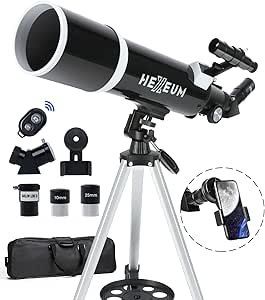
90mm Telescope for Adults High Powered, Magnification 180X
This 90mm telescope stands out for its high magnification potential and included astrophotography accessories, making it ideal for beginners who want to delve into lunar and planetary details. Compared to the Celestron Travel Scope 70mm, it offers better light-gathering power, but its manual focus and lack of motorized tracking limit ease of use for longer observations. The fully multi-coated optics ensure bright, sharp images, and the phone adapter opens up creative possibilities for capturing celestial moments. However, the manual operation means users need patience to fine-tune focus, and the optical quality may not satisfy advanced astronomers. This pick makes the most sense for beginners eager to progress into serious lunar and planetary observation and astrophotography.
Pros:- High magnification range up to 180X suitable for lunar and planetary detail
- Includes a phone adapter for astrophotography
- Portable with adjustable tripod and carrying case
- Easy to assemble with clear instructions
Cons:- Manual focus can require fine adjustments during viewing
- No motorized tracking, limiting long-exposure or hands-free observation
Best for: Beginners with some patience who want detailed lunar and planetary views and are interested in astrophotography.
Not ideal for: Those seeking a fully motorized, hands-free experience or advanced astrophotography features — the manual focus may frustrate them.
- Aperture:90mm
- Focal Length:600mm
- Eyepieces:10mm and 25mm
- Magnification Range:24×–180×
- Mount:Altazimuth
- Optics Coating:Fully multi-coated
Our verdict“This telescope is a strong choice for beginners wanting detailed planetary views and astrophotography opportunities, provided they are comfortable with manual operation.”
Telescope for Adults & Kids, 70MM Aperture FMC Optics, 300MM Refractor, 15X-150X Magnification with Phone Adapter and Tripod
This 70mm refractor offers a flexible balance between ease of use and image quality, making it well-suited for both kids and adults starting their astronomy journey. Unlike the Celestron Travel Scope 70mm, it provides a broader magnification range up to 150X, though this can be limited for detailed deep-sky exploration. The fully multi-coated optics deliver crisp images for terrestrial and celestial viewing, and the included phone adapter makes capturing moments straightforward. However, the lightweight build affects stability in breezy conditions, and manual focusing can be a little finicky for beginners. This model makes sense for families or casual observers seeking a versatile, easy-to-use telescope with good optical quality.
Pros:- Suitable for both kids and adults, easy to set up
- High-quality fully multi-coated optics for clear images
- Includes a phone adapter and multiple accessories for versatility
- Good for terrestrial and celestial viewing
Cons:- Magnification range may be insufficient for advanced deep-sky observations
- Lightweight design can impact stability in windy conditions
Best for: Families or new hobbyists wanting a portable, versatile telescope suitable for daytime and nighttime use.
Not ideal for: Advanced astronomers or those seeking high-magnification astrophotography — its stability and limited advanced features may disappoint them.
- Aperture:70mm
- Focal Length:300mm
- Magnification:15X-150X
- Eyepieces:20mm and 6mm
- Barlow Lens:3X
- Finderscope:5×24
Our verdict“This telescope fits well for beginners and families looking for a lightweight, versatile option that covers both land and sky observations.”
Koolpte 80mm Aperture 600mm Focal Length Telescope for Adults & Beginners with Tripod, Phone Adapter, and Wireless Control
The Koolpte 80mm telescope offers bright images and a straightforward setup, making it suitable for beginners who want quick results and some tech features. Compared to the 90mm Telescope for Adults, it has a slightly larger aperture, but its build quality of accessories and remote control capabilities are less refined. The wireless remote control adds a modern touch, simplifying adjustments during observation, yet the lack of clear information about batteries and durability means some users might find it less reliable long-term. The included eyepieces and finder scope provide basic versatility, but advanced users may find the magnification options limiting. This model is ideal for beginners who enjoy a tech-friendly experience and portable design.
Pros:- Bright, clear images with 80mm aperture
- Includes multiple eyepieces and accessories
- Wireless remote control for easy adjustments
- Portable with carrying bag for travel
Cons:- Build quality of accessories could be improved
- Lack of detailed info about remote control batteries and durability
Best for: Tech-inclined beginners who want a simple, portable telescope with wireless features for casual astronomy and daytime observation.
Not ideal for: Users seeking high-end optical quality or advanced tracking capabilities — build quality and remote control reliability might fall short.
- Aperture:80mm
- Focal Length:600mm
- Magnification:24X-180X
- Eyepieces:25mm and 10mm
- Finder Scope:5×24
- Mount:AZ Tripod
Our verdict“This telescope caters to beginner tech enthusiasts seeking an easy-to-use, portable device with modern wireless features, though it may not satisfy those needing durability or advanced optics.”
Celestron Travel Scope 70mm Portable Refractor Telescope with Backpack
The Celestron Travel Scope 70mm combines portability with decent optical quality, making it perfect for outdoor adventures and casual stargazing. Unlike larger, less portable options like the Koolpte 80mm, it emphasizes ease of transport with a backpack and lightweight design. The fully coated glass optics provide bright images, suitable for daytime terrestrial viewing and basic night sky observations. Its no-tool setup appeals to absolute beginners, but the limited aperture and basic features mean it won’t satisfy those seeking detailed deep-sky views or advanced features. The included software adds some educational value, but overall, this is a travel-ready starter telescope for casual use. This makes the most sense for beginners prioritizing portability and ease of use over deep-sky capabilities.
Pros:- Highly portable with included backpack
- Easy no-tool setup suitable for beginners
- Good brightness with fully coated optics
- Includes accessories and software for educational use
Cons:- Limited aperture restricts deep-sky viewing
- Optics may not satisfy advanced users
Best for: Travelers, families, or casual users seeking a lightweight, easy-to-carry telescope for outdoor and beginner stargazing.
Not ideal for: Advanced astronomers or those wanting detailed deep-sky observation — its small aperture limits performance for serious hobbyists.
- Aperture:70mm
- Optics:Fully coated glass
- Eyepieces:20mm and 10mm
- Tripod:Full-height
- Accessories:Backpack, star diagonal, software
Our verdict“This telescope is ideal for beginners on the go who want a lightweight, simple device for casual land and sky exploration.”
Telescope for Kids, 50mm 100x Beginner Telescope with Tripod
This 50mm telescope offers a fun and educational experience for children aged 6-12, encouraging early curiosity about space. While its small objective lens limits detailed viewing compared to larger models like the 90mm Telescope for Adults, it provides enough magnification for introductory exploration and is easy to handle. The manual focus and basic accessories make it suitable for young learners but less appealing for those seeking serious astronomy. The included tripod and finderscope help children develop skills gradually, but the limited zoom and basic build mean it’s primarily an educational toy rather than a serious observing tool. This is best for parents or educators introducing astronomy to young children in a hands-on, accessible way.
Pros:- Educational and engaging for young learners
- Includes multiple accessories for exploration
- Portable and easy to set up outdoors
- Encourages hands-on curiosity about space
Cons:- Limited magnification for serious astronomy
- Basic focus mechanism may require frequent adjustment
Best for: Children aged 6-12 and their parents or teachers looking for an engaging STEM toy for early space exploration.
Not ideal for: Older kids or adults wanting detailed or advanced astronomical observations — the small aperture and simple focus limit capabilities.
- Objective Lens Diameter:50mm
- Focal Length:400mm to 600mm
- Field Of View:125 degrees
- Zoom Ratio:5
- Eyepieces:6mm & 20mm
- Accessories:Tripod, finderscope, Barlow lens
Our verdict“This telescope provides an accessible introduction to astronomy for children, though it isn’t suitable for advanced or detailed observations.”
Celticbird 80mm Aperture 600mm AZ Mount Refractor Telescope for Adults and Kids
This telescope excels at delivering bright, clear images thanks to fully coated optics, making it a strong choice for beginners who want a reliable, all-around performer. Compared to the Gskyer 70mm, its larger 80mm aperture offers brighter images and better low-light performance, especially for moon and planetary viewing. The inclusion of a phone adapter and moon filter enhances casual astrophotography, while the portable design with a backpack makes it suitable for outdoor trips. However, its manual focus can be tricky for some, and the tripod height range might not suit very tall users, which could limit comfort for extended sessions. Overall, this pick makes the most sense for families or individuals seeking a versatile, easy-to-transport telescope that balances quality and convenience.
Pros:- Bright, clear images with fully coated lenses
- Portable design with backpack and adjustable tripod
- Includes phone adapter and moon filter for casual astrophotography
Cons:- Limited to 66X maximum magnification, not suitable for detailed planetary observation
- Manual focus can be challenging for precise adjustments
- Tripod height may not fit very tall users comfortably
Best for: Families or beginner enthusiasts who want a portable, easy-to-assemble telescope capable of viewing the moon, planets, and stars.
Not ideal for: Advanced astronomers seeking high magnification or motorized tracking, as this model’s manual focus and limited magnification may fall short.
- Aperture:80mm
- Focal Length:600mm
- Mount Type:AZ Mount
- Eyepieces:20mm and 9mm
- Magnification:30X and 66X
- Finderscope:5×24
Our verdict“This telescope is ideal for families or beginners who want a versatile, easy-to-carry option for casual astronomy and outdoor adventures.”
MEEZAA Telescope for Adults & Kids, 80mm Aperture, 500mm Refractor
The MEEZAA 80mm Refractor offers a solid entry point into astronomy with a large aperture and a comprehensive accessory set, including multiple eyepieces, a Barlow lens, and a waterproof backpack. Compared to the Celticbird 80mm, its 500mm focal length makes it slightly less ideal for deep-sky objects, but the extra accessories support a broader range of viewing at a more affordable price. Its portable design and simple assembly make it suitable for outdoor use and family outings. The manual altazimuth mount and focus are intuitive, but the limited magnification range might disappoint those wanting detailed planetary views. Overall, this model provides excellent value for casual use and beginner exploration.
Pros:- Bright, sharp images with large 80mm aperture
- Includes multiple eyepieces, Barlow lens, and waterproof backpack
- Easy assembly without tools and portable for outdoor adventures
Cons:- Magnification range limited compared to more advanced models
- Manual focus requires some adjustment for sharp images
- Not suitable for detailed planetary or deep-sky observation
Best for: Budget-conscious beginners and families seeking a versatile, portable telescope with lots of accessories for casual viewing.
Not ideal for: Serious sky observers or those seeking high magnification for planetary detail, as its 500mm focal length limits deep-sky and high-power viewing.
- Aperture:80mm
- Focal Length:500mm
- Eyepieces:25mm & 10mm
- Magnification Range:20X to 150X
- Mount:Altazimuth
- Tripod Height Range:16.92 to 44.48 inches
Our verdict“This telescope offers excellent value for beginner and family users wanting a feature-rich, portable kit for casual astronomy.”
Telescope for Kids and Adults, 70mm Aperture Refracting Telescope with 15X-150X Magnification, Phone Adapter, Tripod, and Accessories
This versatile telescope stands out for its wide magnification range and user-friendly features, making it suitable for both kids and adults. Its 70mm aperture provides bright images of the moon and planets, comparable to the Gskyer 70mm, but with the added benefit of adjustable magnification from 15X to 150X. The included phone adapter and wireless remote enable simple astrophotography, which is a plus for casual users. However, the inverted image in the finderscope may require some adjustment, and the overall build quality might not withstand heavy handling. Still, its ease of use makes it a good starter choice for family outings or young explorers curious about the night sky.
Pros:- Easy to assemble without tools, suitable for all ages
- Wide magnification range for lunar and planetary views
- Includes phone adapter and remote for casual astrophotography
Cons:- Inverted image in finderscope may be confusing
- Limited durability for rough handling
- Image quality varies with atmospheric conditions
Best for: Beginners and kids interested in exploring the night sky with an adaptable, easy-to-use telescope that supports photography.
Not ideal for: Advanced astronomers or users seeking high-quality, high-magnification planetary details, as this model is primarily for casual observation.
- Aperture:70mm
- Focal Length:300mm
- Magnification:15X-150X
- Eyepieces:6mm & 20mm
- Barlow Lens:3X
- Tripod Height:Up to 45 inches
Our verdict“This telescope provides a flexible, beginner-friendly experience with great features for families and casual sky-watchers.”
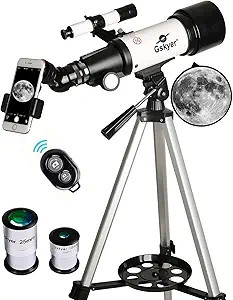
Gskyer 70mm Aperture 400mm Refracting Telescope for Kids and Beginners
The Gskyer 70mm offers a straightforward, affordable way for beginners and kids to explore the moon and stars. Its 70mm aperture and 400mm focal length deliver decent brightness, especially for lunar and planetary viewing. Compared to larger models like the Celticbird 80mm, its shorter focal length and smaller aperture mean less light gathering and detail. Still, the fully coated optics and included accessories make it a reliable, no-fuss option for casual use. The build quality is modest, and it lacks features like high magnification or advanced tracking, but for those just starting out or on a tight budget, it provides a simple entry point into astronomy.
Pros:- Affordable, easy-to-use for beginners
- Includes basic accessories and stable tripod
- Suitable for lunar and planetary viewing
Cons:- Limited maximum magnification and detail
- Build quality is basic and may not withstand rough handling
- Limited to simple observations without advanced features
Best for: Beginners or children wanting an inexpensive, straightforward telescope for basic lunar and planetary observation.
Not ideal for: Serious hobbyists or those who want detailed deep-sky views, as its small aperture limits light collection and image detail.
- Aperture:70mm
- Focal Length:400mm
- Magnification:Variable with eyepieces and Barlow lens
- Finder Scope:5×24 with cross-hair lines
- Tripod:Adjustable aluminum alloy
- Accessories:Phone adapter, wireless remote, carry bag
Our verdict“This budget-friendly telescope is a good starting point for children and novices wanting simple lunar and planetary views.”
Koolpte 80mm/600mm AZ Refractor Telescope for Beginners
The Koolpte 80mm/600mm AZ Refractor combines a decent aperture with straightforward setup, making it suitable for newcomers seeking a lightweight, portable instrument. Its 80mm aperture gathers plenty of light for moon and planetary viewing, comparable to the Celticbird, but with a slightly longer focal length that favors more detailed lunar and planetary images. Its included accessories, such as multiple eyepieces and a Barlow lens, support flexible magnification options. However, the build quality of the accessories could be better, and it lacks advanced features like motorized tracking, which limits its use for long observation sessions. Overall, this model offers a good balance of performance and portability for beginners who prioritize ease of use.
Pros:- Easy to set up without tools
- Includes multiple eyepieces and accessories
- Portable with a carrying bag and phone adapter
Cons:- Magnification may be limited for detailed planetary observation
- Build quality of accessories could be improved
- No motorized tracking capabilities
Best for: Beginners and outdoor enthusiasts who want a lightweight, easy-to-transport telescope for moon and planet viewing.
Not ideal for: Advanced astronomy hobbyists or those wanting high magnification and tracking features, as this model is more basic in design.
- Aperture:80mm
- Focal Length:600mm
- Eyepieces:25mm and 10mm
- Magnification:24X and 60X (up to 180X with Barlow)
- Finder Scope:5×24
- Tripod:Adjustable aluminum
Our verdict“This telescope offers a practical, portable option for beginners focused on lunar and planetary viewing without complex features.”
Celestron StarSense Explorer LT 114AZ Newtonian Smartphone Guided Telescope
This telescope stands out for its innovative smartphone-guided sky navigation via the StarSense Explorer app, making it easier for beginners to find celestial objects compared to traditional manual scopes like the NASA Lunar Telescope. Its 114mm aperture offers sharp views of the Moon, planets, and deep-sky objects, which are impressive for a beginner model. However, the manual altazimuth mount, while simple to operate, limits long-term astrophotography potential and requires some practice for precise tracking. Unlike the NASA Lunar Telescope, which is geared specifically toward lunar observations, the StarSense LT provides a broader view of the night sky, making it more versatile for those interested in exploring beyond just the Moon. The need for a smartphone for optimal use might be a barrier for some, but it effectively bridges technology and beginner-friendly operation.
Pros:- Smartphone-guided star locating simplifies finding objects
- Sharp, vivid views of planets, Moon, and deep-sky objects
- Easy setup suitable for beginners with no prior experience
Cons:- Manual tracking may require practice and patience
- Limited to altazimuth mount, less suitable for astrophotography
- Dependent on smartphone for optimal experience
Best for: Tech-inclined beginners who want an intuitive way to locate objects and enjoy a broad view of the night sky.
Not ideal for: Users seeking a dedicated lunar or planetary telescope with manual tracking for detailed observation without relying on smartphones.
- Aperture:114mm
- Type:Newtonian reflector
- Mount:Altazimuth with manual slow motion
- Connectivity:Smartphone app (StarSense Explorer)
- Warranty:2 years
Our verdict“This pick is ideal for beginners who want guided navigation and versatile sky exploration, accepting some manual tracking tradeoffs.”
NASA Lunar Telescope for Kids Ages 8-12 with Tripod and Finder Scope
This telescope makes lunar and planetary observation accessible for young space enthusiasts, with high-quality optics and a straightforward design that surpasses simpler models like the 50mm beginner telescopes. Its 25mm objective lens provides bright, clear views of the Moon’s surface, and the included finder scope facilitates easy targeting for beginners. The stable tabletop tripod ensures steady viewing, but the short optical tube length and manual focus can limit the range and detail for more advanced planetary studies. Compared to larger telescopes, this model is more limited in scope, focusing mainly on lunar and close planetary views, which is perfect for young explorers but less suited for those seeking more detailed or distant astronomical objects. Its straightforward assembly and educational branding make it a strong choice for introducing children to astronomy.
Pros:- Easy to assemble and operate for young beginners
- High-quality optical glass with clear lunar views
- Includes a stable tripod for steady observation
- Educational and NASA-branded for added engagement
Cons:- Limited to lunar and close planetary observations
- Manual focus can require adjustment for clarity
- Short optical tube restricts viewing range
Best for: Parents and educators seeking a simple, durable telescope for children interested in lunar exploration and basic planetary viewing.
Not ideal for: Older or more experienced users who want to explore deep-sky objects or engage in astrophotography, as the scope’s capabilities are limited to lunar and nearby planets.
- Eye Piece Lens Description:Galilean
- Mount:Equatorial
- Focus Type:Manual
- Power Source:Batteries
- Finderscope:Straight-Through
- Optical Coating:Fully Coated
- Field Of View:0.85 degrees
- Zoom Ratio:75
- Optical Tube Length:1 inches
Our verdict“This telescope is perfect for young space fans eager to explore the Moon, with simple operation and solid optical quality, but not suited for distant or detailed planetary work.”

How We Picked
The telescopes in this roundup were selected based on a combination of performance, build quality, ease of use, and value for beginners. I prioritized models that offer a straightforward setup without sacrificing optical quality, ensuring new users can start observing quickly. Portability was also a key factor, especially for those who want to take their telescope to different locations. Accessories like phone adapters and tripods were considered as they enhance the viewing experience and learning potential. The ranking reflects a balance between affordability and capability, aiming to recommend options suitable for a wide range of beginner interests and budgets.Factors to Consider When Choosing Telescopes For Beginners
When choosing a telescope as a beginner, understanding a few core factors can make your experience more enjoyable and less frustrating. Picking the right aperture size ensures you see more detail, especially on the moon and planets. Ease of use, including quick setup and lightweight design, helps maintain enthusiasm. Compatibility with accessories, like smartphone adapters, can expand your learning and sharing options. Budget is also important—knowing when to spend more for better optics versus sticking to a basic model can impact long-term satisfaction. Lastly, consider what you most want to see in the night sky to select a model that aligns with your interests.Aperture Size and Optical Quality
The aperture, or the diameter of the telescope’s main lens or mirror, directly impacts the amount of light it can gather. Larger apertures reveal more detail and allow for clearer views of celestial objects. For beginners, a 70mm to 80mm aperture strikes a good balance between performance and portability. Smaller apertures, like 50mm or 60mm, are more portable and easier to handle but limit detail, especially on planets and deep-sky objects. High-quality optics and coatings improve image clarity, making it worth considering models with good glass and lens construction even at lower price points.
Ease of Use and Setup
Beginners benefit from telescopes that are quick to assemble and simple to operate. Features like lightweight frames, intuitive mounts, and minimal adjustments reduce frustration and encourage frequent use. Equatorial mounts can be challenging for newcomers, so altazimuth mounts are often preferable for straightforward vertical and horizontal movement. Telescopes with pre-aligned optics or minimal calibration requirements are ideal, as they allow you to start viewing with less technical fuss. Remember, a complicated setup can discourage consistent use, so prioritizing ease of use can lead to a more enjoyable experience.
Portability and Size
If you plan to take your telescope to different locations, portability becomes a key consideration. Compact, lightweight models with carrying cases or backpacks make it easier to transport and store. Larger telescopes often require a sturdy tripod and more setup time, which might be less appealing for casual or travel use. For kids or those with limited storage space, smaller models that still deliver decent optical performance are often the better choice. Think about where you’ll be using your telescope most often to find a balance between size and capability.
Accessories and Expandability
Additional accessories like smartphone adapters, additional eyepieces, and finderscopes can significantly enhance your initial experience. Phone adapters turn your smartphone into a powerfully versatile viewer, allowing easy sharing of images and videos. Multiple eyepieces with different magnifications open up new viewing possibilities, from wide-angle sky surveys to detailed planetary observations. Some models come with built-in mounts or tripods that are stable and adjustable. Considering these features ensures your telescope can grow with your interests, providing more value over time.
Budget and Long-Term Value
While budget options can be attractive, they often come with compromises in optical quality and durability. Spending a bit more can provide a noticeable upgrade in image clarity, ease of use, and overall longevity. Think of a telescope as an investment in your astronomical curiosity—spending wisely upfront can lead to more satisfying experiences and less frustration. However, for absolute beginners or casual enthusiasts, affordable models that cover basic needs might be enough to spark a lasting interest in stargazing.
Frequently Asked Questions
Is a larger aperture always better for beginners?
Generally, a larger aperture allows more light, which can improve detail and visibility of celestial objects. However, bigger apertures also mean bulkier and often more expensive telescopes that might be harder to set up and transport. For beginners, an aperture of around 70mm to 80mm offers a practical balance, providing good views without overwhelming in size or complexity. As you gain experience, you can consider upgrading to larger models, but starting with a manageable size often leads to a more enjoyable first experience.
Should I choose a refractor or a reflector telescope for beginners?
Refractors are typically easier to use and maintain because they have sealed tubes and require less alignment, making them ideal for beginners. They also tend to produce sharper images for planetary viewing. Reflectors, on the other hand, often offer larger apertures at lower costs but require more maintenance and alignment. For most newcomers, a good refractor provides straightforward operation and satisfying views, but if budget and size are concerns, a reflector can be a viable option with some initial learning about collimation.
How important is portability for a beginner’s telescope?
Portability is often a decisive factor for beginners who want to use their telescope at different locations or simply store it easily. Lighter, compact models are easier to carry and quicker to set up, encouraging more frequent use. If you plan to take your telescope on trips, hikes, or to a friend’s house, prioritizing portability can make the experience more convenient and enjoyable. On the other hand, larger, more stable models are better suited for home use where setup time is less of an issue.
Can I use a beginner telescope for astrophotography?
Most beginner telescopes are not designed for astrophotography, especially models with simple mounts and limited tracking capabilities. While some small, portable scopes can capture basic images of the moon or planets with a smartphone, serious astrophotography generally requires more advanced mounts, stability, and tracking features. If astrophotography is a goal, you might want to consider a model with a computerized mount or plan to upgrade later as your skills develop. For now, focus on models that prioritize ease of use and good optical quality for visual observation.
When should I upgrade to a more advanced telescope?
Upgrading often depends on your growing interests and experience level. Once you’ve mastered basic viewing and want to explore more detailed planetary or deep-sky objects, a larger aperture or more sophisticated mount can enhance your experience. If you find yourself consistently frustrated by the limitations of your current model or want to pursue astrophotography, it might be time to consider an upgrade. Starting with a versatile, expandable telescope can also make future upgrades easier, helping you get the most value from your initial investment.
Conclusion
For newcomers seeking a straightforward, reliable start, the 90mm Telescope for Adults High Powered offers a balanced combination of performance and ease of use, making it a strong overall pick. Budget-conscious beginners who want portability should consider the Celestron Travel Scope 70mm. Families or young explorers interested in moon and planet viewing might find the NASA Lunar Telescope for Kids to be an engaging choice. Those looking for a more versatile setup with expandability should explore options like the Koolpte 80mm Aperture 600mm. Ultimately, your choice should align with your specific interests, whether casual stargazing, planetary detail, or family learning, ensuring a rewarding start to your astronomy journey.
Evergreen bestsellers Picks
bestsellers
As an affiliate, we earn on qualifying purchases.