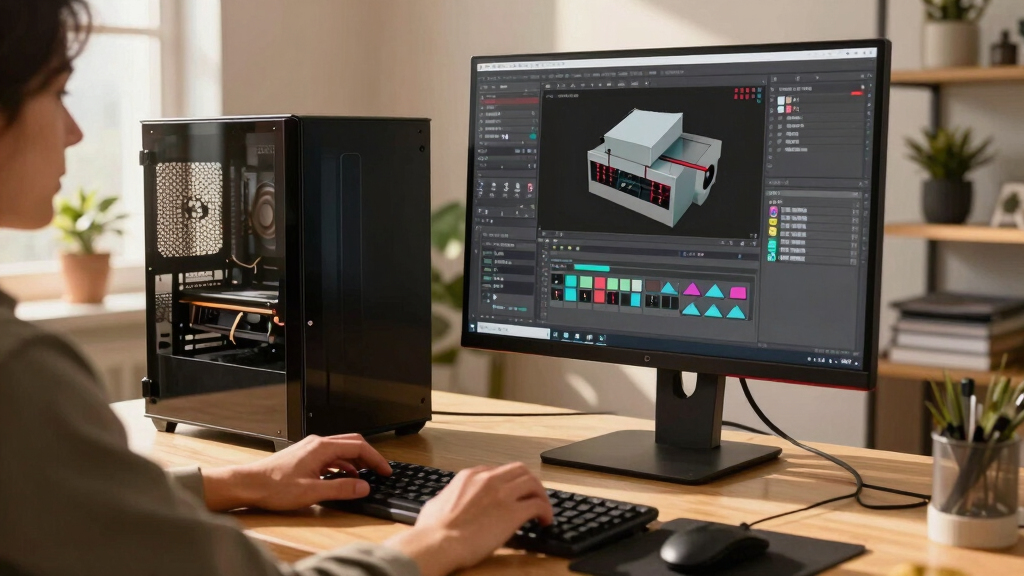

Choosing the best Radeon card for Blender in 2026 involves balancing raw performance, compatibility, and budget. The VisionTek Radeon HD 7750 stands out for budget-conscious users needing basic rendering, while the AMD Radeon Pro W2100 offers professional features for demanding workflows. Mid-range options like the Radeon RX 550 series provide good performance without breaking the bank, but they may fall short on high-end rendering tasks. The main tradeoffs revolve around power efficiency, VRAM capacity, and compatibility with Blender’s GPU acceleration. Continue reading for a detailed comparison to find the best fit for your Blender projects.
Key Takeaways
- The Radeon RX 550 series offers the best balance of price and performance for most Blender users.
- Higher VRAM capacity significantly improves rendering times with complex scenes.
- Professional cards like the Radeon Pro W2100 excel in stability and driver support for demanding workflows.
- Compact and low-profile options are suitable for small form factor builds but often sacrifice raw power.
- Budget cards like the Radeon HD 7750 are suitable for basic tasks but struggle with large, complex projects.
| VisionTek Products Radeon 7350 Graphics Cards 900608 |  | Best for Basic Business and Creative Use | Graphics Coprocessor: AMD Radeon HD 7350 | RAM: 512 MB | Video Output Interface: DVI, DisplayPort | VIEW LATEST PRICE | See Our Full Breakdown |
| VisionTek Radeon Rx 550 4GB GDDR5 – 4K Resolution Support |  | Best for Entry-Level 4K Multi-Monitor Gaming | Graphics Coprocessor: Radeon RX 550 | Memory: 4 GB GDDR5 | Memory Clock Speed: 1500 MHz | VIEW LATEST PRICE | See Our Full Breakdown |
| maxsun AMD Radeon RX 550 4GB GDDR5 ITX |  | Best for Compact 1080p and Light CAD Work | Graphics Coprocessor: Radeon RX 550 | RAM: 4 GB GDDR5 | Core Speed: 1183 MHz | VIEW LATEST PRICE | See Our Full Breakdown |
| VisionTek AMD Radeon RX 550 2GB GDDR5 Low Profile |  | Best for Budget Multi-Monitor Workstations and HTPCs | Graphics Coprocessor: Radeon RX 550 | Memory: 2 GB GDDR5 | Maximum Resolution: 7680×4320 | VIEW LATEST PRICE | See Our Full Breakdown |
| AMD Radeon Pro W2100 Graphic Card – 2 GB GDDR5 |  | Best for Professional CAD and Content Creation | Graphics Processor: AMD Radeon Pro WX 2100 | VRAM: 2 GB GDDR5 | Display Outputs: 2x Mini-DisplayPort, 1x DisplayPort | VIEW LATEST PRICE | See Our Full Breakdown |
| VisionTek Radeon HD 7750 2GB GDDR5 – 4K Resolution Support Graphics Card – Support up to 6 Monitors with Mini DisplayPort Outputs – AMD Eyefinity 2.0 – Suitable Graphics Card for Gaming PC |  | Best for Multi-Display Professionals on a Budget | Graphics Coprocessor: AMD Radeon HD 7750 | Memory: 2 GB GDDR5 | Video Output Interface: Mini DisplayPort | VIEW LATEST PRICE | See Our Full Breakdown |
More Details on Our Top Picks
VisionTek Products Radeon 7350 Graphics Cards 900608
This Radeon 7350 stands out for its energy efficiency and straightforward HD support, making it a solid choice for business users or those engaging in video conferencing where high-end graphics aren’t necessary. Compared with the Radeon HD 7750, it offers lower power consumption and simpler installation, but sacrifices gaming performance and 3D rendering capabilities. Its support for dual-link DVI and Eyefinity technology allows multi-monitor setups, ideal for multitasking in office or creative environments. However, its 512MB RAM and modest DirectX 11 support limit it for demanding graphical tasks or gaming. This card makes the most sense for users who need reliable, low-power display output without requiring high frame rates or complex rendering.
Pros:- Low power consumption with platform-independent power management
- Supports up to three independent displays via Eyefinity
- Compact and energy-efficient form factor
Cons:- Limited 512MB RAM restricts performance in advanced applications
- No external power supply needed limits high-performance capability
- Basic HD support, not suitable for modern gaming or intensive 3D work
Best for: Business users, video conference participants, and casual content creators needing multi-monitor support
Not ideal for: Gamers or 3D artists requiring intensive rendering or high-resolution textures, due to limited VRAM and performance
- Graphics Coprocessor:AMD Radeon HD 7350
- RAM:512 MB
- Video Output Interface:DVI, DisplayPort
- Compatible Devices:Desktop
- Graphics Ram Type:DDR3 SDRAM
- Maximum Display Resolution:2560×1600
Bottom line: Ideal for budget-conscious users needing reliable multi-display support for basic office or light creative tasks.
VisionTek Radeon Rx 550 4GB GDDR5 – 4K Resolution Support
This Radeon RX 550 makes the most sense for users who want a budget-friendly upgrade capable of supporting four 4K displays, especially for multi-monitor setups in gaming or professional work. Compared to the RX 550 2GB variant, the 4GB model provides more VRAM for better multitasking and smoother performance at higher resolutions. Its four HDMI outputs enable easy multi-display configurations, and Radeon FreeSync 2 ensures tear-free gameplay or video playback. While it handles 1080p gaming and basic content creation well, it isn’t designed for demanding 3D rendering or AAA gaming at high settings, and its bus-powered design limits overclocking potential. This card suits those who prioritize multiple 4K outputs over raw gaming power or high-end rendering.
Pros:- Supports up to four 4K monitors simultaneously
- Bus-powered, easy to install without extra power connectors
- Radeon FreeSync 2 for smooth visuals
Cons:- Limited to 4GB VRAM, restricting intensive multitasking or high-resolution textures
- Not suitable for high-end 3D rendering or AAA gaming
- Basic cooling solution may be less effective under prolonged load
Best for: Multi-monitor professionals, digital signage, and casual gamers seeking 4K support
Not ideal for: High-end gamers or 3D artists needing extensive VRAM and advanced GPU features, due to its modest 4GB memory
- Graphics Coprocessor:Radeon RX 550
- Memory:4 GB GDDR5
- Memory Clock Speed:1500 MHz
- Maximum Resolution:4096×2160
- Display Output Interface:4x HDMI
- Interface:PCI-Express 3.0
Bottom line: Best for users who need multiple 4K displays at an affordable price point, with light gaming and media tasks.
maxsun AMD Radeon RX 550 4GB GDDR5 ITX
This RX 550 from maxsun is tailored for users needing a compact, efficient GPU capable of handling 1080p gaming and basic 3D applications like CAD or video editing. Compared with the VisionTek RX 550 4GB, it emphasizes low noise and stability with a 9cm fan and high-quality components like solid capacitors, making it suitable for small form factor builds. Its support for DirectX 12 and 4K video decoding makes it versatile for media and light professional workloads. However, its modest core clock speed of 1183 MHz and 4GB VRAM restrict its performance in demanding gaming or high-resolution rendering, making it less ideal for intensive 3D modeling. This card fits best in compact systems where space and low noise are priorities.
Pros:- Compact size fits in small cases
- Low noise operation with 9cm fan
- Supports DirectX 12 and 4K decoding
Cons:- Lower core clock speed limits gaming performance
- Limited 4GB VRAM restricts heavy multitasking
- Basic cooling may not suffice under prolonged load
Best for: Small form factor PCs, entry-level gaming, and CAD users with space constraints
Not ideal for: High-end gaming or complex 3D rendering, due to limited clock speed and VRAM
- Graphics Coprocessor:Radeon RX 550
- RAM:4 GB GDDR5
- Core Speed:1183 MHz
- Video Decode:4K
- Interface:PCI-Express x16
- Maximum Resolution:3840×2160
Bottom line: Perfect for compact builds needing 1080p gaming or light CAD work without high power requirements.
VisionTek AMD Radeon RX 550 2GB GDDR5 Low Profile
This RX 550 2GB variant is tailored for users who need a low-profile, energy-efficient GPU for multi-monitor setups or media centers. Its four Mini DisplayPort outputs support up to four displays at 4K resolution, ideal for digital signage or office environments. Compared with the 4GB models, it offers less VRAM, which limits heavy multitasking or gaming at high resolutions, but its low power draw and small form factor make it perfect for compact or SFF cases, including HTPCs. The inclusion of passive adapters and support for DirectX 12 enhances versatility for multimedia and productivity tasks. However, the 2GB VRAM and basic GPU performance mean it’s not suitable for high-end gaming or intensive 3D rendering. This card is best for budget-conscious users with space constraints.
Pros:- Low-profile, fits in small cases
- Supports up to four 4K displays via Mini DisplayPort
- Energy efficient, only 50W power draw
Cons:- Limited VRAM restricts intensive multitasking
- No support for demanding gaming or high-end rendering
- Passive cooling may limit thermal performance under load
Best for: HTPC, digital signage, and office multi-monitor setups
Not ideal for: Gaming or professional 3D work requiring significant VRAM or GPU power, due to limited memory and performance
- Graphics Coprocessor:Radeon RX 550
- Memory:2 GB GDDR5
- Maximum Resolution:7680×4320
- Output Interface:4x Mini-DisplayPort
- Power Consumption:50W
- Form Factor:Low Profile
Bottom line: A practical choice for budget-friendly multi-monitor and media applications in space-constrained systems.
AMD Radeon Pro W2100 Graphic Card – 2 GB GDDR5
This Radeon Pro W2100 is designed specifically for professional workflows like CAD, 3D modeling, and content creation, offering stability and certified drivers. Compared to the consumer-oriented RX 550 series, it emphasizes reliability with features like solid capacitors and a low-profile form factor suitable for workstation builds. Its 2GB GDDR5 VRAM limits heavy 3D rendering or large dataset handling, but it provides the necessary support for professional applications with certified drivers and optimized performance. Its dual Mini-DisplayPort and standard DisplayPort outputs make multi-monitor setups straightforward, and the 30-day warranty ensures peace of mind. This card is ideal for users needing dependable graphics acceleration for CAD, visualization, and light professional tasks, rather than gaming.
Pros:- Certified drivers for professional applications
- Low-profile, suitable for compact workstations
- Supports dual Mini-DisplayPort and DisplayPort outputs
Cons:- Limited 2GB VRAM restricts complex 3D modeling
- No gaming optimizations or high-end GPU features
- Short warranty period of 30 days
Best for: CAD professionals, content creators, and users needing certified workstation graphics
Not ideal for: Gaming or high-end 3D rendering due to VRAM constraints and lack of gaming features
- Graphics Processor:AMD Radeon Pro WX 2100
- VRAM:2 GB GDDR5
- Display Outputs:2x Mini-DisplayPort, 1x DisplayPort
- Maximum Resolution:7680×4320
- Interface:PCI-Express x16
- Warranty:30 days
Bottom line: Best suited for CAD and content creation professionals needing reliable, certified graphics for professional workflows.
VisionTek Radeon HD 7750 2GB GDDR5 – 4K Resolution Support Graphics Card – Support up to 6 Monitors with Mini DisplayPort Outputs – AMD Eyefinity 2.0 – Suitable Graphics Card for Gaming PC
This Radeon HD 7750 stands out for its ability to support up to six monitors simultaneously, making it an ideal choice for users who need expansive multi-display setups. Compared with more modern cards like the Radeon RX 550, it offers broader multi-monitor support thanks to its six mini DisplayPorts and AMD Eyefinity 2.0, though it lags behind in raw rendering power for complex Blender projects. Its 2GB GDDR5 memory and 4K UHD content support provide decent visual clarity, but it isn’t designed for intensive 3D rendering or high-poly modeling. The card’s compatibility with older systems and multiple operating systems adds to its versatility. However, its age and limited VRAM mean it struggles with more demanding rendering tasks, and it lacks the hardware acceleration features present in newer models. This pick makes the most sense for professionals who prioritize multi-monitor productivity over raw rendering speed, especially in tasks like monitoring, compositing, or light 3D work.
Pros:- Supports up to six monitors, ideal for expansive workspace setups
- 4K UHD content support enhances visual clarity for media tasks
- Compatible with a wide range of operating systems and older systems
Cons:- Limited to 2GB VRAM, restricting handling of large Blender projects
- Significantly outdated architecture, lacking modern features like hardware acceleration for rendering
Best for: Professionals who need to run multiple monitors simultaneously for tasks like content creation, financial analysis, or healthcare displays without requiring high-end rendering performance.
Not ideal for: Blender artists working on complex scenes or high-poly models that demand more GPU power and VRAM, as this card cannot handle intensive rendering tasks efficiently.
- Graphics Coprocessor:AMD Radeon HD 7750
- Memory:2 GB GDDR5
- Video Output Interface:Mini DisplayPort
- Maximum Resolution:4096 x 2160 @ 60Hz
- System Compatibility:Supports Windows 7, 8, 8.1, 10, Vista, XP
- Multi-Monitor Support:Up to 6 displays
Bottom line: This card is best suited for users who prioritize extensive multi-monitor support and basic 4K content playback over intensive 3D rendering capabilities.