📊 Full opportunity report: TRT And Digital Health: Tracking Labs And Symptoms on IdeaNavigator AI — validation score, market gap, and execution plan.

Get hardware and tech essentials delivered free with Prime
- Fast, free delivery on millions of items
- Prime Video, Amazon Music and more included
- Member-only deals all year
TL;DR
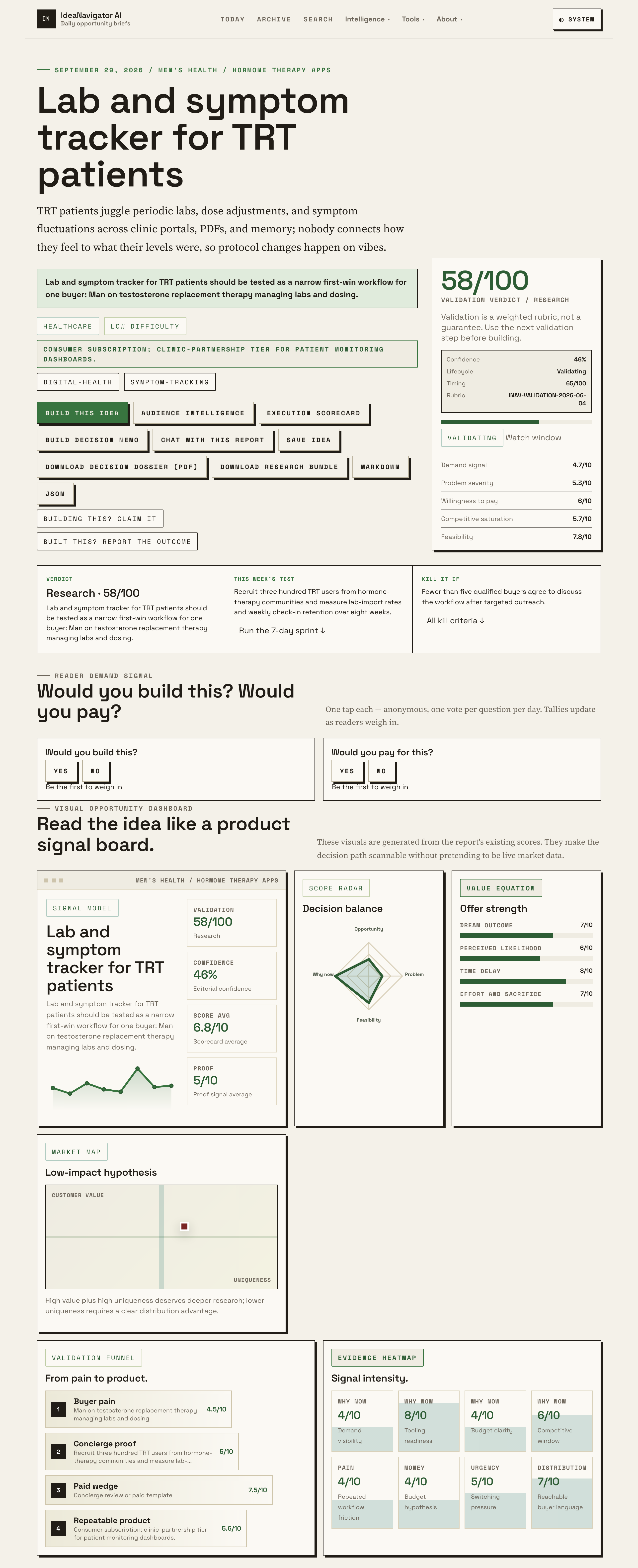
A product proposal outlines a lab and symptom tracker for men receiving testosterone replacement therapy (TRT), linking imported lab results with dose changes and daily symptom check-ins. It recommends testing the workflow with 300 users over eight weeks; no product launch, clinical results or validation findings are reported.
IdeaNavigator AI’s proposal describes testing a digital tracker for men receiving testosterone replacement therapy that would connect lab results, dose changes and daily symptoms. The proposal outlines a potential product and an eight-week user study, rather than a launched service or a clinical finding.
According to the IdeaNavigator AI proposal, the minimum viable product would let users import lab PDFs, chart hormone-panel results over time and record dose changes alongside daily symptom check-ins. The proposal also describes trend summaries for clinic visits and flags for results moving outside target ranges. It does not specify which lab markers or target ranges the app would use, or who would determine them.
The proposal identifies men managing TRT labs and dosing as its intended first users. It says those patients may have to piece together information from clinic portals, PDFs and memory, making it difficult to compare how they feel with measured hormone levels. Its claim that protocol changes consequently happen based on subjective impressions is presented as the proposal’s problem statement, not as a documented finding from a patient study.
For validation, the proposal recommends recruiting 300 TRT users from hormone-therapy communities and tracking lab-import rates and weekly check-in retention over eight weeks. It suggests a consumer subscription and a separate clinic-partnership tier with patient-monitoring dashboards. The proposal provides no pricing, recruitment results, clinic agreements or product availability.
A Test of Connected TRT Records
If developed and adopted, a tracker that brings lab values, dose changes and symptom records together could give patients and their clinicians a more organized view of information collected between appointments. Trend summaries for clinic visits are the proposal’s clearest practical use: they could help users present a timeline rather than rely on scattered files or recollection.
The eight-week study suggested by IdeaNavigator AI would measure whether people import lab reports and keep recording symptoms. Those are early indicators of whether the workflow fits patients’ routines; they would not, by themselves, show that the app improves treatment decisions or health outcomes. The proposal reports no clinical evidence that the tracker can make therapy safer or more effective.
For clinics, the proposal says a monitoring dashboard could offer another way to review patient-submitted information, while a subscription model would place the product directly in the consumer health market. Both paths depend on unresolved questions about data handling, clinical responsibility and how the tool would fit existing care.
Fragmented Records Shape the Proposal
In its proposal, IdeaNavigator AI frames the concept around a specific care-management problem: people receiving TRT may encounter periodic testing, dose adjustments and changes in symptoms across separate systems. It says that information can be split among provider portals and PDF reports, leaving patients to assemble their own history. The proposal offers this as the rationale for a focused app; it does not present survey or medical-record evidence quantifying how often this happens.
The proposal also cites the growth of TRT prescriptions and telehealth clinics as reasons to consider the product now. It gives no prescription figures, market estimates or clinic counts to support that trend and does not identify a particular provider or geography. It frames the market as men’s health and hormone-therapy apps.
IdeaNavigator AI suggests a deliberately narrow approach: focus first on one user group and one task—keeping labs and symptoms in a shared timeline—then assess whether people use it consistently. That is a product-testing plan, not evidence that the market is large or that patients and clinicians have endorsed the concept.
Clinical Rules and Adoption Unspecified
The IdeaNavigator AI proposal does not identify a developer, release schedule, participating clinic or completed study. It is unclear whether the recommended 300-person test has been funded or organized, how participants would be recruited, or what level of lab-import and check-in retention would count as a successful result.
Key design and safety details are also absent from the proposal. It does not explain how the app would extract data from PDFs, validate imported values, set target ranges, handle results outside those ranges or protect sensitive health information. It also does not say whether alerts would be reviewed by clinicians or how users would be told that the app is not a substitute for medical advice. No efficacy or safety claims have been tested in the information provided.
Retention Would Be the First Measure
The next step described in IdeaNavigator AI’s proposal is an eight-week pilot with 300 TRT users. The proposed measures are lab-import rates and weekly symptom check-in retention, which would show whether participants use the core features over time. The proposal gives no recruitment date or study protocol.
If the test goes ahead, its results could clarify whether users maintain the records and whether the workflow merits further development. More information would still be needed on data accuracy, privacy protections, clinician involvement and any effect on care before the concept could support claims about clinical benefit.
Source: IdeaNavigator AI
Key Questions
Is the TRT lab and symptom tracker available?
No launch or availability information is provided in the IdeaNavigator AI proposal. The tracker is described as a product concept with a proposed user test.
What would the proposed app track?
According to the proposal, it would connect imported lab reports and hormone-panel trends with dose changes and daily symptom check-ins, and prepare summaries for clinic visits.
Has the tracker been shown to improve TRT outcomes?
No clinical results are reported in the proposal. The suggested pilot would measure feature use and retention, not establish that the app improves health outcomes.
How would the idea be tested?
The proposal recommends an eight-week test with 300 TRT users, measuring how often they import lab results and complete weekly check-ins. No test start date is given.
Source: IdeaNavigator AI
Halloween Picks
halloween
As an affiliate, we earn on qualifying purchases.