

You've probably noticed the rising buzz around solar companies lately. As the shift towards sustainable energy gains momentum, these businesses are not just about clean power; they're reshaping economies and job markets. Companies like First Solar and Sunrun are at the forefront, pushing innovative technologies and responsible practices. But what does this mean for the future of energy and employment? Let's explore the dynamics driving this industry forward.

Get hardware and tech essentials delivered free with Prime
- Fast, free delivery on millions of items
- Prime Video, Amazon Music and more included
- Member-only deals all year
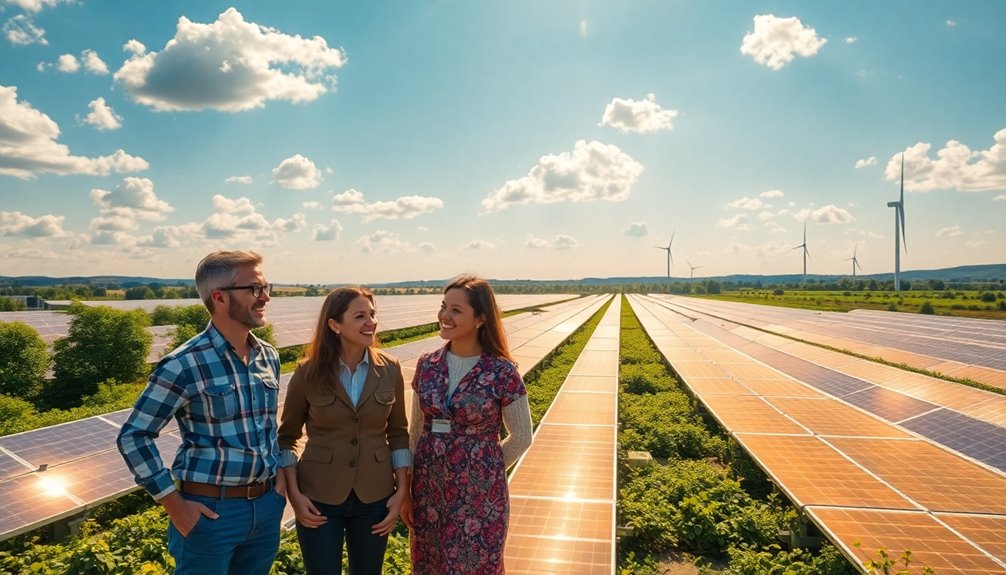
As the world shifts towards sustainable energy sources, understanding solar companies becomes essential for anyone looking to harness the power of the sun. You may find yourself considering the various technologies and manufacturers in the solar industry, particularly those that stand out for their innovation and sustainability practices.
For instance, First Solar's thin film technology utilizes Cadmium Telluride (CdTe) to produce solar modules that have a lower carbon footprint compared to traditional crystalline silicon panels. This not only helps reduce environmental impact but also positions First Solar as a leader in responsible manufacturing.
First Solar's manufacturing footprint is impressive, boasting facilities in Ohio and plans for expansion in the Southeast by 2025, which indicates a strong commitment to domestic production. They're on track to reach over 20 GW of annual manufacturing capacity by 2025, with operations spread across the US, India, Malaysia, and Vietnam.
Their focus on sustainability is evident in their responsible sourcing and recycling practices, ensuring that they minimize their environmental impact from start to finish. Plus, with an innovative production process that leverages Industry 4.0 and AI, they've managed to streamline operations, significantly reducing the usage of semiconductor materials.
When exploring solar companies, you'll also come across leaders like Sunrun, Vivint Solar, and Sunnova. Sunrun offers a variety of solar panel systems, including options for leasing or purchasing, serving over 130,000 customers across 22 states. Sunrun is recognized as one of the largest national solar companies.
Similarly, Vivint Solar provides solar installations with $0 down plans, catering to over 100,000 customers in 21 states. Sunnova takes a different approach by partnering with local installers to offer $0 down options with a pathway to ownership. These companies are crucial players in making solar energy accessible to more people.
You can't overlook SunPower, known for its high-quality solar panels and community solar projects, or SolarCity (Tesla Energy), which focuses on innovative products like the solar roof. However, it's worth noting that residential services for SolarCity have been scaled back recently.
This evolution in the industry shows how companies adapt to market demands while still aiming for growth. The solar industry isn't just about technology and products; it's also a significant contributor to the economy. As of 2023, solar employs nearly 280,000 Americans and generated over $60 billion.
With over 219 GW of solar capacity installed nationwide, it's enough to power more than 37 million homes. The growth rate of 26% annually over the last decade is impressive, with solar accounting for 55% of new electric capacity added in 2023.
Safety and health considerations are also crucial. The construction process of solar panel installation avoids toxic chemicals, focusing instead on mechanical site preparation. Although CdTe panels have raised some concerns, they're generally considered safe.
Proper recycling and end-of-life management can effectively handle the waste generated by solar panels. Overall, the solar industry represents a promising and vital move towards a more sustainable future, and understanding these companies will help you make informed choices as you consider harnessing solar energy. Moreover, as the demand for solar energy increases, so does the importance of sustainable practices within the industry. By leveraging innovations in solar panel recycling and exploring options like mining pools and their advantages, we can enhance not only the efficiency of solar energy production but also contribute to a circular economy. This not only mitigates the environmental impact but also promotes a more responsible and resource-efficient approach to energy consumption.
Products Worth Considering

Jackery Explorer 2000 v2 Portable Power Station with Two 200W Solar Panels

Jackery Solar Generator 1000 V2 with 200W Solar Panel

DJI Osmo Mobile 7P with Mic Mini TX (Infinity Black) Gimbal Stabilizer
As an affiliate, we earn on qualifying purchases.