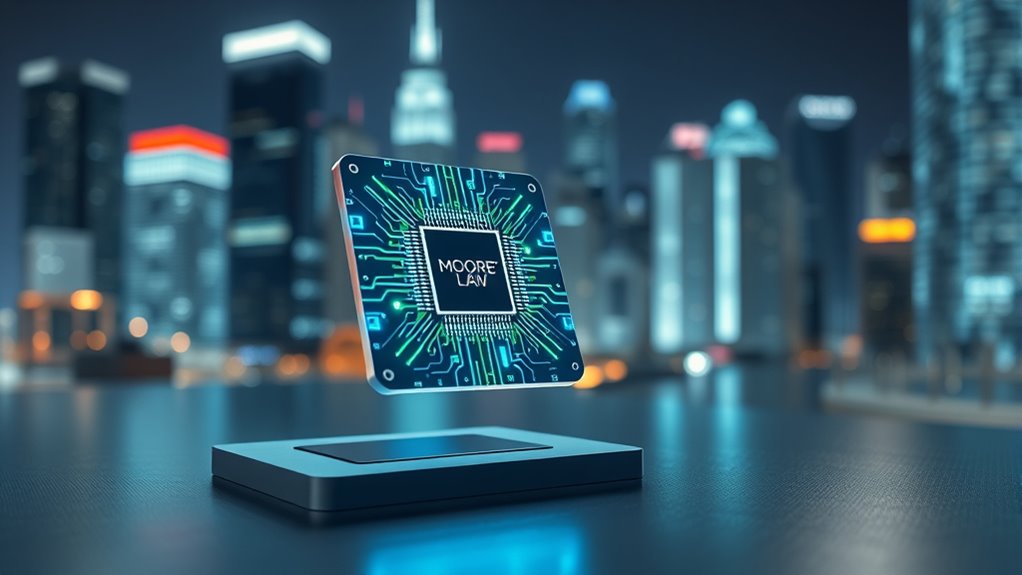

Moore’s Law has driven the rapid growth of computing power by doubling transistors on chips every two years. As we reach the physical limits of silicon technology, quantum computing and advanced AI are emerging as game-changers. These innovations will vastly increase processing speeds and capabilities, transforming industries and everyday life. To understand how these breakthroughs will shape the future and what challenges lie ahead, explore how the next era of technology is unfolding.
Key Takeaways
- Moore’s Law predicts the continuous doubling of transistors, fueling ongoing innovation in classical computing hardware.
- As physical limits are approached, quantum computing offers a new paradigm to surpass traditional silicon-based chips.
- Increasing transistor counts enhance AI capabilities, enabling faster data processing and more complex algorithms.
- The future of computing involves integrating quantum and AI technologies, transforming industries and daily life.
- Cybersecurity remains vital to protect emerging technologies from new vulnerabilities and ensure safe technological progress.
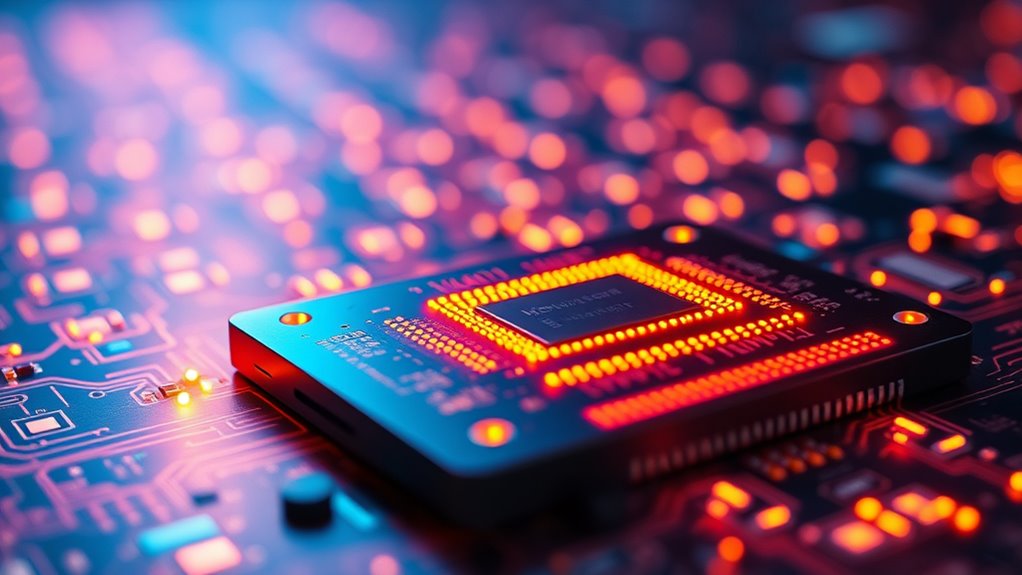
For decades, Moore’s Law has driven the rapid pace of technological innovation by predicting that the number of transistors on a microchip would double approximately every two years. This trend has pushed engineers to continually shrink transistors, resulting in faster, more powerful computers. But as we approach physical limits of silicon-based chips, the landscape of computing is shifting. You’re now witnessing an era where quantum computing and advances in artificial intelligence are becoming pivotal, promising to revolutionize what’s possible.
Quantum computing, in particular, offers a leap beyond traditional microchips. Unlike classical bits, which are either 0 or 1, quantum bits—or qubits—can exist in multiple states simultaneously. This superposition allows quantum computers to process complex calculations exponentially faster than current machines. If harnessed effectively, quantum computing could crack problems that today’s supercomputers struggle with, such as simulating molecular interactions for drug discovery or optimizing complex logistics. As Moore’s Law slows, quantum tech emerges as a groundbreaking solution that doesn’t just extend existing capabilities but transforms them entirely.
Quantum computing surpasses traditional chips with qubits’ superposition, enabling exponential processing power for complex problems.
Artificial intelligence, on the other hand, continues to grow more sophisticated thanks to the increasing computational power driven by Moore’s Law. The more transistors on a chip, the more data you can process and analyze in real time. This means AI algorithms become more accurate, adaptable, and capable of handling tasks once thought impossible—like natural language understanding and autonomous decision-making. As hardware becomes more powerful, AI models expand in complexity, enabling smarter virtual assistants, predictive analytics, and advanced robotics. You’re likely to see AI integrating seamlessly into everyday life, making processes more efficient and opening new frontiers in automation.
Moreover, advancements in cybersecurity are essential to protect these powerful new technologies from emerging threats and vulnerabilities, ensuring a secure foundation for future innovations.
Frequently Asked Questions
Will Quantum Computing Replace Classical Computers Soon?
Quantum computing won’t replace classical computers soon because we haven’t achieved quantum supremacy yet. While quantum machines can tackle problems beyond classical limitations, they’re still in development and face practical challenges like error correction and stability. You’ll see quantum tech complement classical systems for specific tasks, but full replacement isn’t imminent. Instead, expect a hybrid approach that leverages the strengths of both quantum and classical computing.
How Will AI Impact Future Hardware Development?
AI will profoundly influence future hardware development by driving innovations in AI hardware, such as specialized chips tailored for machine learning tasks. You’ll see the rise of neuromorphic chips designed to mimic neural structures, offering faster and more efficient processing. These advancements will enable smarter, more responsive devices, pushing the boundaries of technology. As you adopt AI-powered tools, expect hardware to become increasingly optimized for AI workloads, transforming how you interact with digital systems.
Can Moore’s Law Continue Beyond Silicon-Based Chips?
Moore’s Law can push beyond silicon chips if innovative technologies like photonic chips and neuromorphic architectures take center stage. These advancements promise faster, more efficient processing, but challenges remain. As you explore the future, you’ll wonder if these breakthroughs can truly sustain exponential growth. The answer depends on overcoming technical hurdles and embracing new materials, which could redefine the limits of computing well past traditional silicon boundaries.
What Are the Environmental Impacts of Advancing Computing Technology?
You should know that advancing computing technology increases energy consumption and electronic waste. As devices become more powerful and frequent upgrades happen, energy use rises, impacting the environment. Plus, discarded electronics contribute to pollution if not properly recycled. To reduce these impacts, you can support sustainable practices, recycle electronics responsibly, and choose energy-efficient devices. Being mindful of your tech habits helps lessen the environmental footprint of ongoing technological progress.
How Will Emerging Materials Influence Future Processor Design?
Emerging materials like graphene transistors and carbon nanotubes will revolutionize processor design by enabling faster, more energy-efficient chips. You’ll see these materials allow for smaller, more flexible components that outperform traditional silicon. By integrating graphene and nanotubes, you’ll benefit from improved heat dissipation and durability, pushing computing power forward. These innovations will profoundly influence future processor architectures, making your devices more powerful and sustainable.
Conclusion
As you watch technology accelerate beyond current limits, one thing becomes clear: Moore’s Law may soon reach its edge. But what’s next? Will innovation slow, or will new breakthroughs push us into uncharted territory? The future of computing hangs in the balance, waiting to be revealed. As you stay tuned, remember—what’s coming could redefine everything you thought you knew about progress and possibility. The next chapter is just over the horizon.