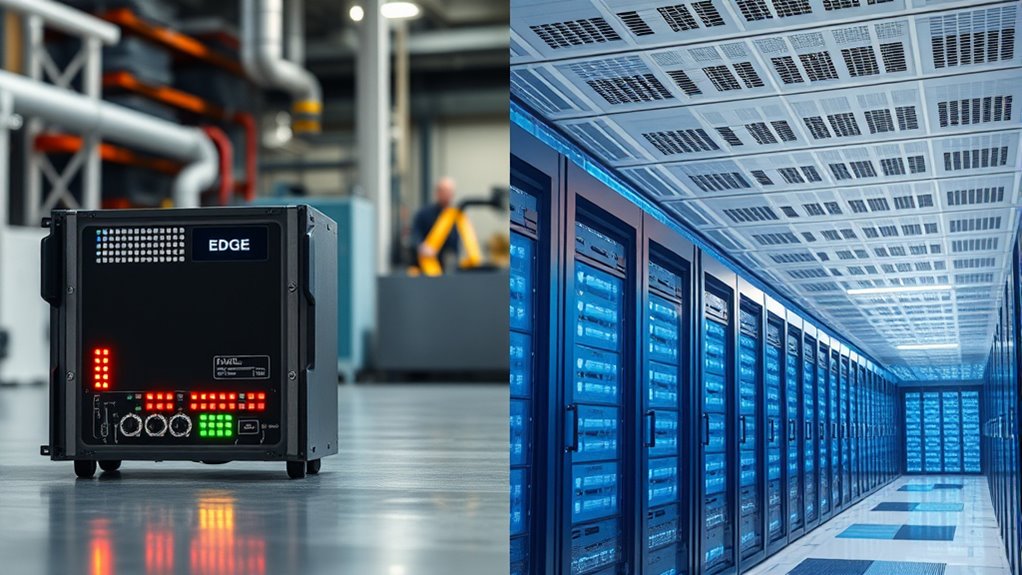

Edge computing processes data close to its source, providing quick responses for real-time needs, while cloud computing uses remote servers for large-scale storage and analytics. With edge, you get faster decision-making and better control over sensitive data, but it may have limited processing power. Cloud offers scalability and flexibility for big data, but can introduce latency. To understand how these systems work together and which fits your needs, keep exploring more details.
Key Takeaways
- Edge computing processes data locally near devices for real-time responses; cloud computing uses centralized servers for large-scale processing.
- Edge offers low latency and immediate decision-making; cloud provides scalable resources for extensive data analytics.
- Edge enhances data privacy and control by keeping sensitive information on-site; cloud involves transmitting data over the internet.
- Edge is ideal for time-critical applications like autonomous vehicles; cloud suits long-term storage and complex analytics.
- Many organizations adopt hybrid models combining both to balance real-time performance and scalability.

Have you ever wondered how data processing happens so quickly in today’s digital world? It’s a question many people ask as they seek faster, more efficient ways to handle the vast amounts of data generated every second. That’s where edge computing and cloud computing come into play. These technologies serve different needs but often work together to optimize data management. Edge computing processes data closer to the source—think sensors, devices, or local servers—allowing for real-time processing. This immediate response capability is vital for applications like autonomous vehicles, industrial automation, and smart cities, where delays could be costly or even dangerous. By handling data locally, edge computing reduces latency, guaranteeing decisions are made swiftly, often in milliseconds. It also helps address data sovereignty concerns, as sensitive information can stay within local jurisdictions, complying with regional privacy laws and regulations. This local data handling gives organizations greater control over their data, reducing dependency on distant cloud servers and lowering the risk of data breaches or unauthorized access. Additionally, advancements in high refresh rates and low input lag in projectors demonstrate how focusing on performance can significantly improve user experience, especially in gaming and multimedia applications.
On the other hand, cloud computing offers centralized storage and processing power, ideal for handling large-scale data operations, complex analytics, and long-term data storage. Instead of relying on local infrastructure, you connect to remote servers managed by providers like Amazon Web Services or Microsoft Azure. Cloud computing enables you to scale resources up or down as needed, providing flexibility and cost efficiency. However, because data is transmitted over the internet to centralized data centers, there can be latency issues, making it less suitable for applications requiring instant responses. Despite this, cloud platforms are continually evolving to integrate more real-time processing capabilities, bridging the gap between speed and scalability.
The choice between edge and cloud computing hinges on your specific needs. If you prioritize real-time processing and data sovereignty, edge computing is often the better fit. It keeps sensitive data local and guarantees rapid responses. But if your focus is on handling large datasets, performing complex analysis, or cost-effective storage, cloud computing provides unmatched scalability and resources. Many organizations now adopt a hybrid approach, leveraging both systems to optimize performance, security, and efficiency. Understanding the fundamental differences helps you make informed decisions, guaranteeing your data infrastructure aligns with your operational goals. In today’s fast-paced digital landscape, knowing when to use edge or cloud computing can give you a significant advantage in delivering timely, secure, and reliable data services.
Frequently Asked Questions
How Does Latency Impact Real-Time Applications in Edge vs. Cloud Computing?
Latency substantially impacts real-time applications, with lower latency enabling quicker responses and smoother performance. In edge computing, latency reduction is easier because data processes closer to you, supporting real-time processing. Cloud computing, however, often involves longer latency due to data traveling to centralized servers, which can hinder time-sensitive tasks. So, for real-time applications, edge computing generally offers better performance because it minimizes latency issues.
What Are the Security Implications of Deploying Data at the Edge?
Data at the edge exposes you to increased security stakes, risking data privacy breaches and regulatory non-compliance. You must safeguard sensitive information with strong encryption, vigilant monitoring, and robust access controls. While edge devices offer speed and local processing, they also demand diligent defenses to prevent data leaks. By prioritizing protective policies, you ensure that your data remains private, compliant, and protected against potential threats.
How Does Cost Efficiency Compare Between Edge and Cloud Solutions?
You’ll find that edge computing often offers better cost efficiency for real-time data processing, reducing bandwidth and storage expenses. Cloud solutions can have higher ongoing costs due to data transfer and storage fees, but they require less upfront investment. The cost comparison depends on your specific needs; edge provides quick investment benefits for localized processing, while cloud scales easily but may cost more over time.
Can Edge Computing Fully Replace Cloud Services in Enterprise Environments?
Edge computing can’t fully replace cloud services in enterprise environments because it mainly handles local data processing, while cloud offers centralized storage and extensive resources. You still need cloud for data sovereignty, ensuring compliance with regulations, and network segmentation to secure sensitive info. Edge complements cloud by providing real-time processing at the source, but for scalability and all-encompassing management, cloud services remain essential.
What Industries Benefit Most From Edge Computing Versus Cloud Computing?
When it comes to industries like industrial automation and healthcare analytics, edge computing is your best bet. You benefit from real-time data processing, reducing latency and boosting efficiency. Cloud computing works well for data storage and large-scale analysis, but edge is ideal when quick decisions matter most. Think of it as having a front-row seat—giving you immediate insights, while the cloud handles the heavy lifting behind the scenes.
Conclusion
Understanding the difference between edge and cloud computing helps you choose the right solution. Did you know that by 2025, it’s estimated that 75% of data will be processed outside traditional data centers? This highlights how edge computing is gaining ground for real-time, localized processing, while cloud remains essential for large-scale storage and analysis. Recognizing these differences ensures you can optimize your technology for speed, efficiency, and cost-effectiveness.