
If you want to run local AI models at home, your hardware needs matter far more than flashy RGB lighting. Focus on a powerful GPU and high-performance CPU to handle complex calculations, along with ample RAM—at least 16 GB for small tasks and more for bigger models. Fast SSD storage is essential for quick data access, and future-proofing with scalable components helps manage growing AI demands. Keep these specs in check to build a reliable AI setup; explore further to get all the details.

Get hardware and tech essentials delivered free with Prime
- Fast, free delivery on millions of items
- Prime Video, Amazon Music and more included
- Member-only deals all year
Key Takeaways
- Adequate GPU and CPU power are crucial for efficient local AI model training and inference.
- Sufficient RAM (16 GB or more) prevents bottlenecks when handling large datasets.
- Fast SSD storage accelerates model loading, training, and data access.
- Proper hardware scalability ensures future AI complexity and performance demands are met.
- Balancing cost, performance, and compatibility avoids bottlenecks and optimizes AI workflows at home.
high performance GPU for AI at home
As an affiliate, we earn on qualifying purchases.
As an affiliate, we earn on qualifying purchases.
What Are the Key Hardware Components for Running AI at Home?

To run AI models effectively at home, you need a few essential hardware components. A powerful GPU is vital, as it handles the intensive calculations AI requires. Pair this with a high-performance CPU to manage data processing efficiently. Sufficient RAM ensures your system can handle large datasets without lag, while fast storage like SSDs speeds up model loading and training. When setting up your AI environment, remember AI ethics and data privacy; choose hardware with secure features to protect sensitive data. Additionally, a reliable power supply and cooling system prevent overheating and guarantee stability during extended use. Investing in quality components not only improves performance but also aligns with responsible AI practices, guaranteeing your projects are both effective and ethically sound. Understanding hardware specifications is crucial to optimizing your AI setup for both performance and ethical considerations, especially when considering GPU capabilities and their impact on processing speed and efficiency. Recognizing hardware limitations helps prevent bottlenecks that could hinder your AI projects and ensures a smoother development process. Moreover, paying attention to system compatibility ensures all components work harmoniously, avoiding potential conflicts that could disrupt your AI workflows.
16GB RAM desktop for AI modeling
As an affiliate, we earn on qualifying purchases.
As an affiliate, we earn on qualifying purchases.
How Much Processing Power Do You Need for Your AI Projects?
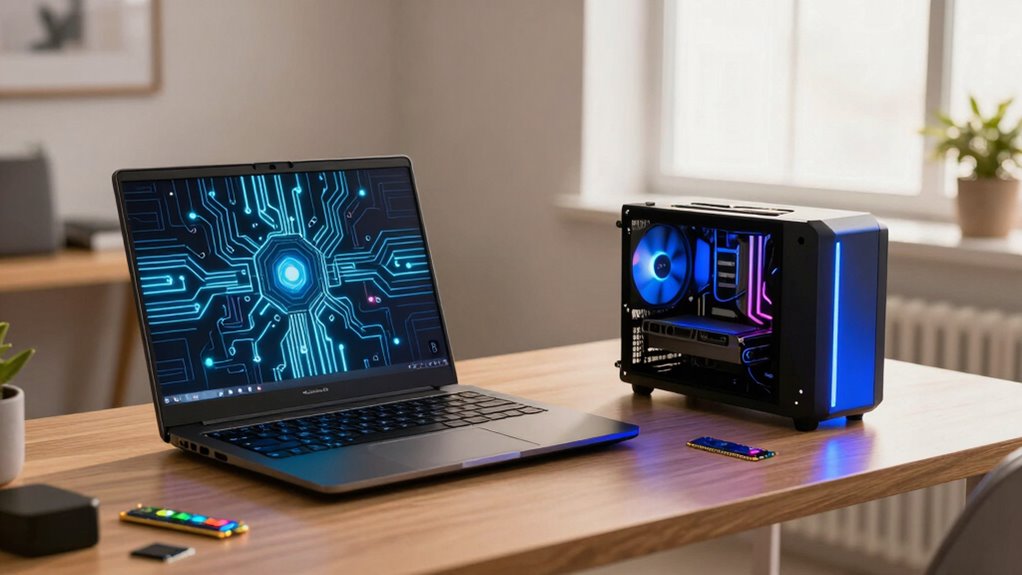
Determining the right amount of processing power for your AI projects depends largely on their complexity and scale. If you’re working on simple models or training small datasets, a mid-range CPU and GPU might suffice. However, for more advanced projects that involve larger datasets or real-time processing, you’ll need higher-performance hardware with multiple GPUs and substantial compute capacity. Consider how AI ethics and model interpretability factor into your work—more robust hardware can help you develop transparent, fair models by enabling thorough testing and analysis. Additionally, just as selecting the proper flywheel upgrade can enhance a car’s performance, choosing the right hardware components ensures your AI system runs smoothly and efficiently. Balancing processing power guarantees you meet project demands without overspending. Ultimately, investing in scalable hardware allows you to improve model accuracy, interpretability, and ethical standards, making your local AI setup both effective and responsible.
fast SSD storage for AI training
As an affiliate, we earn on qualifying purchases.
As an affiliate, we earn on qualifying purchases.
Why Is Sufficient RAM Crucial for AI Model Performance?
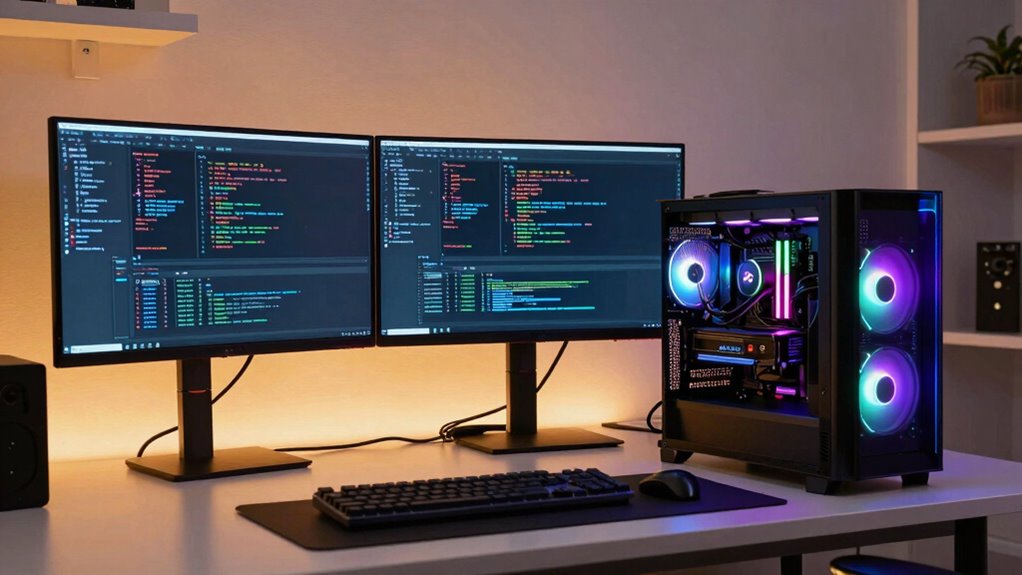
Having enough RAM is essential for AI model performance because it directly affects how smoothly your system can handle large datasets and complex computations. Insufficient memory capacity causes frequent data swapping, slowing processing and hindering training or inference tasks. Upgrading RAM allows you to manage bigger models and datasets more efficiently. Proper hardware configuration is key to optimizing AI workflows and avoiding bottlenecks. Here’s how memory capacity impacts performance:
| RAM Capacity | Effect on AI | Recommended Upgrades |
|---|---|---|
| 8 GB | Limited data handling | 16 GB or more |
| 16 GB | Better for small models | 32 GB for larger projects |
| 32 GB | Handles complex models | Consider 64 GB for extensive use |
| 64 GB | Ideal for intensive tasks | Upgrade if working with heavy datasets |
| 128+ GB | High-end, specialized tasks | Essential for advanced AI workflows |
Additionally, choosing a powerful GPU can significantly enhance AI processing capabilities alongside ample RAM. Upgrading your RAM is a practical step to boost performance and keep your AI projects running smoothly, especially as content complexity increases.
scalable computer components for AI
As an affiliate, we earn on qualifying purchases.
As an affiliate, we earn on qualifying purchases.
What Storage Options Help You Access Data Quickly?
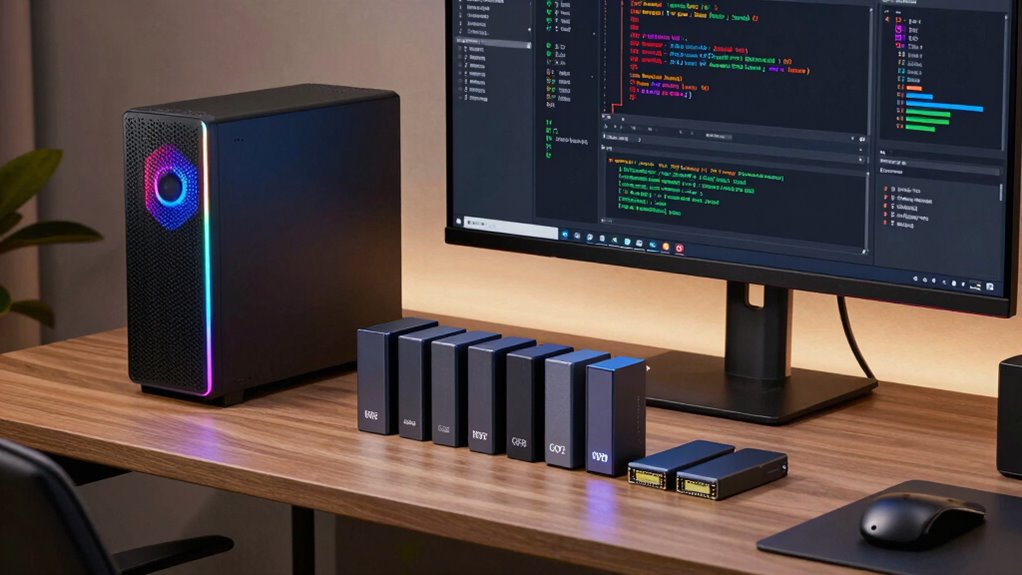
Using an SSD can greatly boost your data access speeds, making your AI workflows more efficient. You’ll also want enough storage capacity to handle your datasets and models without constantly juggling space. Combining fast SSDs with ample storage ensures quick, reliable access to everything you need. Incorporating enterprise USB backups or optical drives can add an extra layer of security for your important data. Additionally, choosing organized storage solutions can help you keep track of your files more easily and prevent clutter.
SSD Speed Advantages
Solid State Drives (SSDs) offer a significant speed advantage over traditional hard drives, making them essential for running local AI models efficiently. Faster data access means your system can process information more quickly, reducing delays during training or inference. This speed is especially vital when working with large datasets, where slow storage can bottleneck performance. Additionally, quick data retrieval helps maintain color calibration and RGB accuracy in visual outputs, ensuring images and videos stay true to their intended appearance. With an SSD, you minimize lag, making the entire workflow smoother and more responsive. This improvement directly impacts your ability to fine-tune models and generate high-quality results without frustrating wait times. Ultimately, investing in a fast SSD enhances your overall AI experience and output quality.
Adequate Storage Capacity
Wondering how much storage capacity you need to run AI models smoothly? You’ll want enough space for datasets and quick access. Opt for SSDs for fast read/write speeds, but don’t forget about cloud storage for backups and scalability. Data redundancy is key to prevent data loss, so consider a setup that automatically copies your files across multiple drives or cloud services. Here’s a quick comparison:
| Storage Type | Best For |
|---|---|
| Local SSDs | Fast local access |
| Cloud Storage | Backup, remote access, scalability |
| HDDs | Cost-effective bulk storage |
Balancing local storage with cloud solutions ensures quick data access and peace of mind. Remember, ample storage isn’t just about size but also about reliability and speed.
Do You Need Special Hardware Like TPUs or FPGAs?
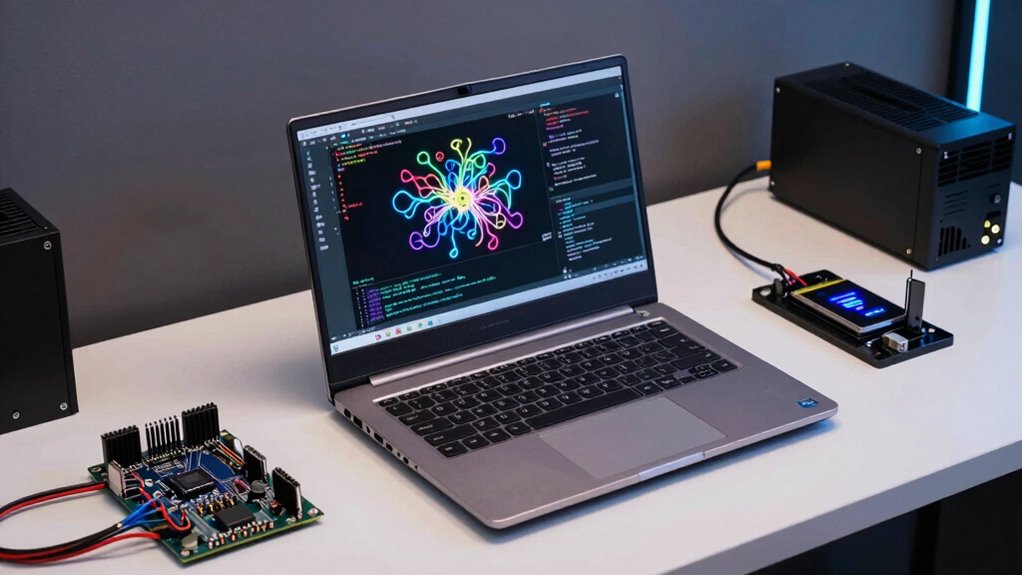
Do you really need special hardware like TPUs or FPGAs to run local AI models effectively? Not necessarily. While these specialized accelerators can boost performance, they’re primarily aimed at large-scale or highly demanding tasks. For most home setups, standard GPUs or even high-end CPUs handle AI workloads well enough. These accelerators offer hardware customization, allowing tailored processing power for specific models, but they come at a cost and complexity. If your AI projects are simple or moderate, investing in a powerful GPU might be more practical and affordable. Special hardware isn’t a must-have; it’s a luxury for specialized use cases. Understanding hardware requirements can help you choose the right setup without overspending. Additionally, considering your hardware compatibility and available resources ensures efficient project execution. Recognizing the computational demands of your AI models can further guide your hardware choices and prevent unnecessary expenses. Being aware of cost-effectiveness is crucial when evaluating whether investing in specialized hardware makes sense for your needs. Evaluating these factors can also help you avoid over-specifying hardware, which can lead to unnecessary costs. Focus on balancing your hardware’s capabilities with your project’s needs before diving into expensive or complex options.
How Can You Balance Cost and Performance When Building AI Hardware?
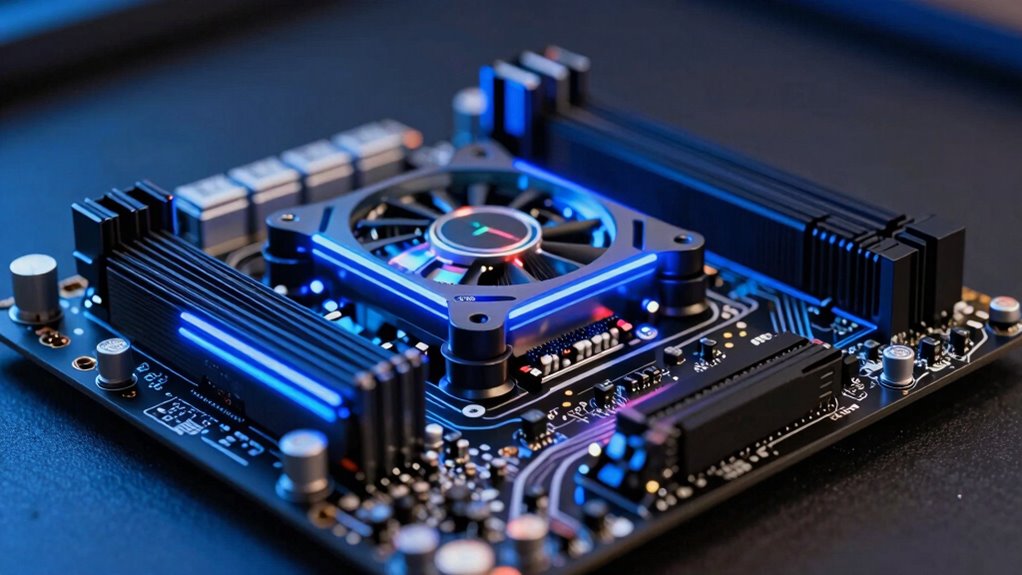
Balancing cost and performance when building AI hardware requires careful planning and prioritization. To maximize value, consider these key factors:
Effective AI hardware balances cost and performance through careful planning and strategic prioritization.
- Choose scalable components that can grow with your needs, avoiding overspending on unnecessary power.
- Prioritize energy efficiency to reduce long-term operating costs and environmental impact. This not only benefits your budget but also aligns with sustainable practices.
- Integrate cloud options for tasks that demand high power, saving money on hardware upgrades and ensuring flexibility.
- Incorporate inspiring leadership and management insights to stay motivated and make strategic decisions that align with your goals. Recognizing the importance of growth mindsets can help you adapt and innovate as your AI needs evolve.
What Common Hardware Bottlenecks Might Slow Down Your AI?
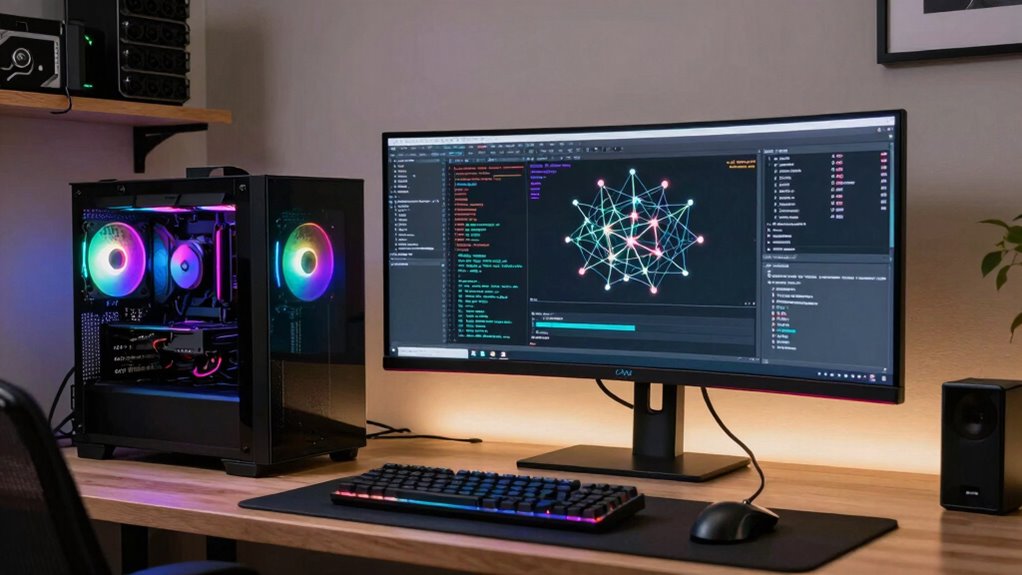
Understanding the common hardware bottlenecks that can slow down your AI is essential for optimizing performance. One major issue is hardware compatibility; if your CPU, GPU, or RAM don’t work well together, it creates delays and reduces efficiency. For example, an incompatible GPU can limit your AI’s processing speed. Power consumption also plays a role—if your hardware draws too much power, it can cause thermal throttling or system instability, slowing down operations. Additionally, limited bandwidth between components can cause data transfer delays, hampering performance. Ensuring that your hardware components are compatible and balanced for power consumption prevents these bottlenecks. Properly managing hardware integration can help maintain optimal data flow and overall system stability. Being mindful of component balance and ensuring all parts work harmoniously can further prevent these issues. By addressing these issues, you keep your AI running smoothly and avoid unnecessary slowdowns caused by hardware mismatches or overload.
How Can You Future-Proof Your Hardware for Evolving AI Needs?
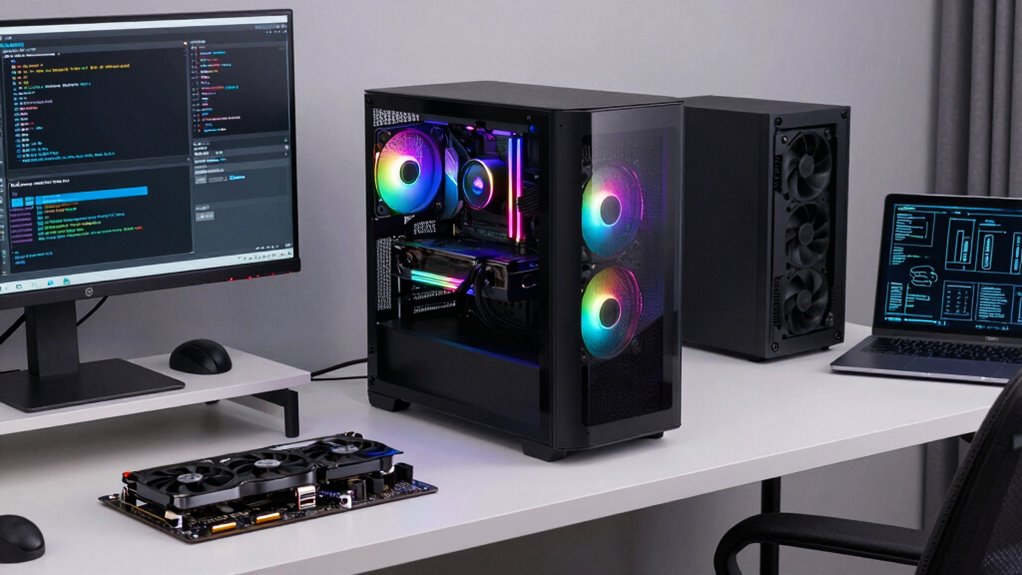
To prepare your hardware for future AI demands, consider upgrading key components like your GPU and RAM regularly. Investing in scalable solutions, such as modular systems or cloud integrations, helps you adapt as your needs grow. Staying flexible with these choices guarantees your setup remains capable as AI models become more complex. Additionally, choosing high-performance graphics tablets can enhance your creative workflow when working on AI-driven projects. Regularly monitoring the evolving AI hardware requirements ensures your system stays competitive and capable of handling increasingly sophisticated models.
Upgrading Hardware Components
As AI workloads continue to grow more demanding, investing in adaptable hardware components becomes essential for future-proofing your setup. To guarantee your system can handle evolving AI needs, focus on these upgrades:
- Choose versatile GPUs with high AI model compatibility, capable of supporting future models without bottlenecks.
- Upgrade your CPU and RAM to handle increased data processing and multitasking demands.
- Improve hardware cooling solutions, such as better fans or liquid cooling, to maintain ideal performance during intensive tasks.
- Consider filter sizing/flow and ensuring your hardware can accommodate future system demands to prevent bottlenecks and maintain optimal performance.
These upgrades help your hardware stay relevant longer, prevent overheating, and guarantee compatibility with upcoming AI advancements. By paying attention to these components, you set a solid foundation for future AI projects at home.
Investing in Scalable Solutions
Investing in scalable solutions guarantees your hardware can adapt seamlessly to future AI advancements. This means choosing components that support ongoing AI training and assure hardware compatibility as models evolve. Planning for scalability involves selecting a system with upgrade paths for RAM, storage, and processing power. To understand this better, consider the table below:
| Future Needs | Current Hardware Capabilities |
|---|---|
| Larger AI models | Expandable GPU/CPU options |
| Faster AI training | Higher throughput support |
| Evolving software | Modular and adaptable design |
This approach guarantees your setup remains relevant, avoiding frequent replacements. By focusing on scalability, you future-proof your investment, keeping pace with the rapid developments in AI training and hardware compatibility.
Frequently Asked Questions
Can Existing Gaming PCS Handle Running Local AI Models Effectively?
Your gaming PC can handle running local AI models if it has the right hardware compatibility and software optimization. Focus on a powerful GPU, ample RAM, and a capable CPU, as these are essential. Make sure your software is optimized for AI workloads to maximize performance. While gaming PCs are often capable, you might need to tweak settings or upgrade components for the best results in AI tasks.
How Important Is Cooling and Power Supply for AI Hardware Stability?
Honestly, ignoring cooling and power supply is like ignoring your AI hardware’s survival kit. Thermal management keeps your system cool under heavy loads, preventing overheating and crashes, while a stable power supply avoids sudden shutdowns that can corrupt data. Without these, your AI setup risks instability and damage. Prioritize cooling and power stability; they’re the backbone that keeps your high-performance hardware running smoothly and reliably, no matter the workload.
What Peripheral Hardware Enhances AI Model Development at Home?
Peripheral hardware like high-quality keyboards, mice, and monitors can enhance your AI model development at home. Focus on AI hardware upgrades that support better performance and peripheral compatibility, such as external GPUs or fast storage devices. These upgrades streamline your workflow, making training and testing more efficient. Invest in peripherals that suit your needs, ensuring seamless integration with your existing setup, and boosting overall productivity.
Are There Compatibility Issues With Different Hardware Components for AI?
Yes, hardware compatibility can be a challenge when building your AI setup. You need to guarantee your components, like GPU, CPU, and RAM, work well together to avoid issues. Proper component integration is essential; mismatched parts can cause performance problems or even hardware failure. Always check compatibility specs and motherboard support before purchasing new hardware, and consider future upgrades to keep your system running smoothly.
How Much Does Network Speed Impact Local AI Model Training and Inference?
Network speed considerably impacts local AI training and inference, especially if your setup relies on cloud resources or data transfer. Bandwidth bottlenecks can cause delays, slowing down data flow and processing times. Latency effects become noticeable when syncing models or accessing large datasets, leading to lag and reduced efficiency. To optimize performance, guarantee your network has high bandwidth and low latency, minimizing these issues for smoother, faster AI operations at home.
Conclusion
Think of your AI setup as a sturdy bridge, connecting your ideas to reality. By choosing the right hardware, you’re laying strong pillars that support your creative journey. Don’t let bottlenecks or outdated parts weaken your foundation. Instead, build with foresight, ensuring your bridge remains resilient as AI landscapes evolve. With solid specs beneath you, you’ll cross any challenge smoothly—transforming your home into a launchpad for limitless innovation.
Columbus Day / Indigenous Peoples' Day Picks
long weekend sales
As an affiliate, we earn on qualifying purchases.