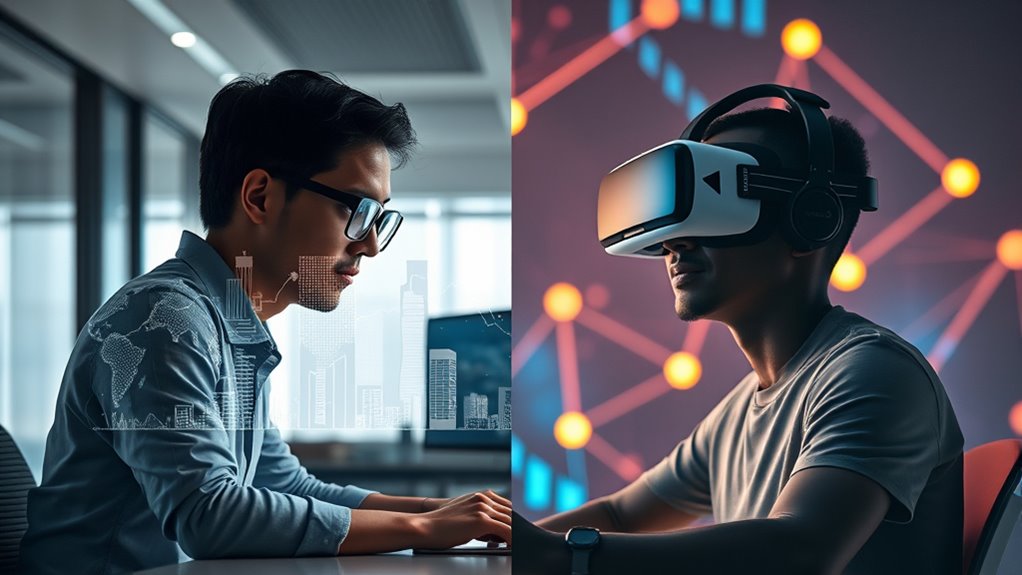

Augmented Reality (AR) adds digital elements to your real-world view, allowing you to see and interact with both simultaneously, making it ideal for quick, interactive experiences like gaming or education. Virtual Reality (VR), on the other hand, fully immerses you in a computer-generated environment, blocking out the physical world for deeper engagement. Understanding these key differences helps you choose the right technology for fun, learning, or innovation—exploring more reveals how each can transform your digital experiences.
Key Takeaways
- AR overlays digital elements onto the real world, while VR creates a fully immersive virtual environment.
- AR enhances real-world interactions and is ideal for quick, accessible applications; VR offers deep immersion for experiential learning.
- AR is commonly used in gaming and education to augment real surroundings; VR is used for immersive gaming, training, and virtual tours.
- AR allows users to see and interact with digital content alongside their physical environment; VR isolates users in a separate virtual space.
- Both technologies are advancing rapidly, blurring lines between reality and digital experiences across various sectors.
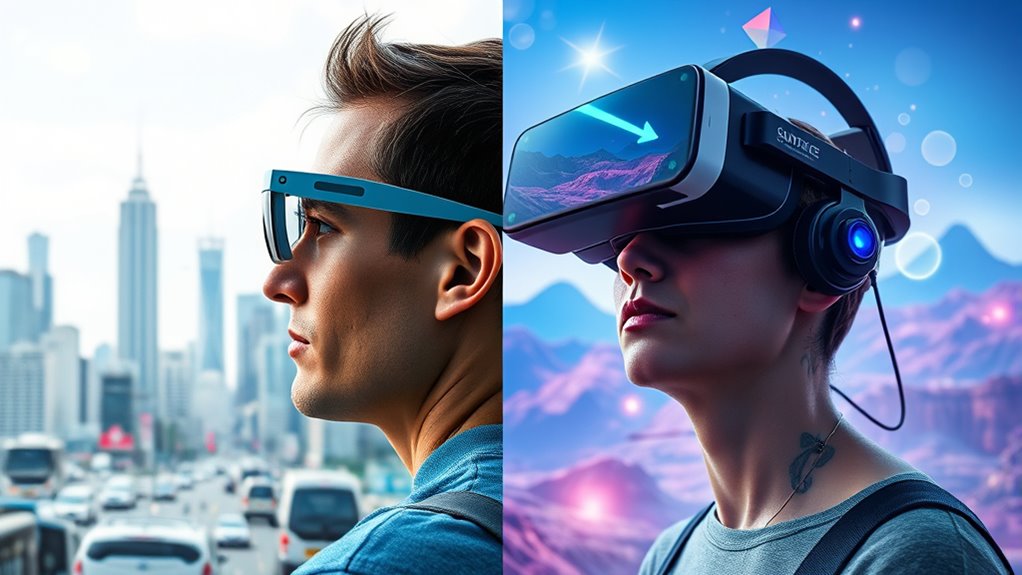
Augmented Reality (AR) and Virtual Reality (VR) are two transformative technologies reshaping how we interact with digital content. When you immerse yourself in these worlds, you’ll notice they serve different purposes and create distinct experiences. AR overlays digital elements onto your real-world environment, so you can still see and interact with your surroundings. VR, on the other hand, immerses you completely into a virtual environment, blocking out the real world entirely. These differences influence how they’re used across various sectors, especially in gaming applications and educational tools.
If you’re into gaming, AR allows you to bring game elements into your physical space. Imagine playing a game where virtual characters appear right in your living room or on your street, blending seamlessly with the real world, which is made possible by high refresh rates that ensure smooth visuals. This creates a more interactive and social experience because you can still see your environment and other people around you. Popular AR games like Pokémon GO exemplify this, encouraging players to explore their real-world surroundings while engaging with digital creatures. VR gaming takes you into entirely new worlds, providing a fully immersive experience. You put on a headset, and suddenly, you’re exploring distant planets, battling in fantasy realms, or racing through futuristic cities. The sense of presence in VR makes gaming intensely engaging, often feeling more realistic than traditional screens.
In education, AR offers a unique way to enhance learning by integrating digital content into real-world settings. For example, you might use an AR app to view 3D models of the human body on your desk, helping you understand anatomy more interactively. It’s useful for teachers and students because it makes complex concepts more tangible and engaging. VR in education takes this a step further by creating entirely virtual classrooms or immersive simulations. Imagine history students walking through ancient cities or science students conducting virtual experiments without any risk or cost. VR provides hands-on experiences that are otherwise impossible or impractical in a traditional classroom, making learning more memorable and impactful.
Both AR and VR are transforming how we learn and play, but they do so in fundamentally different ways. AR enhances reality by adding digital elements to the physical world, perfect for quick, accessible interactions. VR offers complete immersion, ideal for deep engagement and experiential learning. Whether you’re gaming or learning, understanding these differences helps you choose the right technology for your needs. As these technologies become more advanced and accessible, expect them to integrate even further into your daily life, creating richer, more interactive experiences that blur the lines between reality and digital worlds.
Frequently Asked Questions
How Does Hardware Affordability Impact AR and VR Adoption?
Lower hardware costs boost AR and VR adoption by making the technology more accessible. When devices become more affordable through cost reduction, more people can experience immersive environments. Accessibility improvements, like lightweight headsets and easier setup, encourage wider use in education, gaming, and training. As hardware becomes cheaper and more user-friendly, you’ll find AR and VR gaining popularity faster, transforming how you learn, work, and entertain yourself.
What Industries ARe Currently Underutilizing AR and VR Technologies?
You might not realize it, but industries like healthcare innovation and agricultural applications are underutilizing AR and VR technologies. Healthcare can benefit from immersive training and patient care, while agriculture can use AR for crop management and field analysis. By embracing these tools, you can improve efficiency, safety, and outcomes. Don’t overlook these opportunities; expanding AR and VR use in these fields could revolutionize the way you approach challenges and solutions.
How Do AR and VR Affect User Privacy and Data Security?
AR and VR can impact your privacy and data security by collecting sensitive information, so always pay attention to data encryption and user consent. When using these technologies, your data might be stored or shared if you don’t review privacy settings carefully. To protect yourself, make sure apps and platforms prioritize secure data handling and ask for your permission before accessing personal details, keeping your information safe and private.
What ARe the Future Advancements Expected in AR and VR Technology?
Imagine stepping into a world where augmented reality innovations turn your surroundings into a living canvas, blending digital and real seamlessly. You can expect virtual reality breakthroughs to create hyper-real experiences, making you feel truly immersed. Future advancements will likely include smarter, more intuitive AR glasses and more realistic VR environments, transforming how you learn, work, and connect. Get ready for a future where technology feels like second nature.
How Do AR and VR Influence Cognitive and Physical Health?
You might experience cognitive benefits from AR and VR, like improved spatial awareness and problem-solving skills, but you should also be aware of physical risks such as eye strain, headaches, or dizziness. While these technologies can boost learning and interaction, prolonged use can lead to fatigue or discomfort. To stay safe, take regular breaks and limit your exposure, balancing the benefits with potential physical risks.
Conclusion
As you explore the worlds of augmented and virtual reality, remember the wise words of Lewis Carroll—sometimes you need to step through the looking glass to see new possibilities. Whether you’re enhancing your surroundings or immersing yourself completely, both technologies open doors to exciting experiences. Embrace these innovations, knowing each has its unique magic. Just like Alice’s adventures, your journey into AR and VR promises wonder, discovery, and endless potential—so step in and see where it takes you.