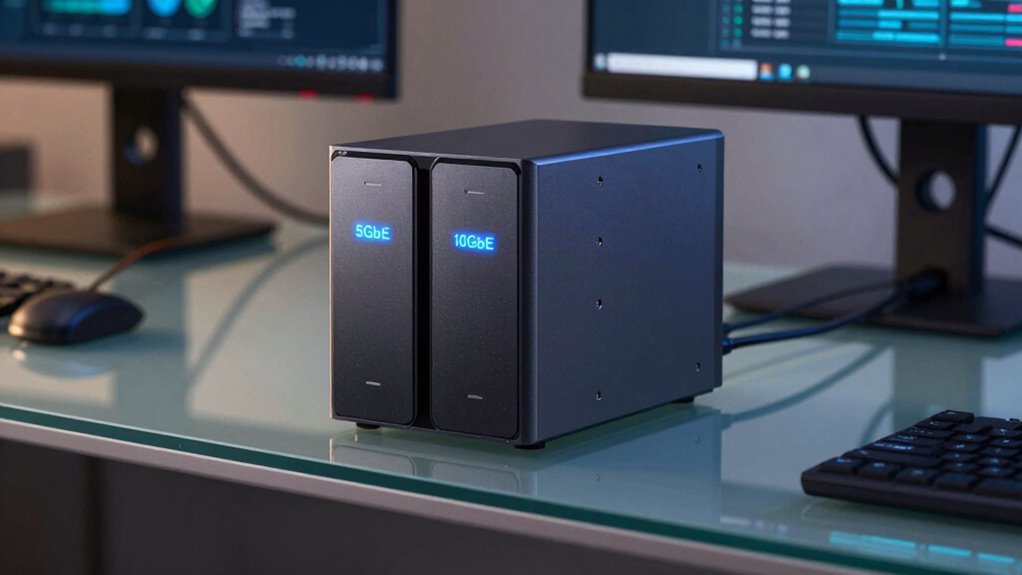

Upgrading from 5GbE to 10GbE is worth it if your workflows involve large files, multiple users, or frequent backups that slow down with slower speeds. Faster data transfer reduces bottlenecks, improves productivity, and guarantees smooth collaborative work. Consider your current setup and future needs, as infrastructure upgrades may be necessary. To find out if your environment truly benefits from switching, explore the details below to make an informed choice.

Get hardware and tech essentials delivered free with Prime
- Fast, free delivery on millions of items
- Prime Video, Amazon Music and more included
- Member-only deals all year
Key Takeaways
- Upgrading to 10GbE is worthwhile when large file transfers, backups, or cloud syncs regularly slow down your workflow.
- Infrastructure upgrades, like compatible switches and cabling, are necessary for 10GbE, impacting overall cost and feasibility.
- 10GbE significantly reduces transfer times, improving productivity for high-volume data environments and multi-user setups.
- If current network congestion or backup speeds hinder performance, upgrading offers noticeable efficiency gains.
- Consider future growth and data demands; 10GbE better accommodates expanding storage needs and user concurrency.
As an affiliate, we earn on qualifying purchases.
Why Speed Matters for Your NAS: Understanding Your Workflow Needs
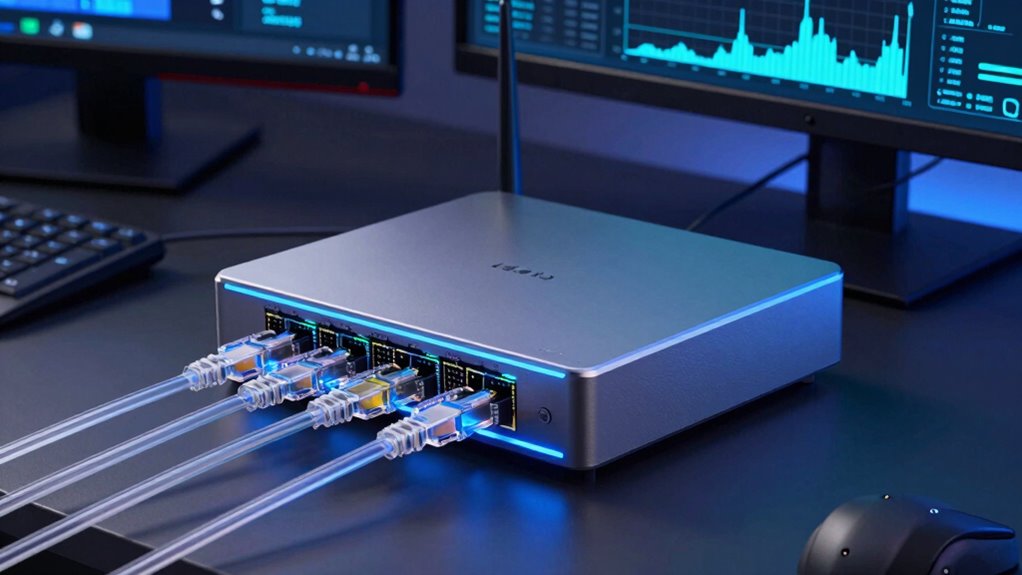
Understanding your workflow needs is crucial because network speed directly impacts how efficiently you can access and transfer data. If you frequently work with large files or rely on cloud storage, faster speeds like 10GbE can substantially reduce upload and download times. This reduction in data transfer time can significantly improve productivity, especially when managing large files or streaming high-resolution content. Additionally, faster speeds help guarantee smooth data encryption processes, which are essential for security during data transfer. When your network can handle high-speed data movement, you won’t experience bottlenecks that slow down your work. Knowing how quickly you need to access or share files helps determine if an upgrade to 10GbE is worthwhile. Considering the importance of digital concepts in modern data transfer can further inform your upgrade decision. A clear understanding of your network infrastructure can also help you optimize your setup for maximum efficiency. Recognizing the role of essential oils in improving focus and reducing stress can create a more productive workspace environment, indirectly supporting your workflow efficiency. Ultimately, matching your network speed to your workflow ensures seamless, secure, and efficient data management.
As an affiliate, we earn on qualifying purchases.
How Do 5GbE and 10GbE Compare? Key Technical Differences
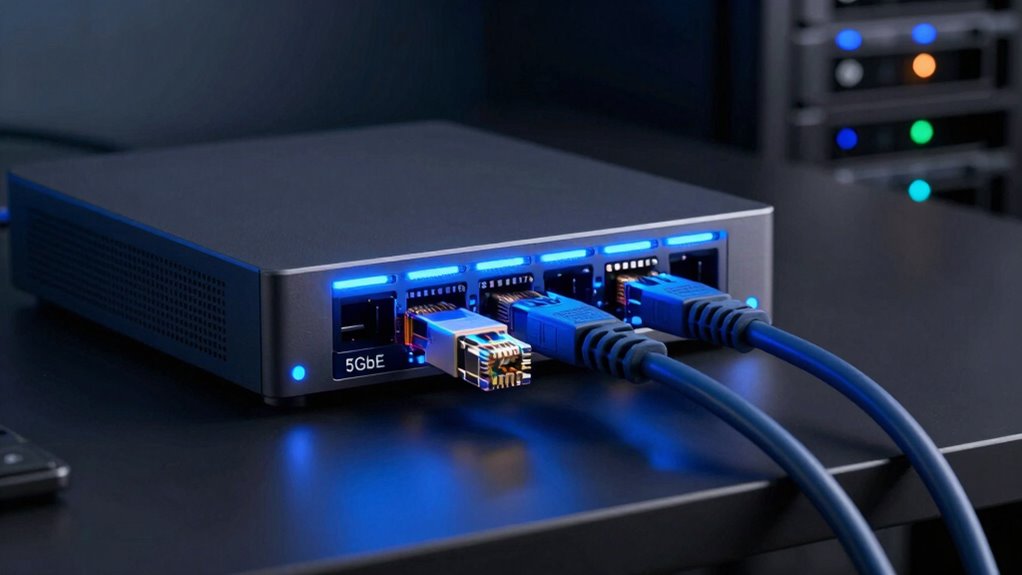
While both 5GbE and 10GbE offer high-speed network connections, their key technical differences significantly impact performance. The main distinctions lie in network latency and hardware compatibility. 10GbE generally provides lower latency, making data transfer faster and more responsive, especially with large files. However, 5GbE offers broader hardware compatibility, as it often requires less specialized equipment.
| Feature | 5GbE | 10GbE |
|---|---|---|
| Network latency | Slightly higher | Lower |
| Hardware compatibility | More common, easier to upgrade | More specialized, potentially costly |
| Cable requirements | CAT5e or CAT6 cables | CAT6a or fiber-optic cables |
| Cost | Generally cheaper | Typically more expensive |
fiber optic Ethernet cable 10GbE
As an affiliate, we earn on qualifying purchases.
As an affiliate, we earn on qualifying purchases.
Is Upgrading to 10GbE Worth It? When Performance Gains Make Sense

Upgrading to 10GbE can dramatically improve transfer speeds, but it’s important to contemplate if your network infrastructure can support it. You’ll also want to weigh the costs against the performance gains to see if the investment makes sense. Ultimately, the decision depends on whether the speed improvements align with your specific needs.
Transfer Speed Improvements
If you’re considering whether to move from 5GbE to 10GbE for your NAS, the key factor is how much faster your data transfers will actually be. Upgrading can notably reduce transfer times, especially with large files or backups. For example, transferring a 10GB file takes about twice as long on 5GbE compared to 10GbE. This speed boost benefits workflows involving cloud storage syncs or remote access. The table below illustrates typical transfer durations:
| File Size | 5GbE Speed | 10GbE Speed |
|---|---|---|
| 1GB | 2.7 min | 1.3 min |
| 10GB | 27 min | 13.5 min |
| 100GB | 4.5 hrs | 2.25 hrs |
Increased transfer speeds also support hardware redundancy and seamless cloud backups, making upgrades worthwhile when time savings matter. Enhancing your network infrastructure with proper cabling can further maximize these speed improvements and ensure reliable performance.
Network Infrastructure Compatibility
Evaluating whether your current network infrastructure can support 10GbE is crucial before making the switch. Your existing switches, routers, and cabling need to handle higher speeds, so check if they’re compatible with 10GbE standards. Wireless connectivity generally won’t influence this decision, but if you rely on wireless for backup or remote access, verify your network can handle increased data flow without bottlenecks. Also, consider your power supply—upgrading to 10GbE may demand more power from your network devices, so confirm your power supply can support the new hardware. If your infrastructure is outdated or lacks the necessary ports and cabling, upgrading might require significant investment. Confirming compatibility now saves you from unexpected costs and guarantees a smooth changeover to faster NAS speeds. Additionally, ensure your network’s cohabitation safety measures are up to date to prevent disruptions during the upgrade process. It’s also helpful to review available upgrading options to ensure your investment aligns with your performance needs. Furthermore, assessing the landscaping of your network setup can help identify potential physical obstructions or environmental factors that might affect performance during the upgrade.
Cost-Benefit Analysis
Deciding whether to invest in 10GbE for your NAS depends on weighing the tangible performance benefits against the associated costs. Upgrading can considerably boost transfer speeds, especially when working with large files or cloud storage integrations, making data access faster and more efficient. However, the costs include new network equipment, potential infrastructure upgrades, and increased power consumption. You should also consider how enhanced speeds impact data encryption processes, which can sometimes slow down transfers but improve security. If your workflow involves frequent large backups, multimedia editing, or cloud storage synchronization, the performance gains may justify the expense. Additionally, understanding network infrastructure can help ensure your upgraded setup remains reliable and scalable for future needs. Conversely, if your current setup meets your needs, the upgrade might not be cost-effective. Ultimately, a detailed cost-benefit analysis helps determine if the speed increase aligns with your specific requirements. Additionally, understanding smart cooking and child safety can help ensure your upgraded kitchen remains safe and efficient for all users.
As an affiliate, we earn on qualifying purchases.
What Factors Should You Consider Before Choosing Your NAS Connection?
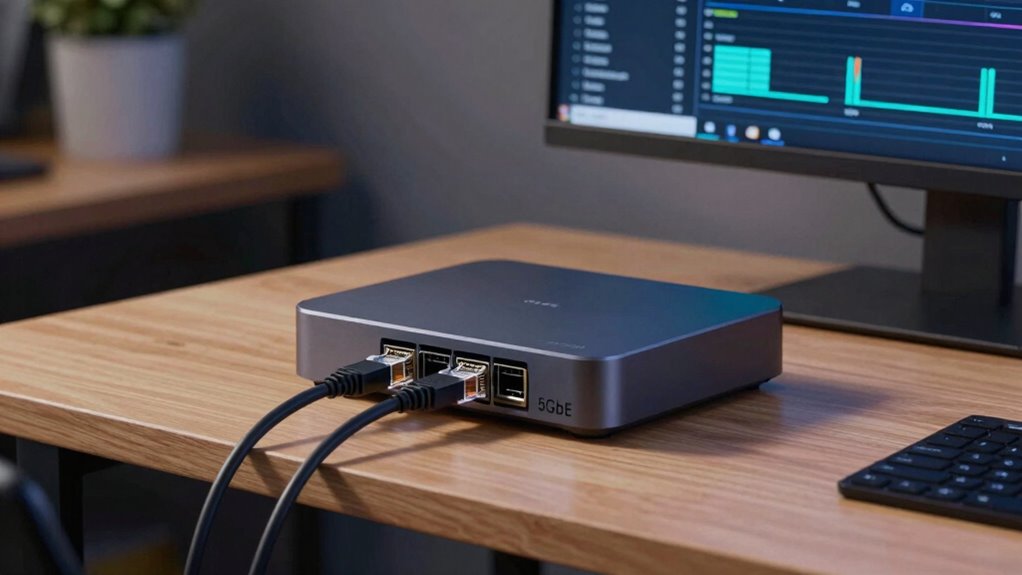
Choosing the right NAS connection depends on several key factors that directly impact your network performance and future scalability. First, consider your current and projected data transfer needs. If you frequently access large files or use cloud storage services, a faster connection like 10GbE may be worth it. Also, think about security; data encryption protocols can affect transfer speeds and should be compatible with your network. Compatibility with your existing hardware is essential to avoid unnecessary upgrades. Additionally, assess your network infrastructure—older switches or cabling might bottleneck higher speeds. Upgrading to higher-speed connections may also require network hardware compatibility to ensure optimal performance. Finally, evaluate whether your network demands could grow, requiring a more scalable connection in the future. All these factors help determine if investing in a faster connection aligns with your storage and security priorities. Considering template compatibility can also ensure your system remains flexible and efficient as your needs evolve.
What Do You Need to Upgrade? Cost, Compatibility, and Hardware Requirements
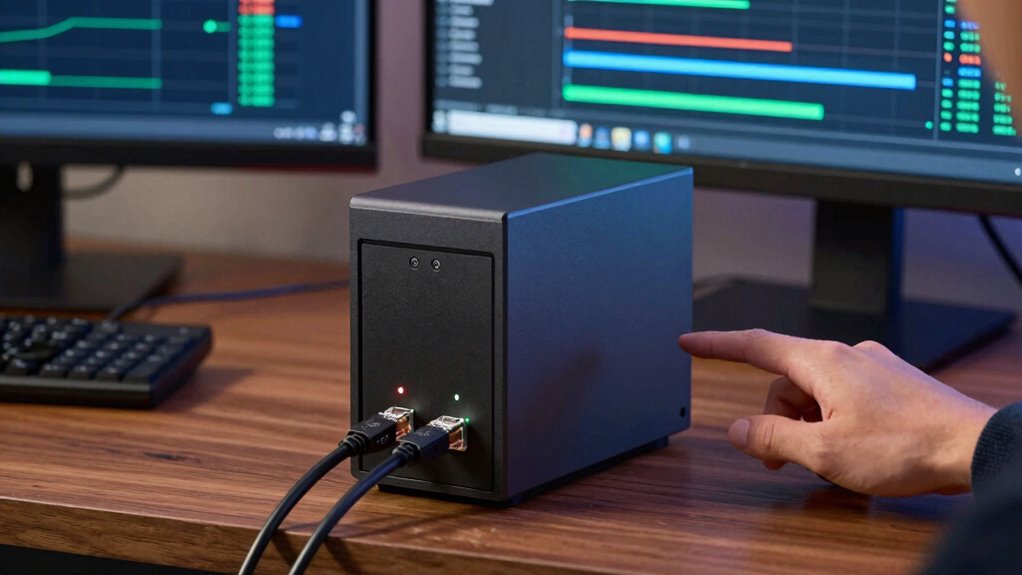
Upgrading your NAS connection requires careful consideration of several practical factors, starting with cost. First, evaluate the upgrade costs for new networking hardware, including switches, network cards, and cables. Second, check hardware compatibility—not all NAS devices or network components support 10GbE, so make sure your existing setup can handle the upgrade. Third, consider the hardware requirements—you might need upgraded network interface cards or additional PCIe slots. Fourth, assess your budget to balance the expense against the benefits of faster speeds. Overall, understanding these factors helps you determine whether the upgrade is worthwhile, avoiding unnecessary expenses or incompatible hardware. Planning ahead ensures you meet your performance needs without overspending.
Real-World Scenarios Where 10GbE Provides a Clear Advantage

10GbE delivers a significant performance boost in scenarios that demand rapid data transfer and high throughput. If you’re working with large files, such as high-resolution videos or extensive backups, 10GbE guarantees faster access to cloud storage and smoother data management. It’s especially beneficial when maintaining data redundancy, as frequent backups reduce downtime and protect against data loss. For businesses with multiple users accessing the NAS simultaneously, 10GbE minimizes bottlenecks, keeping workflows seamless. In environments where quick recovery and real-time collaboration matter, upgrading to 10GbE makes a clear difference. It enables you to handle large data volumes efficiently, improving overall productivity and ensuring your data stays synchronized across all storage points.
Is 5GbE Enough? Signs It’s Time to Switch to Faster NAS Connections
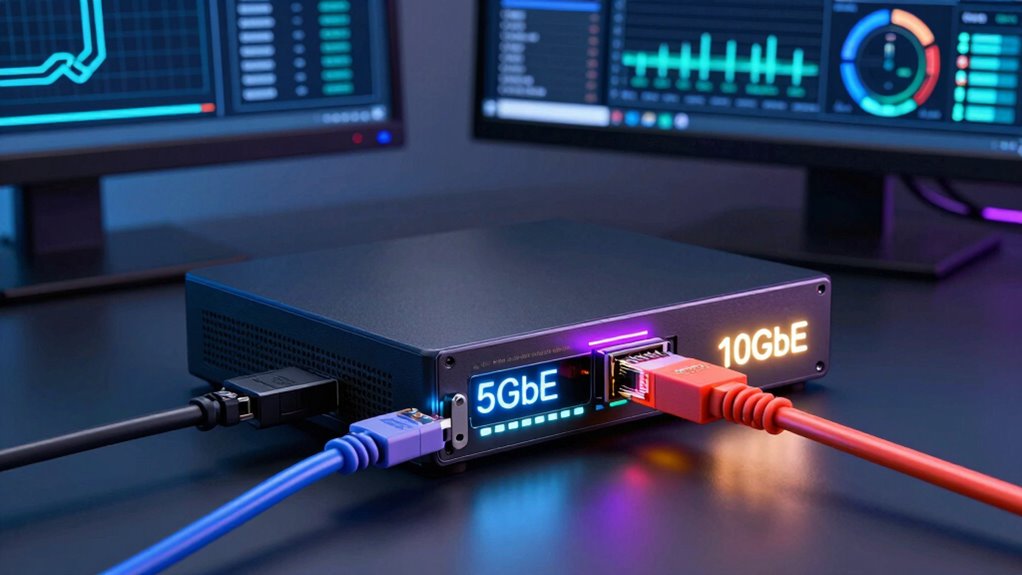
If your data transfer needs are growing or multiple users are accessing the NAS simultaneously, 5GbE might start to slow you down. Performance bottlenecks become noticeable when tasks take longer than expected or files transfer sluggishly. When these signs appear, it’s likely time to contemplate upgrading to a faster connection like 10GbE.
Increasing Data Transfer Needs
As your data needs grow, your current 5GbE connection might start to show its limitations. Large files, frequent backups, and increasing reliance on cloud storage demand faster transfer speeds. If you notice delays when accessing or transferring data, it’s a sign you need an upgrade. Additionally, managing data encryption for security becomes more challenging with slower speeds, risking bottlenecks. Here are some signs it’s time to switch:
- Transfers take too long, disrupting workflow
- Cloud backups become sluggish and unreliable
- Frequent large file sharing hampers productivity
- Data encryption processes slow down, risking data security
Upgrading to 10GbE can help meet these increasing transfer needs, providing smoother, faster access to your expanding data.
Multiple Users Simultaneously
When multiple users access your NAS simultaneously, a slow connection can quickly become a bottleneck, causing frustration and delays. If several team members stream, back up, or edit files at once, 5GbE might struggle to keep up. This can lead to longer wait times and decreased productivity. Upgrading to 10GbE helps manage concurrency more effectively, ensuring smoother workflows. Additionally, faster connections can improve security by reducing the need for workarounds that expose vulnerabilities. Plus, modern 10GbE setups are more energy-efficient, consuming less power during heavy usage. Consider this table:
| Aspect | 5GbE | 10GbE |
|---|---|---|
| Multiple Users | Possible bottlenecks | Handles high concurrency smoothly |
| Security Concerns | Slightly higher risk, slower updates | Enhanced, faster security patches |
| Energy Efficiency | Less efficient under load | More energy-efficient |
| Cost | Lower initial investment | Higher upfront cost |
| Futureproofing | Limited for growth | Ready for expansion |
A faster network connection can also help reduce network congestion, ensuring consistent performance even during peak usage times. Improving bandwidth management and avoiding performance drops are additional benefits of upgrading to a higher-speed network.
Performance Bottlenecks Appear
Even with multiple users accessing your NAS, you might not notice issues until performance slows down noticeably. Signs of bottlenecks include:
- Longer file transfer times, especially with large files or during storage compression.
- Increased latency when accessing data, affecting productivity.
- Reduced backup speeds, hindering data redundancy strategies.
- System sluggishness during simultaneous data reads and writes, indicating bandwidth limits.
If your NAS handles tasks like storage compression or data redundancy regularly, a 5GbE connection may become a bottleneck. As data demands grow, you’ll see the need for faster connections like 10GbE to prevent performance issues and keep workflows smooth. Upgrading ensures your network keeps pace with data-intensive tasks.
Frequently Asked Questions
Can My Existing Network Equipment Support 10GBE Speeds?
Your existing network equipment probably doesn’t support 10GbE speeds unless it explicitly states support for 10GbE or higher. Check your hardware’s specifications for network compatibility, focusing on ports and network cards. You’ll need compatible switches and network interface cards that meet the hardware requirements for 10GbE. If your current equipment lacks these features, an upgrade is necessary to achieve 10GbE performance.
How Much Does Upgrading to 10GBE Typically Cost?
Upgrading to 10GbE can be like investing in a high-performance engine; it’s more costly than sticking with 5GbE. Typically, the cost analysis includes a new network card, switches, and cabling, which might range from a few hundred to over a thousand dollars. You should consider your budget considerations carefully, weighing the benefits of faster data transfer against the initial investment to determine if it’s a worthwhile upgrade.
Will 10GBE Improve Performance for Small File Transfers?
Yes, 10GbE can improve performance for small file transfers, especially if your network experiences congestion. With faster speeds, you’ll notice quicker file transfer times and less waiting, even during busy periods. However, if your network is already optimized or mostly handles larger files, the benefits might be less noticeable. Upgrading makes sense if you want smoother, more efficient data movement and reduced bottlenecks during peak usage.
What Are the Power Consumption Differences Between 5GBE and 10GBE?
Switching from 5GbE to 10GbE increases power consumption slightly, but the difference isn’t huge. You’ll notice a small drop in energy efficiency with 10GbE, which slightly raises environmental impact due to higher power use. If you prioritize energy efficiency and reducing environmental impact, 5GbE is more eco-friendly. However, if faster data transfer speeds are critical, the power increase with 10GbE may be worth it.
Is There a Significant Difference in Latency Between 5GBE and 10GBE?
You’ll find that the latency impact between 5GbE and 10GbE is minimal for most users, so upgrading might not substantially improve response times. However, the higher bandwidth of 10GbE can enhance bandwidth optimization during large data transfers, reducing bottlenecks. If your workflow demands rapid, consistent data access, the 10GbE’s lower latency can be beneficial, but for typical use, the difference remains subtle.
Conclusion
Ultimately, choosing between 5GbE and 10GbE depends on your workflow’s subtle nuances and future aspirations. While 5GbE may suffice for now, a gentle nudge towards 10GbE could elegantly elevate your experience when your data needs become more demanding. Consider your current tasks and growth potential thoughtfully—sometimes, a modest upgrade can quietly open a new domain of efficiency, making your NAS setup feel truly refined and future-ready.
Halloween Picks
halloween
As an affiliate, we earn on qualifying purchases.