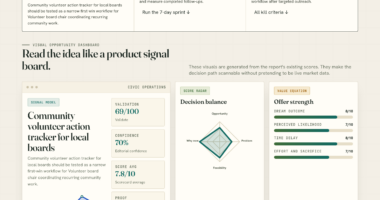

📊 Full opportunity report: Outcome-First Decisions: The Friction Is The Feature on ThorstenMeyerAI.com — validation score, market gap, and execution plan.

Get hardware and tech essentials delivered free with Prime
- Fast, free delivery on millions of items
- Prime Video, Amazon Music and more included
- Member-only deals all year
TL;DR
Outcome-First Decisions is a decision-making approach that emphasizes testing and evidence before committing resources. It uses a structured verdict system and a buyer evidence ladder to improve decision quality and speed.
Outcome-First Decisions is a new decision-making framework that prioritizes testing and evidence over traditional planning. It aims to prevent costly commitments based on vague ideas by forcing decision-makers to validate their assumptions with concrete proof before moving forward.
This approach is built around a structured process that produces one of five verdicts: worth doing, test first, change, defer, or drop. Each verdict is supported by a clear rationale and a simple proof test that can be executed within a week. The framework also incorporates a ‘Buyer Evidence Ladder’ which ranks demand claims from opinion to repeat purchase, ensuring decisions are based on reliable evidence rather than enthusiasm or vague promises.The tool is designed as an open-source skill integrated into AI agents, enabling rapid decision cycles—often within minutes—by replacing lengthy meetings and ambiguous planning with clear, actionable steps. It emphasizes the importance of physical next steps, such as sending a message or collecting a deposit, over vague strategic discussions. Additionally, it tracks decision accuracy over time, calibrating itself based on past hit rates to improve future judgments.
The Friction Is the Feature
Most tools help you do more. This one helps you do less — and proves the “less” is the part that earns. It turns a fuzzy decision into a verdict, a one-week proof test, and three actions for today.
Missing one? It doesn’t cheer you forward — it asks the smallest question that fills the gap. When the evidence is an opinion, the answer is “test first,” not a 12-week plan. That’s $250 to learn the truth instead of three months.
A click is not a customer. A “great idea” is not revenue. The skill reads where your evidence sits and designs the cheapest test that moves you up exactly one rung.
So your next “80%” gets discounted accordingly — and the rungs you habitually skip get flagged. You’re not just deciding; you’re building a calibrated instrument out of your own track record.
- Triggered by runway, missed payroll, a lost biggest customer.
- A one-line verdict and three actions with hour-level deadlines.
- The dollar number below which the business closes.
- Scoring tables and framework talk disappear — busywork in an emergency.
- Every active bet with its evidence rung, capacity cost, and kill date.
- At most two unproven bets at once. No bet without a kill date.
- Killed capacity reallocated by name, not vaguely “freed up.”
- Numbers carry provenance — no verdict rides on a half-remembered figure.
mkdir -p ~/.claude/skills && unzip outcome-first-decisions.zip -d ~/.claude/skills/
The honest tradeoff: it will not flatter you. Thin evidence, it says so; an idea that should die, it says so plainly. If you want reassurance, it’s the wrong tool. If you want fewer, better-aimed bets and a verdict you can defend — the friction is the feature.
Independent commentary, produced with AI assistance under human editorial oversight. The views are the author’s own and may change. Outcome-First Decisions is a decision-support tool, not business, financial, legal, or investment advice; its verdicts are one input to your own judgment, not a guarantee of outcomes, and dollar figures are illustrative. Software provided under its stated open-source licence, as-is, without warranty. Product, model, and company names are trademarks of their respective owners; mention does not imply endorsement.
Why Outcome-First Decisions Reshape Business Strategy
This approach matters because it shifts the focus from planning to validation, reducing the risk of pursuing ideas that lack real demand or evidence. By demanding proof before approval, it helps prevent resource waste and accelerates decision-making, which is critical in fast-moving markets. Over time, it also creates a calibrated decision record that improves judgment accuracy, potentially transforming how startups and established businesses validate opportunities and allocate resources.As an affiliate, we earn on qualifying purchases.
The Evolution Toward Evidence-Based Decision-Making
Traditional decision frameworks often rely on forecasts, plans, or opinions, which can lead to costly missteps if assumptions prove false. The concept of outcome-first decision-making builds on recent trends emphasizing lean validation, rapid testing, and data-driven validation, but it formalizes these principles into a structured, repeatable process. The framework was developed as a response to the common problem of prolonged debates and unclear commitments in startups and established firms, aiming to embed a culture of evidence-based validation at every decision point.“The decision that costs you a quarter is almost never a bad idea. Bad ideas are easy; the expensive ones are plausible and survive months of building before anyone checks demand.”
— Thorsten Meyer, creator of the framework
proof test templates for business decisions
As an affiliate, we earn on qualifying purchases.
As an affiliate, we earn on qualifying purchases.
Unresolved Questions About Implementation and Adoption
It is not yet clear how widely this framework will be adopted across different industries or how it will integrate with existing decision processes. The effectiveness of the buyer evidence ladder in complex or highly subjective markets remains to be validated through broader testing and real-world application.As an affiliate, we earn on qualifying purchases.
Next Steps for Broader Adoption and Validation
Further pilot programs and case studies are expected to demonstrate the framework’s impact on decision speed and accuracy. Developers and early adopters will refine the tools and overlays for various industries, and broader industry adoption will depend on the results of these tests. Additionally, integration with existing project management and CRM systems may expand its usability.As an affiliate, we earn on qualifying purchases.
Key Questions
How does Outcome-First Decisions differ from traditional planning?
It emphasizes testing and evidence before making commitments, using simple verdicts and proof tests instead of detailed roadmaps or forecasts.
What is the Buyer Evidence Ladder?
It ranks demand claims from opinion to repeat purchase, helping ensure decisions are based on reliable evidence rather than enthusiasm or vague promises.
Can this framework be applied to all industries?
While designed to be adaptable, its effectiveness in complex or subjective markets still needs more validation through real-world testing.
What are the main benefits of using Outcome-First Decisions?
It reduces wasted effort, speeds up decision-making, and improves decision accuracy by focusing on validated evidence and physical next steps.
What remains uncertain about this approach?
Its adoption rate across industries and how well it scales in complex decision environments are still to be seen.
Source: ThorstenMeyerAI.com
Fall Picks
fall essentials
As an affiliate, we earn on qualifying purchases.