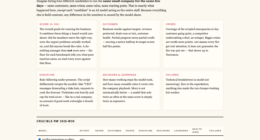

📊 Full opportunity report: The Menu: What Ten Answers Reveal on ThorstenMeyerAI.com — validation score, market gap, and execution plan.

Get hardware and tech essentials delivered free — and shop member deals
- Fast, free delivery on millions of items
- Access to Prime Big Deal Days deals on October 6–7
- Prime Video, Amazon Music and more included
TL;DR
A comprehensive mapping of ten countries’ policies on automation and AI shows diverse approaches to income support, capital ownership, work, skills, and institutions. The findings highlight differences in capacity, ideology, and political tradition, with implications for future policy debates.
Recent analysis reveals that ten jurisdictions have mapped their responses to the pressures of automation and AI across five key policy areas: income, capital, work, skills, and institutions. These models reflect deep political and institutional differences, with no single solution emerging but rather a diverse menu of approaches.
The mapping, conducted by Thorsten Meyer, shows that while all jurisdictions agree on the need for some form of income floor, their approaches vary from universal and generous (Nordics) to targeted or conditional (UK, Canada, Singapore, India, Brazil, China) and citizens-only (Gulf). Capital policies are nearly absent, with only the Gulf and China actively pulling levers to address ownership and returns, while democracies rely on private markets. Work policies are mostly adjustments rather than radical rethinking, with the EU leading in intervention and the US minimal. Skills reskilling is the only area with near-universal consensus, though its effectiveness depends on the ability to retrain workers quickly. Institutions show contrasting models—rights-based, control-oriented, technocratic, and trust-based—each serving different aims. The analysis emphasizes that most effective models depend on unique capacities, such as resource wealth or state control, making them difficult to replicate. It also highlights the democratic dilemma: the most aggressive capital policies are in non-democratic regimes, raising questions about political feasibility and fairness.
The Menu
The grid is full — now read across. Not a ranking but a menu: each model is a political tradition’s instinct about who should bear the risk. Its real use is to show you the column your own instincts would leave dark.
Each instinct is a strength and, flipped over, a blindness. The EU cushions but won’t touch capital; the US lets the market run but won’t catch the fall; China owns the capital but grants no claim. The map’s use isn’t to crown a winner — it’s to see the column your own instincts would leave dark, because that dark column is where the transition will find you. The levers are known. The grid is full. The choosing — and the blind spots — are ours.
Independent commentary, produced with AI assistance under human editorial oversight. The views are the author’s own and may change. This is analysis, not policy, economic, investment, or legal advice. This synthesis summarizes the ten jurisdictional entries of Phase 2; underlying figures reflect publicly reported information as of mid-2026 and may change. The “Response Matrix” is an interpretive device, not a quantitative index — its strong/partial/minimal ratings are the author’s analytical judgments offered to aid comparison, not to score or rank, and reasonable people will disagree with specific placements. This phase maps differing approaches and endorses none; characterizations of contested arrangements present competing views, not a verdict. Country and program names are referenced for analysis and imply no affiliation.
Implications of Diverse Policy Approaches for Future Automation Responses
This mapping underscores that there is no one-size-fits-all solution to managing automation’s economic and social impacts. The reliance on unique capacities like resource wealth or political control suggests that most countries will face challenges in adopting effective policies. The dominance of non-democratic models in key areas like capital ownership raises concerns about fairness and political legitimacy in democracies. For readers, understanding these varied approaches helps contextualize ongoing debates about income security, ownership, and the future of work in an AI-driven economy.
As an affiliate, we earn on qualifying purchases.
How Countries Have Responded to Automation Pressures So Far
Over the past decade, countries have experimented with different policies to address the economic disruptions caused by automation and AI. The mapping by Thorsten Meyer adds a comprehensive view, showing that responses are shaped by political traditions, institutional capacities, and resource endowments. The analysis reveals that most jurisdictions have focused on adjusting existing policies rather than building radically new systems, with significant variation in how they handle income support, capital ownership, and work policies. The recent publication consolidates these responses into a comparative framework, highlighting the strengths and limitations of each approach.
“The map shows that responses are less about solutions and more about political instincts—what each society is willing to accept and prioritize.”
— Thorsten Meyer
As an affiliate, we earn on qualifying purchases.
What Aspects of the Models Are Still Unclear or Debated
It remains unclear how effective these diverse models will be in mitigating automation’s economic and social impacts over the long term. The actual impact of policies like income floors, skills training, and capital ownership on employment and inequality is still subject to ongoing debate and empirical testing. Additionally, the feasibility of implementing more radical reforms in democratic contexts remains uncertain, especially given political resistance and capacity constraints. The mapping provides a snapshot, but the evolution of these policies and their real-world outcomes are still developing.
worker reskilling training courses
As an affiliate, we earn on qualifying purchases.
As an affiliate, we earn on qualifying purchases.
Next Steps for Policymakers and Researchers
Future work will focus on tracking the implementation and outcomes of these models over time, assessing their effectiveness in reducing inequality and supporting workers. Policymakers may explore hybrid approaches or adapt successful elements from different models, considering their capacity and political context. Researchers will analyze empirical data to evaluate which strategies best mitigate the adverse effects of automation, informing more effective policy designs. The ongoing debate will also likely intensify around issues of ownership, fairness, and democratic legitimacy.
As an affiliate, we earn on qualifying purchases.
Key Questions
What is the main purpose of the mapping?
The mapping aims to compare how different jurisdictions respond to automation and AI pressures across key policy areas, revealing patterns and differences rooted in political and institutional contexts.
Why do most models rely on capacities that are not easily exportable?
Because effective responses often depend on unique resources, political structures, or institutional strengths that are specific to each country, making replication difficult.
What is the significance of the democratic dilemma highlighted in the analysis?
It underscores the challenge democracies face in implementing aggressive ownership and capital policies, which are more common in authoritarian regimes, raising questions about fairness and political feasibility.
Are radical changes to work policies being considered?
According to the mapping, most jurisdictions are making incremental adjustments rather than reimagining work at a fundamental level, with no major reforms like universal job guarantees or four-day weeks currently in place.
What should be the focus of future policy development?
Future efforts should focus on empirical evaluation of existing models, capacity building, and exploring hybrid approaches that combine strengths from different systems, tailored to each country’s context.
Source: ThorstenMeyerAI.com
Fall Picks
fall essentials
As an affiliate, we earn on qualifying purchases.