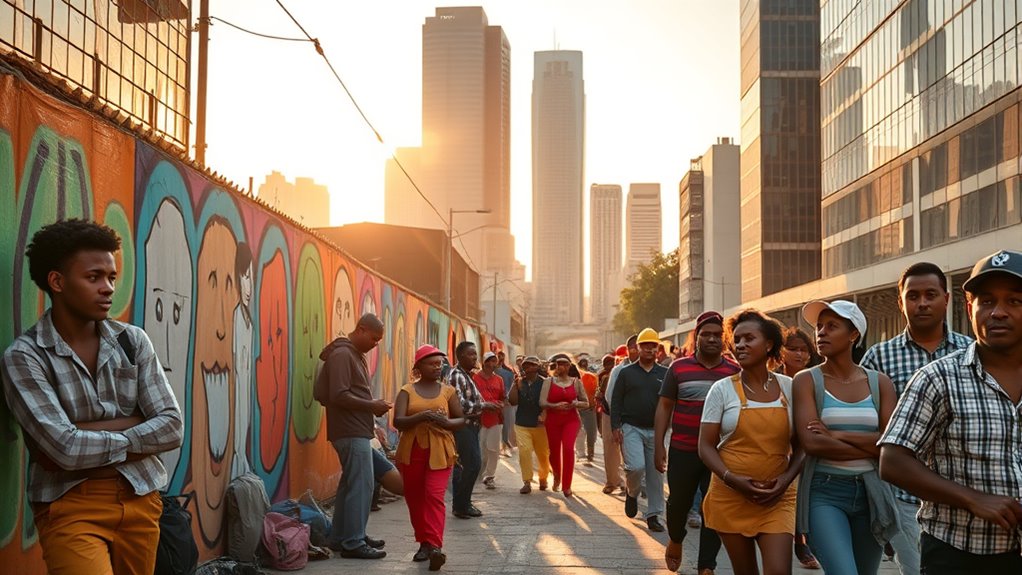

Imagine a world where factories hum less, robots take over more, and your worth isn’t tied to a paycheck. As automation reshapes jobs, the Post-Labor Movement challenges you to rethink what human rights really mean beyond employment. This shift could redefine societal values, but how far are we willing to go to guarantee dignity and security for everyone? The answer might change everything.
Key Takeaways
- Post-labor shifts focus from job-based rights to ensuring basic human needs and dignity regardless of employment status.
- Universal Basic Income (UBI) serves as a foundation for economic security beyond traditional work.
- Automation and AI accelerate job displacement, making post-labor policies essential for societal stability.
- Redefining human rights in the post-labor era emphasizes value and dignity independent of work.
- The movement advocates adapting policies to protect human rights in an evolving, automation-driven economy.

The Post-Labor Movement marks a significant shift in how societies approach work, workers, and economic priorities after the decline of traditional labor unions and industrial activism. Instead of focusing solely on job preservation or collective bargaining, this movement emphasizes redefining human rights in a context where work isn’t the only measure of worth or security. Central to this shift is the idea of Universal Basic Income (UBI), which proposes providing everyone with a regular, no-strings-attached financial stipend. UBI challenges the traditional notion that employment is the primary way to secure economic stability, especially as the Automation Impact accelerates. With machines and AI increasingly capable of performing tasks once done by humans, many fear job losses and economic insecurity. The Post-Labor Movement recognizes that, in this new landscape, safeguarding human dignity requires more than just protecting jobs—it demands ensuring everyone’s basic needs are met regardless of employment status. As society adapts, the discussion around Automation Impact becomes crucial in shaping policies that uphold human rights in an evolving economy.
Conclusion
You see, the Post-Labor Movement is about more than just work. It’s about redefining your worth, securing your dignity, and shaping a society where everyone’s needs are met, regardless of employment. It’s about valuing human life beyond jobs, beyond productivity, beyond survival. It’s about embracing equality, autonomy, and respect. It’s about creating a future where your rights aren’t tied to your labor, but rooted in your inherent humanity. And in that, you find true human rights.