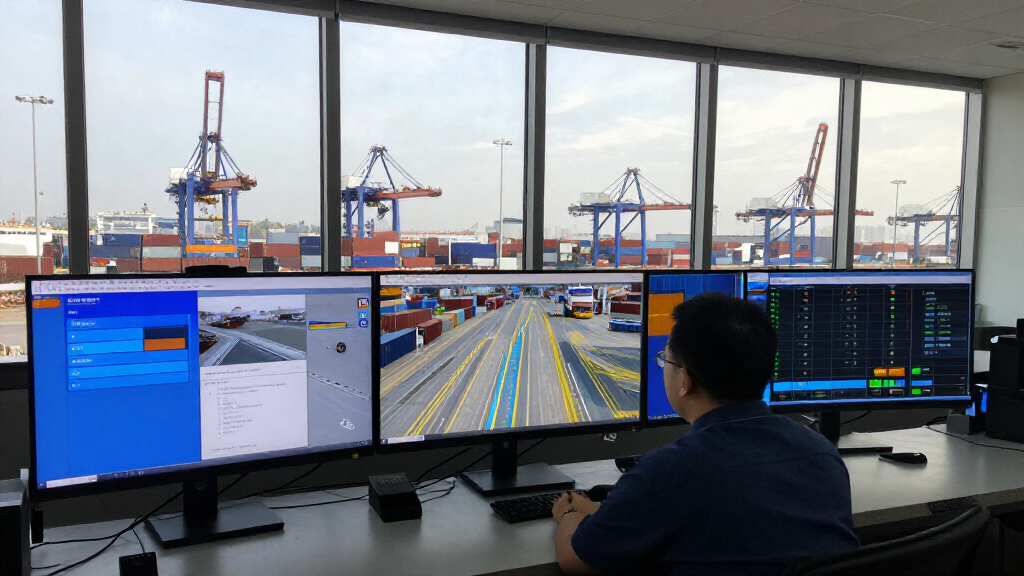

🔍 Read the full analysis: Container Ports Are Becoming AI-Driven on ThorstenMeyerAI.com

Get hardware and tech essentials delivered free with Prime
- Fast, free delivery on millions of items
- Prime Video, Amazon Music and more included
- Member-only deals all year
TL;DR
Container ports are increasingly using AI alongside cranes, automated vehicles and digital systems to manage cargo and terminal operations. The shift extends a history of mechanization that cut handling costs but reshaped dock work; available evidence does not show that automated terminals are always faster, and labor and safety effects remain contested.
Container ports are adding AI-driven systems to the cranes, vehicles and software that move cargo, extending a mechanization process that began with the shipping container in the 1950s. The development could change how terminals schedule equipment and handle containers, but the historical record and a 2024 US government report caution against assuming that automation always makes port operations faster or eliminates disruption.
The underlying change is from moving individual pieces of freight to handling standardized containers as units, with digital systems increasingly coordinating the work. The source account, published by Thorsten Meyer on November 23, 2026, presents AI-driven port operations as a current development but does not identify a specific port, AI product, installation date or measured performance result. The extent and results of AI adoption therefore cannot be established from the account alone.
The container’s earlier effect is documented in the account. On April 26, 1956, a crane in Newark loaded 58 truck bodies onto the Ideal X; the ship reached Houston five days later. Historian Marc Levinson’s figures, as cited in the account, put 1956 handling costs at $5.83 per ton for loose cargo and 15.8 cents per ton for the Ideal X. The account calculates that difference as roughly 36 times cheaper, while noting that containers depended on a wider system of ships, trucks, cranes and compatible terminals.
That productivity shift also changed port employment and labor relations. The account says the Port of New York and New Jersey had more than 35,000 longshoremen in the early 1960s and about 3,500 in 2013, citing the Waterfront Commission. On the US West Coast, a 1960 agreement between the dockworkers’ union and employers allowed mechanization while providing a fund, income protections and other benefits for registered workers. More recently, East and Gulf Coast dockers struck in 2024 over wages and automation, according to the account.
Infographic 01 · Before the box
Why the port cost more than the ocean
Before the container, every sack and crate was handled one by one. The port, not the sea, was the expensive part of a trip.
One truckload of medicine, Chicago → Nancy (France) · estimate ca. 1960 · total $2,386
Cost of loading one ton · 1956
Roughly 36 times cheaper to load (5.83 ÷ 0.158, our calculation). The loading figures are from Levinson’s own article; other authors cite them to The Box, 1st ed. (2006), p. 52.
Sources: M. Levinson, The Box, 2nd ed. (Princeton UP, 2016), ch. 1, Table 1, p. 12 (American Association of Port Authorities data); M. Levinson, The Box That Shrank the World, Works That Work No. 2.
Powered by Thorsten Meyer AI
Automation Reshapes Port Work
Port operations affect the movement and cost of goods well beyond the waterfront. The container system showed how changing cargo handling could reduce time and expense across shipping networks. AI tools may add another layer by helping operators coordinate cranes, vehicles, storage space and vessel schedules, although the source material supplies no quantified results for those uses.
The distribution of benefits is also at stake. Earlier mechanization lowered handling costs while sharply reducing the number of workers needed for particular tasks. Labor agreements shaped who received protections and compensation. Current arguments over automation are therefore not only about equipment: they involve job security, wages, working conditions and who captures productivity gains.
Claims about efficiency need care. A 2024 US government report cited in the account found denser stacking at some automated terminals, but also slower moves and more breakdowns at some sites. Those findings do not establish that all automated ports perform poorly; they do show why adoption counts alone cannot prove that AI or automation improves throughput.
Products Worth Considering

Logitech MX Brio Ultra HD 4K Webcam for Streaming and Collaboration

DJI Mini 3 Drone with DJI RC Controller

Samsung 32 Odyssey G5 QHD Gaming Monitor
As an affiliate, we earn on qualifying purchases.
From Cargo Boxes to Algorithms
Before standardized containers, ports handled break-bulk cargo: sacks, barrels and crates moved individually between transport and ship holds. The account describes a 1954 voyage from Brooklyn to Bremerhaven involving 194,582 separate items. Around 1960, a cost estimate for moving a truckload of medicine from Chicago to France put port charges at $1,163 of a $2,386 total, or 48.7 percent, citing Levinson’s book The Box.
Containerization did not begin with AI, and Malcom McLean did not invent the cargo box itself. As the Port Authority of New York and New Jersey notes, metal cargo boxes had been used earlier. McLean’s contribution was a system for transferring a container between truck and ship without opening it. The account cautions that the familiar story that McLean conceived the idea while waiting at a pier is not supported by a record from the time.
The labor history is relevant to the current debate. The account describes how the 1960 West Coast agreement exchanged relaxed work rules for protections for registered dockworkers, while eligibility did not extend equally to every worker. In 2024, East and Gulf Coast dockers again made automation a bargaining issue alongside wages. AI adoption is entering an industry where technology and labor terms have long been negotiated together.
““epochal in the annals of industrial relations””
— The Bureau of Labor Statistics, describing the 1960 West Coast mechanization agreement
AI Results Remain Unmeasured
The source account does not name which ports have adopted AI systems, describe the systems’ capabilities, or provide dates, deployment figures or performance data. It is therefore unclear how widespread the shift is or whether AI is being used mainly for scheduling, equipment control, predictive maintenance or other tasks. Those applications should not be treated as confirmed details of a particular installation.
The cited 2024 government report concerns automated terminals generally; the account does not say that it measured AI specifically. Its findings on denser stacking, slower moves and breakdowns at some terminals cannot be generalized to every port or technology. The source also does not quantify how current AI deployments affect employment, safety, costs or cargo delays.
Watch Operations and Labor Talks
The next useful evidence will come from port authorities and terminal operators describing where AI systems are in use and publishing comparable results on cargo throughput, equipment downtime, costs and safety. Without a named deployment and a clear baseline, claims that AI has made a port faster or more efficient remain difficult to verify.
Labor negotiations will also help show how the technology is changing work. The account records a long history of unions bargaining over mechanization and notes the 2024 East and Gulf Coast strike over wages and automation. It does not identify a future contract deadline or a specific next decision. For now, the development is ongoing, with operational outcomes and workforce effects still to be established.
Key Questions
What does AI-driven port operation mean?
It refers broadly to using AI within port operations, potentially alongside automated cranes, vehicles and management software. The source account does not specify a particular system or port deployment.
Does automation always make ports faster?
No. The account cites a 2024 US government report that found denser stacking but slower moves and more breakdowns at some automated terminals. The findings do not describe every terminal.
How did containers change cargo handling?
Containers let cargo move as standardized units between ships and trucks without being unpacked and handled piece by piece at each transfer. The account cites a large difference between break-bulk and Ideal X handling costs in 1956.
What is known about AI’s effects on port jobs?
The source describes earlier reductions in dockworker numbers following mechanization and reports that automation was a subject of the 2024 East and Gulf Coast strike. It provides no specific estimate of jobs affected by current AI systems.
Source: ThorstenMeyerAI.com