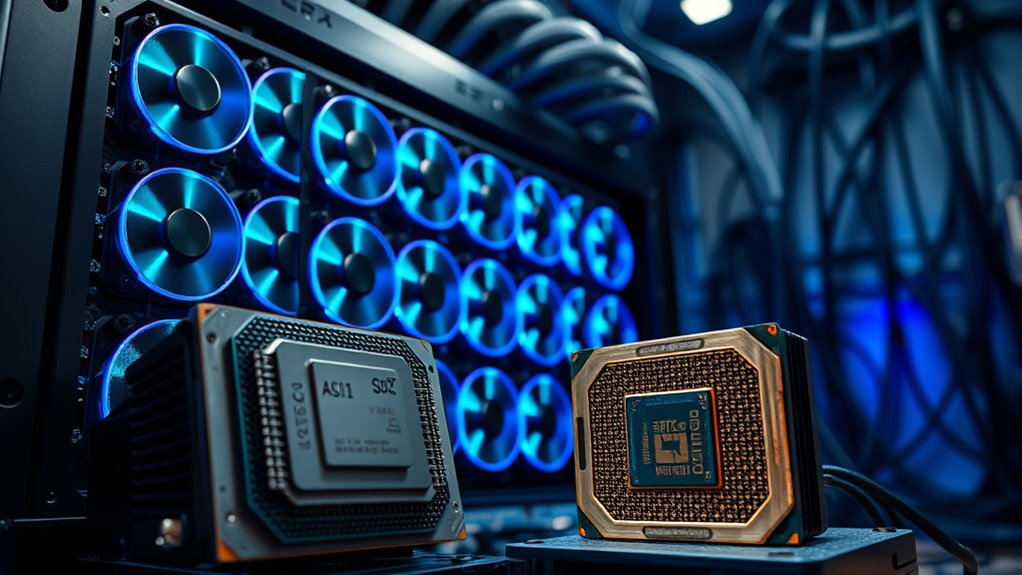

You discover that crypto mining started with CPUs, making it accessible for many. As competition grew, miners shifted to GPUs for higher processing power, which increased energy costs. The arrival of ASICs brought a full leap in efficiency, designed specifically for mining tasks. These specialized devices outperform earlier hardware but quickly become outdated, prompting ongoing upgrades. If you want to understand how this hardware evolution impacts mining today, keep exploring the key developments that shaped the industry.
Key Takeaways
- Mining began with CPUs, offering easy access but limited efficiency as difficulty increased.
- GPUs replaced CPUs, providing higher hash rates but significantly increasing energy consumption.
- ASICs emerged, delivering superior performance and energy efficiency, but quickly became obsolete with new models.
- Industry shifted toward purpose-built hardware, requiring ongoing upgrades and fueling rapid technological advancement.
- The evolution emphasizes increased specialization, efficiency, and environmental concerns due to rising energy demands.
The evolution of crypto mining hardware has dramatically transformed how enthusiasts and professionals participate in blockchain networks. In the early days, you could mine cryptocurrencies like Bitcoin using just your CPU. It was accessible, straightforward, and required minimal investment. However, as more people joined the network, the difficulty of mining increased, and so did the need for more efficient hardware. Back then, energy consumption was manageable because CPUs didn’t consume vast amounts of power, but that changed quickly. As mining became more competitive, the push for specialized hardware emerged to maximize hash rates while trying to keep energy costs under control.
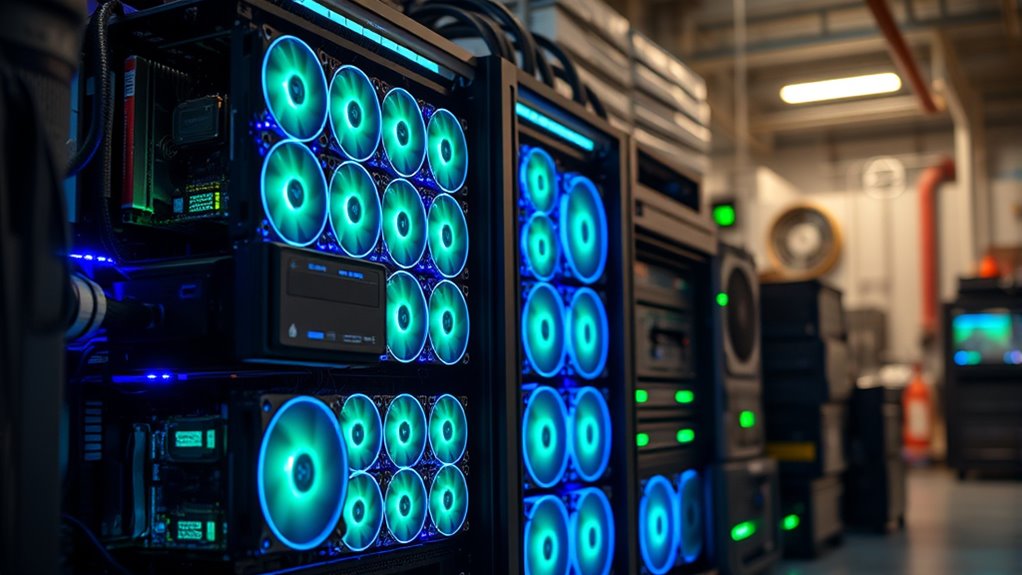
Crypto mining started simple with CPUs, but quickly evolved into specialized hardware to handle increasing difficulty.
Soon, GPUs took over because they offered a significant boost in processing power compared to CPUs. This shift allowed you to mine more efficiently, but it also meant higher energy consumption. GPUs are power-hungry components, and as their use became widespread, energy costs skyrocketed for many miners. This increased energy consumption became a major concern, especially for those operating large-scale mining farms. The environmental impact and operational costs prompted some to seek hardware that delivers higher performance with lower energy demands. Unfortunately, the rapid pace of innovation meant that GPUs, too, quickly became outdated as newer technologies emerged.
The relentless march of hardware obsolescence pushed the industry toward even more specialized solutions. Enter Application-Specific Integrated Circuits, or ASICs. These chips are designed explicitly for mining and outperform GPUs and CPUs by a wide margin. When you switch to ASICs, you notice a dramatic improvement in hashing power and energy efficiency. However, the flip side is that ASICs are highly specialized; they’re not versatile like CPUs or GPUs. This specialization means that when a new, more efficient ASIC comes out, your old hardware quickly loses relevance. This rapid obsolescence is a double-edged sword—it boosts mining profitability but also forces you to frequently upgrade your equipment to stay competitive.
The shift from CPU to ASIC reflects how the industry’s focus moved from general-purpose hardware to highly optimized, purpose-built devices. While ASICs enhance mining performance and reduce the energy consumption per unit of work, they also contribute to hardware obsolescence. As new models are released, older ASICs become less profitable or entirely unviable, pushing miners to invest continuously. This cycle underscores the ongoing challenge for miners: balancing the need for cutting-edge hardware that maximizes efficiency against the costs and environmental impacts of constantly replacing outdated equipment. Ultimately, this evolution underscores how technological innovation continually reshapes the landscape of crypto mining, making it more efficient but also more demanding in terms of energy and hardware management. Recognizing the importance of community resilience and sustainable practices is crucial as the industry advances.
Frequently Asked Questions
How Does Energy Consumption Compare Across Different Mining Hardware Types?
You’ll find that energy efficiency varies greatly across mining hardware types. CPUs consume more power relative to their output, making them less efficient. GPUs improve on this, offering better power consumption ratios. However, ASICs are the most energy-efficient, designed specifically for mining, which drastically reduces power consumption per hash. Overall, as hardware evolved, power consumption decreased while efficiency increased, helping miners save on energy costs and reduce environmental impact.
What Are the Environmental Impacts of Crypto Mining Hardware Evolution?
Think of crypto mining hardware evolution as a double-edged sword—you gain efficiency but also increase environmental strain. You might notice that newer hardware demands more energy, stressing sustainable energy solutions. This shift also leads to electronic waste management challenges, as outdated equipment becomes obsolete. To minimize harm, you should support greener tech innovations and proper disposal practices, ensuring the crypto industry advances responsibly without sacrificing our planet’s future.
How Do Hardware Costs Influence Mining Profitability?
Your hardware investment directly impacts mining profitability because higher costs mean you need more time and earnings to break even. Market volatility can make it tougher to predict returns, so if hardware prices rise sharply, your profits may shrink or vanish. Staying updated on hardware costs helps you plan better, manage risks, and optimize your mining strategy amidst fluctuating market conditions.
What Future Developments Are Expected in Mining Hardware Technology?
They say, “The only constant is change,” and future mining hardware will prove it. You can expect quantum computing breakthroughs to revolutionize mining speed and efficiency, while hardware diversification guarantees resilience against market shifts. These innovations may lead to more sustainable and powerful mining setups, pushing the industry forward. Staying adaptable and informed will help you capitalize on these emerging technologies and maintain a competitive edge in the evolving landscape.
How Does Hardware Obsolescence Affect the Crypto Mining Ecosystem?
Hardware obsolescence impacts the crypto mining ecosystem by shortening mining hardware lifespan, leading to increased electronic waste. You can help by participating in hardware recycling programs, guaranteeing outdated equipment is properly disposed of or repurposed. As mining hardware becomes obsolete faster, it pressures miners to upgrade more frequently, which can raise costs and environmental concerns. Supporting sustainable practices ensures the ecosystem remains more resilient and eco-friendly.
Conclusion
As you see, crypto mining hardware has come a long way, from basic CPUs to powerful ASICs. Imagine you started mining with your old PC, only to find it wasn’t enough anymore. Upgrading to an ASIC, like a miner in China did in 2019, markedly boosted their profits. This evolution shows how technology keeps pushing boundaries, making mining more efficient and competitive. So, staying updated can turn your hobby into a lucrative venture.