
📊 Full opportunity report: Planning Consent Management For Youth-Service Providers on IdeaNavigator AI — validation score, market gap, and execution plan.

Get hardware and tech essentials delivered free with Prime
- Fast, free delivery on millions of items
- Prime Video, Amazon Music and more included
- Member-only deals all year
TL;DR
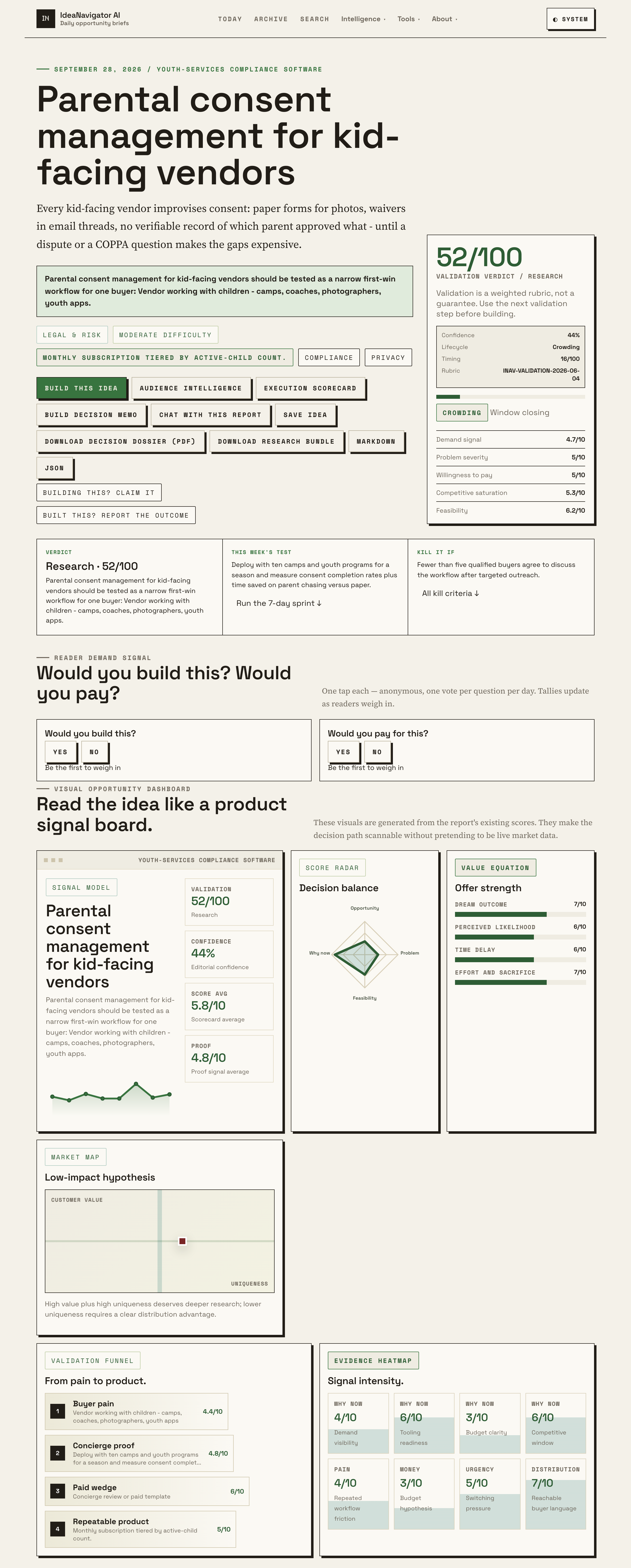
A proposal for youth-service providers would replace scattered paper forms and email waivers with vendor-branded mobile consent flows and per-child records. It suggests testing the idea with ten camps and youth programs, but no pilot, product launch or measured results are reported.
IdeaNavigator AI has proposed a parental consent management service for camps, coaches, photographers and youth apps, aiming to replace improvised forms and email records with phone-based approvals. The proposal also recommends testing the service with ten camps and youth programs; it does not report that a product or pilot has launched.
The proposed service would let each vendor offer parents a branded consent flow that works on a phone. The listed consent categories include photo use, data collection, medical information and liability. The proposal describes identity checks calibrated to the risk level, a consent ledger for each child, expiry tracking and an audit export.
The problem identified is that providers may collect permission through paper forms, email waivers or other separate processes, leaving them without a readily verifiable record of which parent approved which use. The proposal says those gaps can become costly during a dispute or a question about compliance; it provides no examples, case counts or cost estimates.
For validation, IdeaNavigator AI suggests deploying the service with ten camps and youth programs for a season, then measuring consent completion rates and the time staff spend chasing parents compared with paper-based processes. Its proposed revenue model is a monthly subscription tiered by active-child count. Pricing, technical requirements and pilot participants are not specified.
Consent Records Across Youth Programs
If providers adopt a shared digital process, staff could have a clearer record of who gave permission, for which child and for what purpose. Expiry tracking and audit exports could also make it easier to review permissions when programs change activities or need to answer a parent’s question. Those are intended benefits in the proposal; no evidence yet shows how well the suggested system would work in practice.
The proposal connects the opportunity to children’s privacy rules and parental scrutiny of photo and data use. It refers broadly to COPPA updates and state laws but does not identify particular provisions or explain which providers would be covered. The compliance impact would depend on the provider, the information collected and the applicable rules. A digital ledger could support recordkeeping, but the proposal does not establish that it would by itself satisfy legal requirements.
For small organizations, the test is practical as well as legal: whether parents complete forms more reliably and staff spend less time following up. A seasonal pilot could supply those measures, while also showing whether providers can afford the service and whether parents trust its identity checks.
From Paper Forms to Digital Ledgers
The idea is framed for a narrow customer group: businesses and programs that work directly with children, including camps, coaches, photographers and youth apps. Their permission needs can differ. A photo release, a medical disclosure and a liability waiver involve different information and risks, which is why the proposal calls for identity verification suited to each risk tier.
The recommendation is to begin with a focused workflow for one buyer type rather than establish a broad compliance platform at the outset. It then proposes a seasonal test across ten camps and youth programs. The material does not give a timeline, selection criteria or a report of earlier trials. Its references to expanding enforcement and increasing parental challenges are presented as reasons to explore the market, without supporting figures or named regulatory actions.
Pilot, Rules and Safeguards
No product launch, pilot or measured outcome is confirmed in the available proposal. It is not clear whether any youth-service providers have agreed to take part, when a test might begin or what results would count as success.
The proposal also leaves open how identity would be verified, how sensitive medical information would be protected, how consent could be withdrawn and how records would be retained or deleted. It does not specify pricing, integrations or the legal review needed to tailor forms to different jurisdictions and activities. The cited privacy developments are not detailed enough to establish which specific duties apply to each type of vendor.
A Seasonal Test Would Measure Uptake
The next step proposed is to recruit ten camps and youth programs for a seasonal deployment. The test would compare completion rates and staff follow-up time against paper processes. No start date, product availability or enrollment details have been announced.
Any results would need to show not only whether parents complete the forms, but whether providers can keep accurate, accessible records across consent types and changing permissions. Until a pilot is reported, the service’s usability, cost and compliance value remain untested.
Source: IdeaNavigator AI
Key Questions
Has a parental consent platform launched?
No launch is reported. The material describes a proposed service and a suggested pilot.
Who is the proposed service for?
It targets vendors working with children, including camps, coaches, photographers and youth apps.
What would parents be asked to approve?
The proposed flows cover photo use, data collection, medical information and liability. The exact forms would depend on the provider and activity.
How would the proposal be tested?
It recommends a seasonal deployment with ten camps and youth programs, measuring consent completion and staff time spent following up compared with paper forms.
Would the service guarantee legal compliance?
The proposal does not make that determination. Applicable requirements can vary by provider, information and jurisdiction, and no legal assessment of the proposed service is reported.
Source: IdeaNavigator AI
Halloween Picks
halloween
As an affiliate, we earn on qualifying purchases.