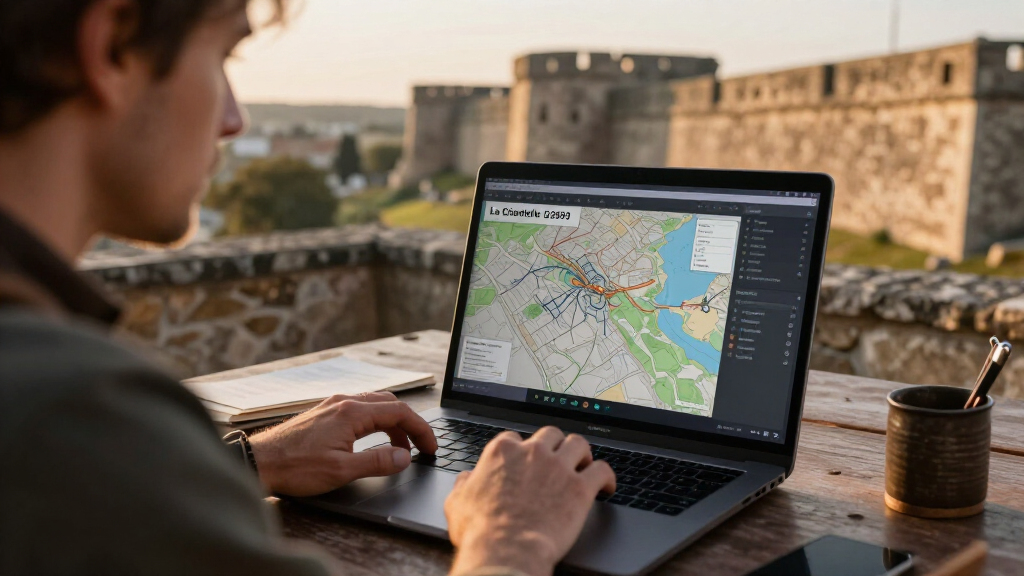

🔍 Read the full analysis: Revolutionizing Historical Archives: La Citadelle Siege Of 1693 Through AI on ThorstenMeyerAI.com

Get hardware and tech essentials delivered free with Prime
- Fast, free delivery on millions of items
- Prime Video, Amazon Music and more included
- Member-only deals all year
TL;DR
An AI-powered interactive digital exhibition has been launched, vividly reconstructing the 1693 siege of La Citadelle. It uses layered SVGs, CSS, and canvas to create a cinematic, explorable experience, marking a breakthrough in digital historical archives.
An AI-generated interactive exhibition now vividly reconstructs the 1693 siege of La Citadelle, offering a cinematic, explorable experience that balances historical fidelity with artistic storytelling. The project, developed by Thorsten Meyer AI, leverages layered SVGs, CSS, and canvas elements to create a dynamic digital monument, marking a significant advancement in how digital historical archives are preserved and accessed.
The exhibition, titled La Citadelle — An Anatomy of Siege, 1693, is hosted on a dedicated website that employs a sophisticated, scroll-driven interactive diagram to simulate the terrain and military movements of the historic siege. This visualization is built entirely through code—using no embedded images—relying instead on layered SVGs, CSS effects, and canvas animations to produce a cinematic experience that responds seamlessly to user interactions.
Developed through a three-stage AI-guided workflow, the project begins with detailed construction of the digital terrain and siege elements, followed by iterative critique and refinement driven by AI analysis of visual coherence and historical plausibility. Final approval is granted by an art director, ensuring the exhibit maintains educational integrity while delivering aesthetic appeal. The site’s design employs a restrained color palette inspired by archival materials, with fonts that emphasize monumentality and clarity, creating an atmosphere of gravitas.
Key features include animated earthworks, artillery trajectories with smoke puffs, and a breach formation, all synchronized to simulate the progression of the siege across days. The signature interaction involves a multi-layered SVG siege map, where each layer—grid, fortress, trenches, and trajectories—is animated through JavaScript functions, delivering a real-time, cinematic narrative of the event. The entire project is hosted as a single-page site, optimized for multiple device sizes, and built without external frameworks or image assets, ensuring scalability and fidelity.
Transforming Historical Education Through AI
This innovative digital reconstruction exemplifies how AI and web technologies can revolutionize the preservation and presentation of historical events. By providing an interactive, cinematic visualization of the 1693 siege, the project enhances engagement and understanding for both scholars and the general public. It demonstrates a new approach to digital archiving—one that combines technical precision with artistic storytelling—potentially setting a new standard for historical exhibits worldwide.
Furthermore, this method allows for detailed exploration of military engineering, siege tactics, and terrain analysis in an immersive format. As a result, it could influence future educational tools, museum displays, and virtual history platforms, broadening access to complex historical narratives in a compelling way.
interactive historical exhibit software
As an affiliate, we earn on qualifying purchases.
As an affiliate, we earn on qualifying purchases.
Innovative Techniques in Digital Historical Reconstruction
The project builds on recent advances in AI-driven web development, where layered SVGs, CSS, and canvas are used to create dynamic, interactive visualizations. Unlike traditional static images or video reenactments, this exhibit offers a scalable, code-based simulation that can be explored from multiple angles and depths. The development process involved meticulous manual critique, AI analysis, and art direction, ensuring historical accuracy and visual coherence.
Historically, reconstructions of events like the 1693 siege have relied on static illustrations, models, or text descriptions. This project departs from that tradition by integrating real-time animations, responsive interactions, and cinematic effects, making the siege accessible and engaging for a modern audience. It also aligns with broader trends in digital humanities, where AI and coding are used to create immersive, educational experiences that are both precise and emotionally resonant.
“This project demonstrates that AI can guide the creation of deeply layered, interactive historical visualizations that are both accurate and artistically compelling.”
— Thorsten Meyer
digital siege reconstruction models
As an affiliate, we earn on qualifying purchases.
As an affiliate, we earn on qualifying purchases.
Remaining Questions About Historical Fidelity and Interactivity
While the exhibit offers a highly detailed and dynamic visualization, it is not yet clear how closely it reflects the actual historical events beyond the visual narrative. The accuracy of troop movements, terrain features, and siege tactics depends on the historical sources used, which are not detailed publicly. Additionally, the extent to which AI critique ensures absolute fidelity remains to be evaluated as the project is still in early deployment phases.
Further, the interactive elements are designed to simulate real-time progression, but how users will engage with these features at scale, and whether the exhibit can be adapted for educational institutions or museums, is still under consideration.
AI-driven history visualization tools
As an affiliate, we earn on qualifying purchases.
As an affiliate, we earn on qualifying purchases.
Next Steps for Broader Adoption and Validation
The developers plan to gather feedback from historians, educators, and visitors to refine the exhibit’s accuracy and usability. They also aim to expand the platform to include other historical events, leveraging the same AI-guided process. A potential integration with educational curricula and museum installations is under discussion, which could further validate the technology’s effectiveness and foster wider adoption.
In the coming months, updates may include enhanced interactivity, expanded contextual information, and collaborative features that allow users to explore alternative siege scenarios or compare different historical interpretations. These developments will help determine the exhibit’s potential as a standard tool for digital history education.
historical military strategy simulation
As an affiliate, we earn on qualifying purchases.
As an affiliate, we earn on qualifying purchases.
Key Questions
How accurate is the reconstruction of the 1693 siege?
The visualization is based on available historical sources and AI critique for visual coherence and plausibility. However, the precise troop movements and terrain details are interpretive and subject to further scholarly validation.
Can this exhibit be used in educational settings?
Yes, the exhibit’s scalable, interactive design makes it suitable for classroom or museum use, though further adaptation may be needed for integration into formal curricula.
What technologies underpin the exhibit?
The project uses layered SVGs, CSS effects, and HTML5 canvas animations, all built without external frameworks or images, ensuring high fidelity and responsiveness across devices.
Will there be more historical reconstructions like this?
Developers plan to expand to other historical events, utilizing the same AI-guided process to produce immersive, interactive visualizations.
How does AI contribute to the project?
AI guides the critique and refinement process, analyzing visual coherence, responsiveness, and plausibility, helping ensure the exhibit balances educational accuracy with artistic storytelling.
Source: ThorstenMeyerAI.com
Halloween Picks
halloween
As an affiliate, we earn on qualifying purchases.