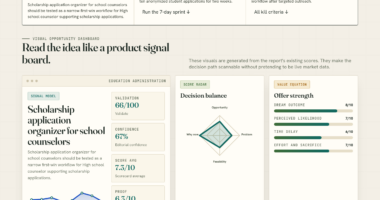

📊 Full opportunity report: 2026 Guide: Best AI Tools For Student Clubs And Societies on ThorstenMeyerAI.com — validation score, market gap, and execution plan.

Get hardware and tech essentials delivered free with Prime
- Fast, free delivery on millions of items
- Prime Video, Amazon Music and more included
- Member-only deals all year
TL;DR
In 2026, AI tools are transforming how student clubs and societies operate. This guide reviews the top options for organization, note-taking, and communication, highlighting their features and tradeoffs.
In 2026, several AI-powered tools are emerging as essential resources for student clubs and societies, helping members manage schedules, notes, and communication more efficiently. Why These 5 AI Tools Are Essential For Student Organization In 2026. These tools are gaining popularity due to their ability to automate routine tasks and improve collaboration, making student organization more effective and accessible. Enhance Student Group Coordination With 6 AI Tools In 2026.
Recent evaluations by ThorstenMeyerAI.com highlight the top AI tools tailored for student organizations, including options like the Comulytic Note Pro AI Voice Recorder and Google Notebook LM. These platforms offer features such as automatic transcription, note summarization, and seamless device integration. The selection process prioritized AI capabilities, usability, platform support, and cost-effectiveness, ensuring these tools meet diverse student needs.
Many of these tools support multi-device use, integrate with popular apps like Google Calendar and email, and provide offline capabilities. Premium options often include advanced features like conference recording and multilingual support, though they may come with higher costs or increased complexity. The focus remains on balancing automation with user-friendly interfaces to maximize productivity without overwhelming users.
The 10 picks
- 1
 Navigating Generative AI in Higher Education: Ethical, Theoretical and Practi…View on Amazon →
 - 2
 AI Smart Pen with ChatGPT IntegrationView on Amazon →
 - 3AI Smart Pen with ChatGPT IntegrationView on Amazon →
- 4
 AI in the Classroom Made Easy: Strategies to Revolutionize Learning, Empower…View on Amazon →
 - 5
 The AI-Powered Classroom: A Practical Guide to Enhancing Teaching and Learnin…View on Amazon →
 - 6
 The Complete Notion AI Guide: Boost Productivity, Creativity, and Workflow fo…View on Amazon →
 - 7
 Google NotebookLM Essentials: Practical Methods for Managing Documents, Condu…View on Amazon →
 - 8
 AI for Educators: Personalize Learning, Enhance Engagement, Streamline Tasks,…View on Amazon →
 - 9
 Google Notebook LM 2026 User GuideView on Amazon →
 - 10
 Google Notebook LM User Guide 2026: A Step-by-Step Guide to Mastering AI-Powe…View on Amazon →
Impact of AI Tools on Student Organization Efficiency
The adoption of AI tools in student clubs and societies represents a significant shift toward digital organization, enabling faster communication, better record-keeping, and more efficient event planning. These tools can save members time, reduce administrative burdens, and foster greater collaboration. As AI technology advances, student organizations that leverage these tools are likely to see improved engagement and operational success, making AI integration a strategic advantage.
Evolution of AI in Student Management in 2026
Over the past few years, AI has increasingly integrated into educational and organizational tools, with 2026 marking a milestone in tailored solutions for student groups. Earlier tools focused on simple note-taking, but recent developments now include automation features like task reminders, meeting transcription, and collaborative editing. The market has expanded to include both free and premium options, with a growing emphasis on ease of use and cross-platform compatibility. This trend aligns with broader digital transformation initiatives in education and student life management.
“Integrating AI tools like transcription and scheduling apps can dramatically reduce administrative overhead for student clubs, allowing members to focus on their core activities.”
— Jane Liu, Student Tech Advocate
Unconfirmed Aspects of AI Tool Effectiveness and Adoption
While many tools are highly rated, it remains unclear how widespread adoption will become across different types of student organizations and whether all tools will maintain their effectiveness over time. Specific details about long-term reliability, data privacy, and user satisfaction are still emerging, and some tools may face compatibility issues with certain platforms or devices. Additionally, the impact of AI inaccuracies in transcription or automation remains a concern for some users.
Future Developments and Adoption Trends in 2026
In the coming months, developers are expected to release updates that enhance AI accuracy, expand language support, and improve interoperability with existing student management platforms. Universities and student organizations will likely experiment with these tools to determine best practices, and further research may emerge regarding their impact on student engagement and organizational efficiency. Monitoring user feedback and technological advancements will be key to understanding how these tools evolve.
Key Questions
Can these AI tools integrate with existing student apps like calendars or email?
Yes, many of the top AI tools in 2026 support integration with popular apps such as Google Calendar, Outlook, and email clients. These integrations enable automatic syncing of tasks, reminders, and notes, streamlining organizational workflows.
Are these AI tools suitable for students with limited tech experience?
Most tools are designed with user-friendliness in mind, offering intuitive interfaces and tutorials. Simpler options like Google Notebook LM are particularly accessible, while more advanced platforms may require some initial learning but often provide support resources.
Do these AI tools support multiple languages for diverse student groups?
Language support varies across tools. Some, like certain transcription apps, offer multilingual capabilities, while others primarily support English. It’s important to verify language options before selecting a tool for multilingual use.
Are there privacy concerns with AI tools handling student data?
Data privacy is a consideration; reputable providers typically implement encryption and privacy policies. Users should review each tool’s privacy terms to understand data handling practices, especially when sensitive information is involved.
Source: ThorstenMeyerAI.com
Halloween Picks
halloween
As an affiliate, we earn on qualifying purchases.