

The Fed's decision to rule out Bitcoin reserves is a clear signal that central banks can't engage with the cryptocurrency. Due to legal restrictions under the Federal Reserve Act, Bitcoin ownership isn't an option for the Fed, as emphasized by Chair Jerome Powell. This ruling highlights concerns about market stability and the lack of oversight in crypto ventures. Consequently, investor confidence has shaken, leading to notable price drops in the crypto market. If you want to uncover the broader implications of this ruling on the cryptocurrency landscape, there's more to explore in the evolving world of digital assets.
Key Takeaways
- The Federal Reserve Act explicitly prohibits Bitcoin ownership by the Fed, ruling it out as a reserve asset.
- Fed Chair Jerome Powell emphasized legal restrictions that prevent the Fed from holding Bitcoin.
- Recent proposals to purchase Bitcoin with Fed resources have been met with skepticism regarding their financial viability.
- Following the Fed's announcement, Bitcoin's likelihood for strategic reserve dropped from 40% to 34%.
- The Fed's decision heightened investor uncertainty and led to a 7.5% decline in overall cryptocurrency market capitalizations.
Central Banks' Bitcoin Stance
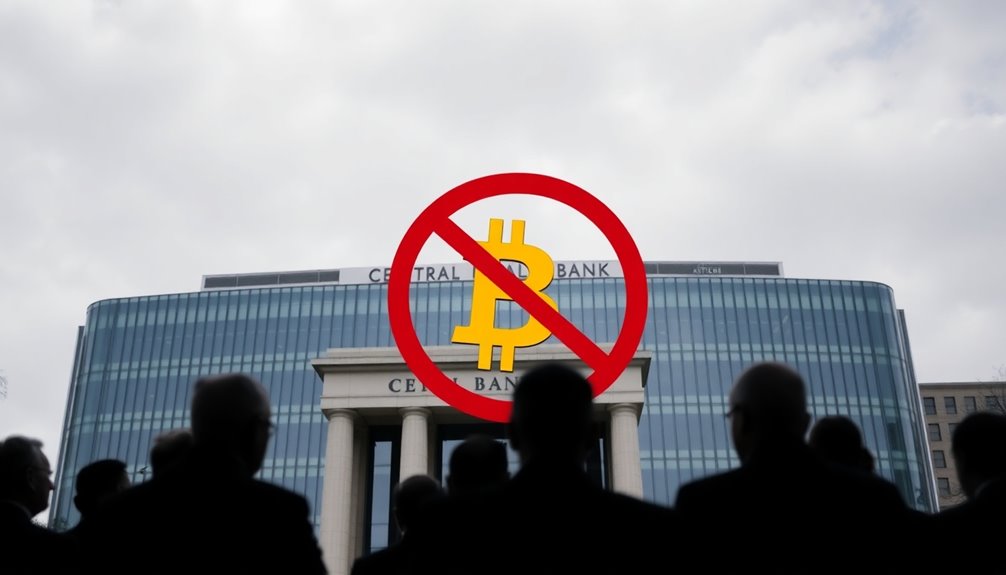
As central banks navigate the complexities of the cryptocurrency landscape, their stances on Bitcoin vary significantly.
While some countries embrace Bitcoin, others impose strict regulations or outright bans. For example, the U.S. has approved Bitcoin exchange-traded funds (ETFs), yet the sector remains largely unregulated.
In contrast, China aggressively cracked down on crypto in 2021, banning all transactions and mining. This regulatory variance complicates enforcement, as crypto exchanges still thrive in banned regions, generating substantial revenue.
The European Central Bank has warned about Bitcoin's volatility, while some view it as a hedge against inflation. Additionally, many central banks are exploring central bank digital currencies (CBDCs) to compete with Bitcoin's decentralized model.
Ultimately, central banks are weighing the risks and opportunities, shaping their strategies toward Bitcoin's role in the financial ecosystem.
Fed Declares Bitcoin Ineligible

While many investors speculate on the potential of Bitcoin, the Federal Reserve has made it clear that the cryptocurrency won't be part of its balance sheet.
The Federal Reserve Act explicitly excludes Bitcoin, and the Fed has no plans to seek legislative changes to alter that stance. Fed Chair Jerome Powell has reinforced this position, emphasizing that central banks, including the Fed, aren’t allowed to own Bitcoin due to existing legal restrictions. These regulations stem from concerns over stability and the lack of regulatory oversight in the cryptocurrency market. Consequently, the Federal Reserve will continue to focus on traditional assets, leaving Bitcoin off-limits and reinforcing its commitment to compliance with current monetary policies. Furthermore, recent proposals to purchase Bitcoin using existing Federal Reserve resources have been met with skepticism regarding their financial viability. As discussions around cryptocurrency regulation continue to evolve, some states have taken steps to address the implications of digital assets at a local level. One notable example is the proposed Oklahoma Bitcoin Reserve Act, which aims to establish a framework for managing state assets in Bitcoin while ensuring compliance with federal regulations. The Oklahoma Bitcoin Reserve Act details outline specific guidelines for state investment in cryptocurrencies, highlighting a growing recognition of digital assets in the financial landscape, even as federal institutions remain cautious.
Cryptocurrency Investment Patterns

With the Federal Reserve clearly ruling out Bitcoin from its reserves, investors are left to navigate the complexities of cryptocurrency investment patterns.
Understanding market cycles is crucial; you'll experience accumulation phases with low sentiment, followed by uptrends driven by growing interest. As prices stabilize, you might enter a distribution phase, so having a long-term strategy is key. Establishing emergency savings should be prioritized before diving into crypto investments. Additionally, it's important to consider IRA Investment Strategy as a way to enhance your overall financial plan.
Consider dollar-cost averaging to mitigate volatility—automate your purchases to reduce psychological stress. Focus on established assets like Bitcoin and Ethereum, which have shown resilience over time.
Regularly rebalance your portfolio, ensuring you manage risk by not overinvesting in major cryptocurrencies. Employ technical analysis tools to identify patterns and make informed trading decisions, enhancing your investment strategy.
Corporate Blockchain Integration

Corporate blockchain integration represents a transformative shift in how businesses manage data and operations.
With higher data security, you can rely on digital signatures and immutable records to protect sensitive information. This decentralized storage makes unauthorized access nearly impossible, enhancing customer loyalty. Moreover, higher data security ensures that sensitive information remains intact and trustworthy throughout its lifecycle.
Transparency is another key benefit; all parties access the same immutable records, reducing disputes and improving audit trails.
By automating manual tasks through smart contracts, you lower operating costs and eliminate intermediaries. This efficiency accelerates processes, allowing for instantaneous payments and approvals.
Regulatory Decisions and Market Reactions

As regulatory decisions shape the landscape of the cryptocurrency market, the Federal Reserve's recent stance on Bitcoin reserves has sparked significant reactions.
Chairman Jerome Powell's declaration that the Fed won't accumulate Bitcoin due to legal constraints sent shockwaves through the market. Following his remarks, Bitcoin prices swiftly dropped, causing the likelihood of a strategic reserve to fall from 40% to 34%. Additionally, the Fed's cautious approach reflects broader concerns regarding volatility and regulatory challenges associated with cryptocurrencies.
The overall cryptocurrency market capitalizations plummeted by 7.5%, reflecting investor uncertainty. While some anticipated a more favorable regulatory environment with the upcoming administration, Powell's comments highlighted ongoing volatility and regulatory unpredictability.
Investors remain cautious, grappling with the implications of the Fed's position on their expectations and market stability.
Central Banks' Digital Currency Evolution

The recent Fed decision on Bitcoin reserves underscores the shifting dynamics in the financial landscape, where central banks are increasingly exploring the potential of digital currencies.
You'll notice that the journey began with the Bank of Finland's Avant smart card in 1993, paving the way for CBDC research. Now, nearly 100 CBDCs are in various stages of development, reflecting a global push for financial inclusion and efficient payment systems. Countries aim to reduce currency substitution and enhance competition. Furthermore, the development of CBDCs can lead to greater resilience in domestic payment systems, similar to how hydrogen fuel cells contribute to a sustainable energy future.
However, challenges like cybersecurity risks, data privacy, and potential bank withdrawals linger. As central banks weigh these factors, the evolution of CBDCs could reshape the financial ecosystem, impacting everything from consumer access to the role of traditional banks.
Frequently Asked Questions
What Are the Advantages of Using Bitcoin for Individuals?
Using Bitcoin offers you several advantages.
You gain complete control over your money, free from government interference. Transactions are secure and private, as no central authority tracks them.
Plus, you enjoy negligible transaction fees and the benefit of irreversibility, meaning once you send funds, they're gone for good, eliminating charge-back risks.
With a decentralized network, you also maintain financial freedom without worrying about taxes or third-party seizures.
How Does Bitcoin Compare to Traditional Currencies?
When you compare Bitcoin to traditional currencies, you'll notice several key differences.
Bitcoin's market value is highly volatile, while traditional currencies tend to maintain stability.
Unlike government-backed money, Bitcoin operates on a decentralized network, giving you more control over your transactions.
Additionally, Bitcoin has a finite supply, which can help prevent inflation, whereas traditional currencies can be printed freely.
Finally, Bitcoin exists only in digital form, offering unique accessibility advantages.
What Is the Future of Bitcoin Mining?
The future of Bitcoin mining looks promising, driven by technological advancements and increased efficiency.
You'll likely see more integration with AI and high-capacity computing, enhancing profitability.
However, you'll also need to consider sustainability, as the energy consumption and carbon footprint remain significant concerns.
Are There Any Countries Embracing Bitcoin as Legal Tender?
You might find it intriguing that some nations are boldly stepping into the future by adopting Bitcoin as their legal tender.
El Salvador and the Central African Republic have taken the plunge, embracing BTC to potentially enhance their economies.
Meanwhile, countries like Paraguay and Ukraine are considering similar paths, exploring the benefits of digital currencies.
This shift could signify a growing trend where traditional monetary systems evolve to include cryptocurrencies, offering new opportunities for financial growth.
How Do Consumers View Bitcoin as an Investment?
As a consumer, you might find that perceptions of Bitcoin as an investment are shifting positively.
More than half of people see cryptocurrencies as valuable assets. While there's still some skepticism, fewer individuals expect drastic price drops, and most don't view crypto as a fad anymore.
However, you should remain aware of Bitcoin's volatility and regulatory uncertainties, as these factors can significantly impact your investment decisions and potential risks involved.
Conclusion
So, while central banks are busy declaring Bitcoin off-limits, it seems they're missing the irony of their own digital currency ambitions. Isn't it amusing that as they dismiss the decentralized darling of the crypto world, they're simultaneously racing to create their own digital versions? You can't help but wonder if they're trying to control the narrative while overlooking the very innovation that's reshaping finance. In the end, they might just be chasing a trend they can't grasp.