
Ethereum's rapid upgrades make Bitcoin seem like ancient tech. With the Dencun Upgrade on the horizon, Ethereum is set to enhance scalability and drastically reduce transaction fees, giving it a competitive edge. While Bitcoin's updates focus on security, Ethereum innovates with smart contracts and decentralized finance applications, attracting more investors. Plus, Ethereum's shift to proof-of-stake has slashed energy use by 99.95%, promoting sustainability. As the market evolves, Ethereum's growing appeal and unique use cases position it for potential price explosions. Stick around to discover how these changes could impact your investment strategy!

Get hardware and tech essentials delivered free with Prime
- Fast, free delivery on millions of items
- Prime Video, Amazon Music and more included
- Member-only deals all year
Key Takeaways
- Ethereum's upcoming Dencun Upgrade will enhance scalability and reduce transaction costs, making it more efficient than Bitcoin.
- EIP-4844 and proto-danksharding will significantly lower gas fees for Layer 2 solutions, boosting Ethereum's appeal.
- Ethereum's average block time of 13 seconds allows for faster transaction confirmations compared to Bitcoin's up to 10 minutes.
- The deflationary environment post-The Merge, coupled with Ethereum's unique use cases, increases demand for the asset.
- Growing institutional investment in Ethereum, including 100+ Fortune 500 companies, highlights its legitimacy and potential for explosive price growth.
Ethereum smart contract development kit
As an affiliate, we earn on qualifying purchases.
As an affiliate, we earn on qualifying purchases.
Technological Advancements in Ethereum
Ethereum is on the brink of noteworthy technological advancements that promise to enhance its scalability, efficiency, and sustainability. With the upcoming Dencun Upgrade expected in March or April 2024, you're set to experience major improvements, particularly through EIP-4844. This initiative aims to reduce gas costs for Layer 2 solutions, markedly boosting scalability and efficiency. Additionally, institutional interest in ETH is anticipated to rise as the Dencun upgrade progresses, further reinforcing Ethereum's position in the market.
The integration of proto-danksharding plays an essential role in this upgrade, targeting lower transaction fees on L2 networks. As L2 activity expands, reaching a total ecosystem value of $16 billion, the enhancements to light clients will allow you to process block headers and verify Layer 1 transactions more efficiently. Additionally, the proposed increase in blob capacity will improve data availability, making transactions smoother and faster.
On the sustainability front, Ethereum's shift to a proof-of-stake consensus has slashed energy requirements by an impressive 99.95%. With these advancements, Ethereum not only improves its infrastructure but also guarantees a decentralized and efficient network. As Ethereum continues to innovate, it's positioning itself as a formidable player in the blockchain space, leaving Bitcoin to look increasingly outdated.
Ethereum staking hardware wallet
As an affiliate, we earn on qualifying purchases.
As an affiliate, we earn on qualifying purchases.
Unique Use Cases of Ethereum

The unique use cases of Ethereum showcase its versatility and transformative potential across various sectors. In the domain of decentralized finance, you can borrow stablecoins using Ether as collateral through platforms like Maker DAO. Ethereum also powers prediction markets, allowing you to forecast events like sports matches with tools such as Gnosis and Augur. Automated payments through smart contracts streamline transactions, eliminating the need for intermediaries.
Moreover, decentralized applications (dApps) thrive on Ethereum. You can participate in Decentralized Autonomous Organizations (DAOs) that promote transparency and community governance. If you're into trading, decentralized exchanges like Uniswap facilitate peer-to-peer transactions without traditional barriers.
In supply chain management, Ethereum's smart contracts guarantee product authenticity and transparency, making it easier to track goods from manufacture to sale. You can also utilize its capabilities for secure peer-to-peer payments and efficient cross-border transactions, reducing costs and delays. With Ethereum, you can engage in innovative practices like yield farming, content monetization, and even secure healthcare data management. Additionally, Ethereum enhances efficiency through automated royalty payments and rights management in the music industry. These diverse applications highlight how Ethereum is reshaping industries and revolutionizing how we interact with technology.
As an affiliate, we earn on qualifying purchases.
Supply Dynamics: Bitcoin Vs Ethereum
Supply dynamics play an essential role in distinguishing Bitcoin from Ethereum, influencing their value propositions and market behaviors. Bitcoin has a capped supply of 21 million coins, which emphasizes scarcity and helps preserve its value. In contrast, Ethereum doesn't have a fixed supply limit, allowing for potential increases based on network needs. Currently, about 93% of Bitcoin's supply is in circulation, while Ethereum has around 120 million ether available, with ongoing changes driven by network upgrades. Additionally, the flexibility of Ethereum's supply model makes it appealing for Bitcoin IRA diversification strategies.
Bitcoin's supply is created through a Proof of Work (PoW) mechanism, where miners solve complex puzzles, while Ethereum has shifted to a Proof of Stake (PoS) system, selecting validators based on their stake. This change allows Ethereum to create supply more efficiently and sustainably. With the London Upgrade, Ethereum introduced a burn mechanism that reduces its circulating supply, which, combined with the PoS shift, has slowed its supply growth rate. Additionally, Ethereum's adaptability allows for innovative applications, further enhancing its value proposition in the market.
These differing supply dynamics not only impact how each cryptocurrency is perceived but also influence investor sentiment and market demand. As Ethereum adapts its supply to network needs, it may increasingly attract attention from investors seeking utility alongside potential deflationary benefits.
As an affiliate, we earn on qualifying purchases.
Transaction Speed and Costs Explained
When it comes to transaction speed and costs, users often find significant differences between Bitcoin and Ethereum. Ethereum boasts a block time of around 13 seconds, allowing for faster processing. Depending on the gas fee you choose, your transaction can confirm in under 30 seconds or take up to 30 minutes during times of congestion. Unlike Bitcoin, Ethereum's transaction speed is affected by complexity; simple ETH transfers are quicker than those involving smart contracts or dApps. Additionally, Ethereum's network can handle approximately 13-15 transactions per second(13-15 TPS), which contributes to its overall efficiency compared to Bitcoin.
Gas fees play a vital role in transaction speed. They consist of a base fee and an optional tip, which you can adjust to prioritize your transaction. Higher gas fees can help your transaction get processed faster, especially during peak network activity. If you're looking to save on costs, consider timing your transactions during off-peak hours or using layer-2 solutions to lower fees.
Development Trends and Future Outlook

As Ethereum continues to evolve, development trends are shaping its future with exciting innovations and significant shifts in scalability. Layer 2 solutions are paving the way for increased transaction throughput and reduced costs. You'll notice major players like Base and StarkNet leading the charge with impressive transaction speeds and security features.
| Layer 2 Solution | Key Features |
|---|---|
| Base | Fastest-growing, 6.38M transactions daily, $1.8B TVL |
| StarkNet | 500 transactions/sec, 15-min proof generation |
| Polygon | Multi-chain framework, widely used in DeFi |
Moreover, enterprise integration is skyrocketing, with over 100 Fortune 500 companies investing in L2 projects. This trend signifies Ethereum's growing legitimacy and adoption in traditional finance. Notably, L2 solutions achieved an average 94% reduction in transaction fees compared to Ethereum mainnet, fostering new use cases in micro-transactions and gaming.
Looking ahead, expect proto-dank sharding to potentially reduce fees by up to 90%, while specialized L2s will emerge for AI and privacy applications. However, keep an eye on regulatory challenges that may impact this rapid growth. Overall, the outlook is promising, with a focus on decentralization and enhanced developer experiences driving Ethereum's future.
Market Performance Comparison
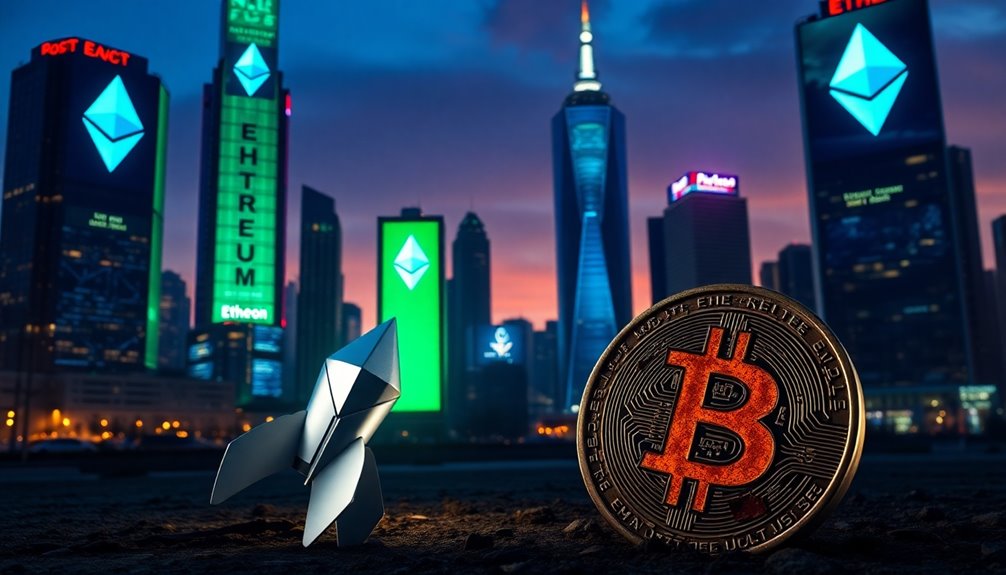
Ethereum's advancements in scalability and utility have set the stage for a compelling market performance comparison with Bitcoin. While Bitcoin remains a digital gold and a hedge against inflation, Ethereum's role as the backbone of decentralized finance (DeFi) and non-fungible tokens (NFTs) has greatly boosted its demand. You might appreciate Bitcoin's stability during economic uncertainty, but Ethereum's support for smart contracts and decentralized applications (dapps) opens up an array of use cases in finance, gaming, and decentralized autonomous organizations (DAOs).
In terms of technological upgrades, Ethereum's shift to Proof of Stake (PoS) with Ethereum 2.0 enhances its scalability and energy efficiency, making it more appealing. Conversely, Bitcoin's updates like SegWit and the Lightning Network focus on refining its security without altering its core principles. When it comes to transaction speed, Ethereum leaves Bitcoin in the dust with confirmation times under a minute, while Bitcoin can take up to 10 minutes. Additionally, the declining Ether supply since The Merge has created a more deflationary environment, further increasing demand for Ethereum as an asset. This shift in dynamics has led many investors to consider Ethereum as a more versatile and future-proof blockchain ecosystem compared to Bitcoin’s more traditional, store-of-value approach. However, Bitcoin’s enduring reputation as “digital gold” and its historical status during the earlystage bitcoin boom continue to solidify its position as a trusted asset in the crypto space. Both networks ultimately cater to distinct use cases, appealing to different investor mindsets and technological priorities.
Lastly, while Bitcoin is known for its lower volatility, Ethereum's diverse applications can lead to greater price fluctuations. This makes diversifying your portfolio between these two cryptocurrencies a smart way to manage risk.
Frequently Asked Questions
How Does Ethereum's Pos Impact Its Security Compared to Bitcoin's Pow?
Ethereum's Proof of Stake (PoS) enhances security through economic incentives, where you risk losing your staked coins if you validate fraudulent transactions. This discourages malicious behavior. In contrast, Bitcoin's Proof of Work (PoW) relies on energy-intensive computations, making alteration difficult. While PoW promotes decentralization through global miners, PoS can lead to centralization if wealthier validators dominate. So, each has unique strengths and weaknesses in maintaining network security.
What Are the Potential Risks of Investing in Ethereum?
When you consider investing in Ethereum, be aware of several potential risks. Technical challenges during its shift to Ethereum 2.0 could disrupt the network. High transaction costs and scalability issues may deter users. Regulatory uncertainties can create investment risks, especially if governments impose restrictions. Market volatility can also affect Ethereum's price, as can macroeconomic factors. Additionally, vulnerabilities in smart contracts could lead to financial losses, so thorough research is essential before diving in.
How Does Ethereum Handle Network Congestion Differently Than Bitcoin?
Ethereum handles network congestion more efficiently than Bitcoin by implementing Proof of Stake and sharding. When demand spikes, Ethereum increases transaction capacity, allowing more transactions to be processed simultaneously. You'll notice that Ethereum can still experience congestion, but its upgrades help mitigate slowdowns. In contrast, Bitcoin relies on its Proof of Work system, which can lead to longer confirmation times and higher fees during busy periods. This makes Ethereum more adaptable in high-demand situations.
Can Ethereum Compete With Traditional Financial Systems Effectively?
Can Ethereum truly compete with traditional financial systems? Absolutely! It's not just a rival; it's a revolution! You'll find Ethereum's decentralization, transparency, and smart contracts offer an efficiency that traditional banks can't match. With near-instant transactions and lower fees, it's like comparing a rocket ship to a horse-drawn carriage. Plus, its programmability opens doors to innovative financial products that make traditional methods seem archaic. You're witnessing the future of finance unfold!
What Role Do Regulators Play in Ethereum's Future Growth?
Regulators play an essential role in Ethereum's future growth. They establish the rules that can either promote or hinder innovation in the crypto space. By providing clear guidelines, you'll see increased investor confidence and participation. Regulatory clarity helps protect you as an investor while encouraging institutional adoption. As regulators collaborate with the blockchain community, they can create frameworks that balance compliance with the technological advancements Ethereum offers, ultimately fostering its growth.
Halloween Picks
halloween
As an affiliate, we earn on qualifying purchases.