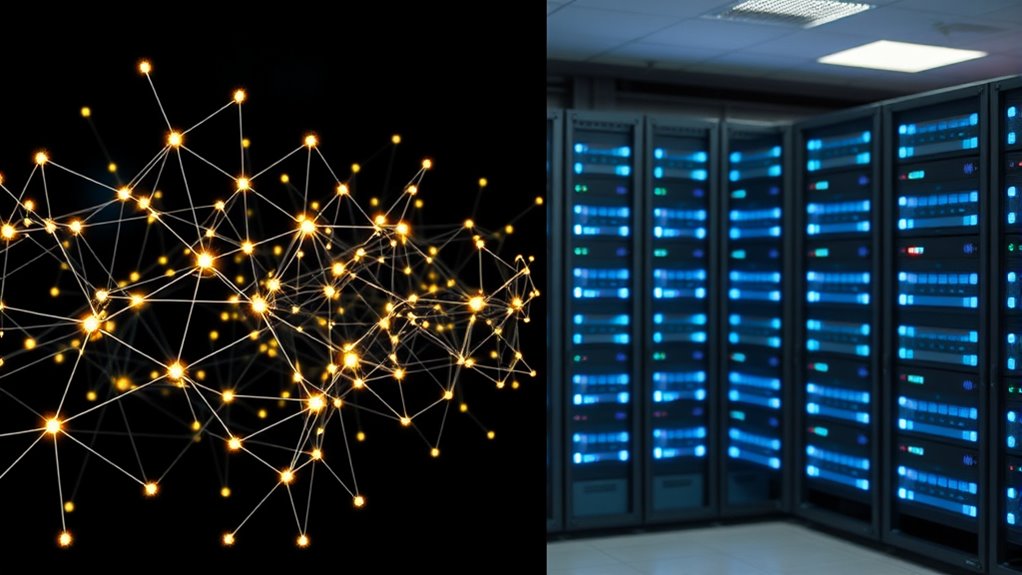

Blockchain and traditional databases differ mainly in how they store and secure data. Blockchain is decentralized and uses cryptography to create a tamper-proof ledger, making it ideal for secure transactions and transparency. Traditional databases are centralized, prioritizing speed and flexibility for day-to-day business operations. If you want to understand the strengths and differences of each system and how they can fit your needs, there’s much more to explore below.
Key Takeaways
- Blockchain is decentralized with distributed data, while traditional databases are centrally controlled by a single authority.
- Blockchain ensures data security through cryptography and tamper-proof linked blocks, unlike permission-based security in traditional databases.
- Traditional databases support high-speed, real-time data processing and complex queries, whereas blockchain emphasizes transparency and immutability.
- Blockchain offers a transparent, tamper-resistant ledger ideal for secure transactions, while traditional databases are optimized for performance and data management.
- Use cases differ: blockchain suits secure, decentralized applications like cryptocurrencies; traditional databases excel in business data processing.
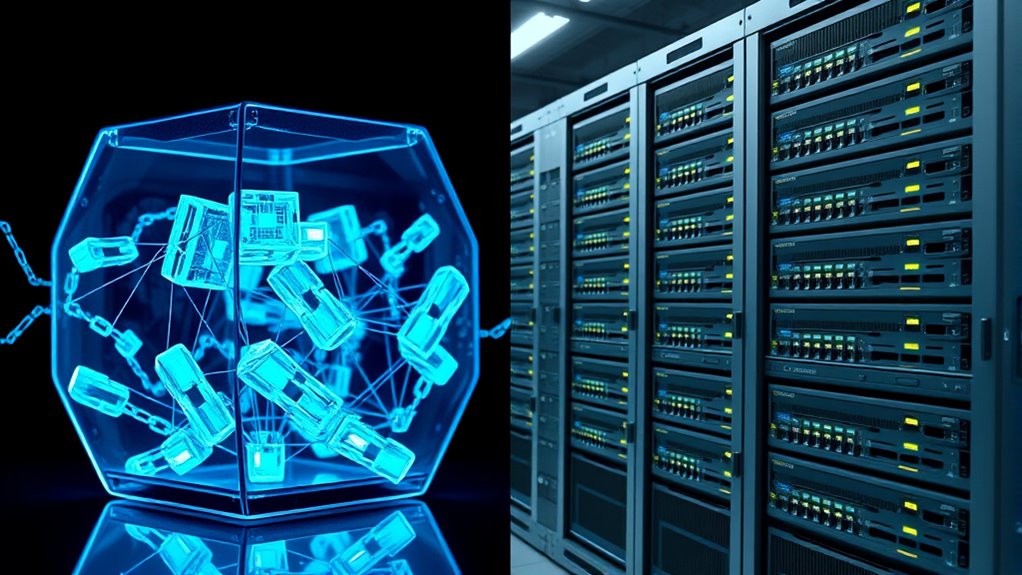
When choosing between blockchain and traditional databases, understanding their fundamental differences is vital. These differences directly impact how you manage data, guarantee security, and trust the system you’re working with. Traditional databases, like SQL or NoSQL systems, are centralized, meaning a single authority controls the data. This setup allows for quick access, easy updates, and straightforward management. However, it also makes the database vulnerable to single points of failure, hacking, or data tampering, especially if security measures are weak. On the other hand, blockchain operates on a decentralized network, where data is distributed across multiple nodes. This structure considerably enhances data decentralization, reducing the risk of corruption or unauthorized alterations because no single entity has complete control. For cryptocurrency security, this decentralization is vital, making it much harder for hackers to compromise the entire system. Instead of trusting a central server, you trust the collective consensus of the network, which is maintained through cryptographic techniques and consensus algorithms like proof of work or proof of stake. This means that transactions or data entries are verified and recorded immutably, providing a transparent and tamper-proof ledger. Blockchain also employs high data integrity** measures that ensure the accuracy and consistency of data over its lifecycle. Traditional databases typically rely on user authentication and permission controls to secure data, but they can still be vulnerable if those controls are bypassed or compromised. Blockchain, however, uses cryptography at every transaction, guaranteeing data integrity and security without depending solely on user permissions. Because each block is linked cryptographically to the previous one, altering any piece of data would require changing every subsequent block across the entire network, which is practically impossible in a well-maintained blockchain. This makes blockchain ideal for applications where data integrity and security are paramount, such as cryptocurrency transactions. It also offers an audit trail that is both transparent and tamper-resistant. Conversely, traditional databases excel at handling large volumes of data with high speed and flexibility, making them suitable for many business applications where real-time updates and complex queries** are necessary. But they require rigorous security measures and backups to prevent data loss or breaches. In brief, your choice depends on your priorities: if you need a system with high security, transparency, and decentralization—especially for cryptocurrency security—blockchain provides unique advantages. If you prioritize speed, flexibility, and centralized control, traditional databases might be more appropriate. Understanding these core differences helps you select the best option for your specific use case.
Frequently Asked Questions
Can Blockchain Replace All Traditional Databases?
No, blockchain can’t substitute all traditional databases. While it offers enhanced data integrity through decentralization and tamper resistance, it lacks centralized control, making it less suitable for tasks requiring quick updates or complex queries. You should consider blockchain for transparency and security needs, but for efficiency and flexibility, traditional databases remain more practical. Balancing both ensures you leverage their strengths without compromising data management.
How Does Blockchain Handle Data Privacy Concerns?
You can rest assured that blockchain handles data privacy concerns through strong cryptography techniques and strict access control. It uses encryption to protect sensitive data, ensuring only authorized users can access or modify information. Additionally, access control mechanisms restrict who can view or change data, maintaining privacy. By combining cryptography and access controls, blockchain provides a secure environment, addressing privacy issues effectively while still offering transparency and decentralization.
What Are the Costs Associated With Blockchain Deployment?
You’ll find that blockchain deployment expenses can be higher than traditional databases due to the cost comparison of infrastructure, security, and maintenance. You might face significant upfront investment in hardware, software, and skilled personnel. Additionally, ongoing operational costs include energy consumption for mining or consensus mechanisms. While blockchain offers enhanced security, these deployment expenses can make it less cost-effective for smaller projects, so you should weigh these costs carefully before implementation.
Is Blockchain Suitable for Real-Time Data Processing?
Yes, blockchain can be suitable for real-time data processing, especially when you need secure, transparent updates through smart contract applications. However, its decentralized storage and consensus mechanisms may introduce latency, making it less ideal for ultra-fast processing. You should consider your application’s specific needs, balancing real-time performance with the benefits of blockchain’s security and decentralization.
How Scalable Are Blockchain Networks Compared to Traditional Databases?
You might think blockchain networks are as scalable as traditional databases, but that’s not entirely true. Due to scalability challenges and network limitations, blockchains often struggle to handle high transaction volumes efficiently. Unlike traditional databases, which easily expand with hardware, blockchain networks face inherent bottlenecks. This means they’re less suitable for applications demanding rapid, large-scale data processing, making them more ideal for secure, transparent transactions rather than massive real-time data management.
Conclusion
Now that you see the differences, you understand how blockchain offers transparency, security, and decentralization, while traditional databases provide speed, efficiency, and control. You recognize how blockchain builds trust through immutability, whereas databases focus on quick data retrieval. Both serve your needs—one creates a secure, transparent ledger; the other ensures fast, organized data management. Ultimately, it’s about selecting the right tool for your goals—trust or efficiency, decentralization or control.