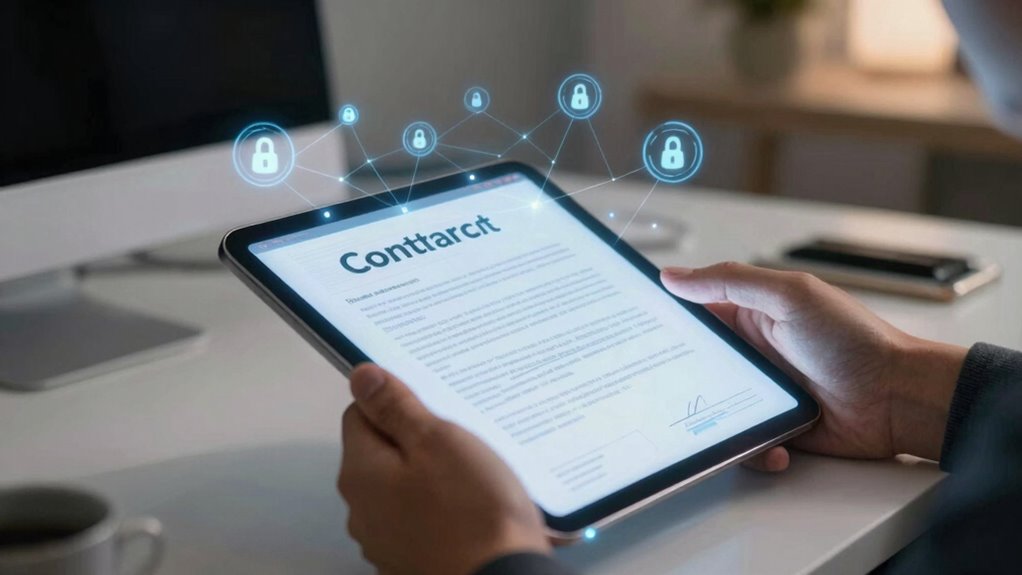

Smart contracts remove friction from digital agreements by automating processes and guaranteeing instant execution once conditions are met. They cut delays caused by manual oversight and reduce costs linked to traditional enforcement. You benefit from transparent, tamper-proof records that minimize human error and streamline transactions like payments and escrow. As technology and legal frameworks evolve, understanding how to leverage these benefits can help you maximize efficiency and trust in digital deals—stay tuned for more insights.

Get hardware and tech essentials delivered free with Prime
- Fast, free delivery on millions of items
- Prime Video, Amazon Music and more included
- Member-only deals all year
Key Takeaways
- Automate execution of agreements, reducing delays and manual intervention.
- Ensure transparent and tamper-proof transaction records, increasing trust.
- Lower administrative costs by eliminating the need for intermediaries.
- Streamline processes like payments and escrow, simplifying complex transactions.
- Minimize human errors through code-based, self-enforcing contracts.

Smart contracts are revolutionizing how we execute digital agreements by automating and securing transactions without intermediaries. Instead of relying on traditional contracts that require trust in third parties, smart contracts run on blockchain networks, guaranteeing that once conditions are met, actions are automatically executed. This automation reduces delays, lowers costs, and minimizes the chance of human error, making agreements more efficient and transparent.
However, adopting smart contracts isn’t without its challenges. You need to understand the legal implications involved. Unlike conventional contracts, which are governed by specific legal frameworks, smart contracts operate in a relatively new legal landscape. You might wonder how enforceable they are if disputes arise or if the code fails to execute as intended. Jurisdictions are still working out how to interpret these digital agreements, and the absence of clear legal standards can create uncertainty. It’s essential to recognize that, despite their technical robustness, smart contracts might not automatically satisfy all legal requirements. You may need supplementary legal agreements or provisions to guarantee full enforceability, especially in complex or high-stakes situations.
Security vulnerabilities are another critical consideration. While blockchain technology is celebrated for its security features, smart contracts can still be susceptible to flaws. Coding errors or overlooked vulnerabilities can lead to unintended consequences, such as funds being locked or stolen. For example, if a smart contract contains a bug, malicious actors could exploit it, causing significant financial damage. You must be diligent in auditing and testing the code before deploying it on a blockchain. Additionally, once a smart contract is live, you generally can’t alter it easily; this immutability can be problematic if vulnerabilities are discovered after deployment. Thus, security is not just an added bonus but a fundamental requirement when integrating smart contracts into your digital agreements. Incorporating blockchain security standards can help mitigate some of these risks.
Despite these hurdles, the benefits of reducing friction in digital agreements are substantial. With smart contracts, you eliminate the need for manual oversight, reduce administrative overhead, and create transparent, tamper-proof records. They can streamline processes like payments, escrow services, and supply chain management. Furthermore, the adoption of smart contract auditing services is growing, which can help identify vulnerabilities before deployment. As legal frameworks evolve and security measures improve, smart contracts are poised to become a cornerstone of frictionless digital commerce. But to fully leverage their potential, you must stay informed about legal considerations and prioritize rigorous security practices to minimize vulnerabilities. Only then can you confidently harness the power of smart contracts to simplify and secure your digital agreements.
smart contract auditing services
As an affiliate, we earn on qualifying purchases.
As an affiliate, we earn on qualifying purchases.
Frequently Asked Questions
Can Smart Contracts Be Modified After Deployment?
Smart contracts generally can’t be modified after deployment to prevent contract tampering, ensuring security and trust. However, developers can build upgradeable smart contracts using proxy patterns, allowing controlled changes. Still, this introduces risks like code vulnerabilities, so you must carefully manage and audit these modifications. Overall, while you can’t easily alter smart contracts, thoughtful design enables necessary updates without compromising security or transparency.
What Industries Benefit Most From Smart Contract Automation?
You’ll notice industries like finance, real estate, and supply chain benefit most from smart contract automation. Their industry adoption increases automation efficiency by streamlining transactions and reducing manual errors. As you adopt smart contracts, you’ll find processes become faster, more transparent, and less prone to disputes. These sectors leverage smart contracts to guarantee secure, automated agreements, notably enhancing operational flow and trust across all parties involved.
How Secure Are Smart Contracts Against Hacking?
They say, “a chain is only as strong as its weakest link,” and smart contracts are no exception. While blockchain vulnerabilities exist, robust encryption protocols make hacking challenging. You should still stay cautious, as no system is perfectly secure. Developers continually improve security measures, but understanding potential risks helps you better protect your digital agreements. Remember, security isn’t absolute, but smart contracts remain a resilient tool when used wisely.
Do Smart Contracts Require Third-Party Approval?
No, smart contracts don’t require third-party approval because blockchain transparency guarantees all parties can see and verify the contract’s conditions. Contract automation handles the execution automatically once predefined criteria are met, eliminating the need for intermediaries. This transparency and automation streamline processes, reduce delays, and lower costs, making smart contracts efficient and reliable for digital agreements without relying on third-party validation.
What Legal Enforceability Do Smart Contracts Have Worldwide?
Smart contracts are generally legally enforceable across many legal jurisdictions, but their validity depends on local laws and regulations. You need to guarantee the contract’s terms comply with jurisdiction-specific contract validity rules. While smart contracts automate enforcement, you should consult legal experts to confirm that your digital agreement aligns with regional legal standards, making sure it’s recognized and enforceable worldwide.
blockchain security testing tools
As an affiliate, we earn on qualifying purchases.
As an affiliate, we earn on qualifying purchases.
Conclusion
Smart contracts streamline digital agreements by eliminating delays and reducing the need for intermediaries. You’ll find that automation and transparency make transactions smoother and more trustworthy. When you embrace this technology, you’re cutting through red tape and opening doors to a more efficient future. It’s clear that smart contracts are here to stay, and the sooner you adapt, the better positioned you’ll be to reap their benefits. Don’t let this opportunity pass you by — seize the moment now.
smart contract development platform
As an affiliate, we earn on qualifying purchases.
As an affiliate, we earn on qualifying purchases.
automated escrow service software
As an affiliate, we earn on qualifying purchases.
As an affiliate, we earn on qualifying purchases.
Halloween Picks
halloween
As an affiliate, we earn on qualifying purchases.