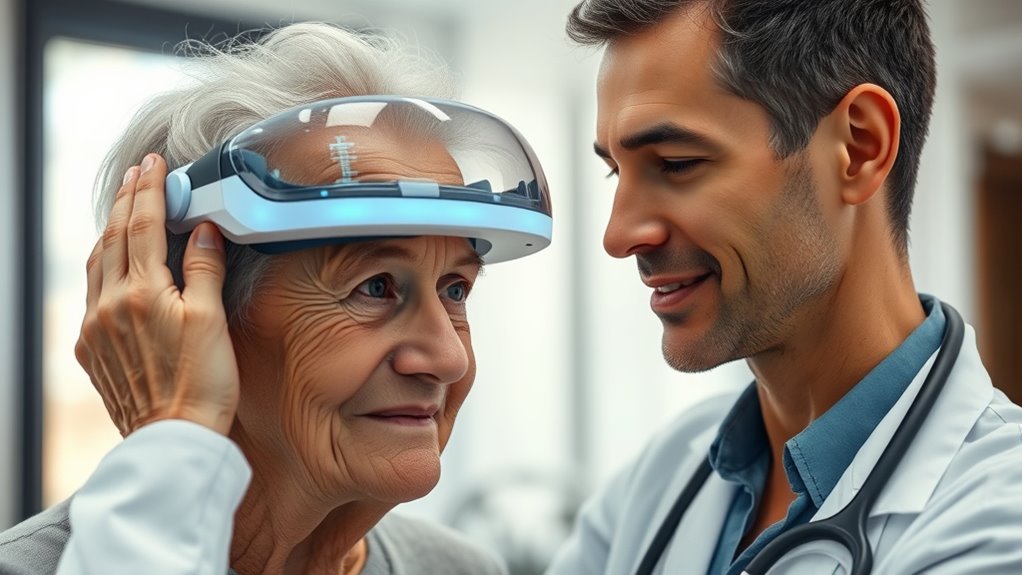

“Augmented” intelligence is transforming medicine by improving diagnostic accuracy, personalizing treatments, and reducing errors, making healthcare more compassionate and patient-centered. It helps clinicians focus more on caring rather than administrative tasks and supports better decision-making. By enhancing human judgment, it fosters trust and better outcomes for patients. If you want to understand how this shift is shaping a more humane and effective healthcare future, there’s more to explore ahead.
Key Takeaways
- Augmented intelligence enhances clinician decision-making, allowing personalized care while maintaining human empathy and judgment.
- It reduces physician burnout by streamlining administrative tasks, fostering a more humane and patient-centered healthcare environment.
- AI-driven diagnostics improve accuracy and early detection, leading to better patient outcomes and less invasive treatments.
- By democratizing access to expertise, augmented intelligence ensures equitable care for underserved populations.
- Ethical AI governance safeguards patient privacy and security, promoting trust and humane practices in medical technology.

Augmented intelligence is transforming medicine by empowering healthcare professionals with advanced tools that enhance diagnostic accuracy, streamline administrative tasks, and improve patient outcomes. With two-thirds of physicians now using healthcare AI in 2024—a 78% jump from the previous year—the technology is becoming an integral part of everyday clinical practice. These tools help with essential but time-consuming tasks like documenting billing codes, creating discharge instructions, translating languages, and assisting with diagnoses. As a result, doctors can focus more on patient care rather than paperwork, reducing burnout and increasing efficiency.
Physician enthusiasm for AI has grown considerably, with 35% expressing positive attitudes in 2024, while concerns have decreased to 25%. This shift indicates that more doctors see AI as a helpful aid rather than a threat. The goal is to make AI an asset that supports physicians in delivering personalized treatments, rather than a burden that complicates their workflow. The American Medical Association emphasizes better implementation and usability to ensure AI serves as a seamless extension of clinical judgment. This approach fosters trust and encourages broader adoption.
Physicians’ positive attitudes toward AI are growing, with increased trust and emphasis on seamless integration into clinical workflows.
In terms of clinical effectiveness, AI models analyze complex biological data—multi-omic profiles—to improve chemotherapy predictions by 25–30%. AI-guided oncology treatments have demonstrated a 10–15% increase in progression-free survival compared to standard guideline-based approaches. These personalized plans not only enhance treatment efficacy but also reduce side effects by tailoring medications to individual patient profiles. Early AI interventions, such as remote monitoring, can identify issues before they escalate, cutting down hospital admissions and readmissions. Patients also tend to feel more comfortable with AI when their physicians explain the outcomes, with 69% reporting acceptance of AI-driven genomic data analysis.
AI’s potential to reduce healthcare costs is equally compelling. By optimizing treatment plans and eliminating unnecessary procedures, it helps lower expenses. Predictive analytics improve demand forecasting and population health management, making resource allocation more efficient. The drug discovery process, now accelerated from 5–6 years to about a year, slashes costs by up to 70%. This rapid development, supported by AI, could generate an economic impact of $60–110 billion annually, primarily through faster approvals and reduced R&D costs.
In medical imaging, radiology leads the way, with over 75% of FDA-cleared AI devices focused on imaging. As of 2024, 882 AI/ML devices have FDA approval, mainly in radiology. AI models in breast ultrasound have achieved near-perfect accuracy, outperforming radiologists and reducing False positives and unnecessary biopsies. These advancements support early detection and improve diagnostic precision. Importantly, AI also aids less-trained physicians by handling routine tasks and filtering straightforward cases, allowing specialists to concentrate on complex conditions. This democratizes access to expertise, especially in underserved areas, and fosters health equity. Proper IT governance ensures patient privacy and safeguards intellectual property, reinforcing AI’s role as a humane, supportive force in medicine. Additionally, implementing risk management strategies is crucial to mitigate potential challenges associated with AI integration in healthcare.
Frequently Asked Questions
How Does Augmented Intelligence Differ From Artificial Intelligence in Healthcare?
You see, augmented intelligence works alongside you, supporting your decisions with validated, transparent suggestions, while artificial intelligence operates independently, making autonomous decisions. Augmented systems prioritize explainability and human oversight, reducing risks and fostering trust, whereas AI often acts as a “black box,” limiting understanding. This collaboration enhances personalized patient care, keeps clinicians accountable, and ensures ethical, safe integration into clinical workflows, unlike AI’s fully automated approach.
What Are the Potential Risks of Implementing Augmented Intelligence in Medicine?
Like Pandora’s box, implementing augmented intelligence in medicine risks releasing data breaches, bias, and misdiagnoses. You might see patient privacy compromised, biased treatment decisions amplified, or AI hallucinations leading to errors. Network vulnerabilities and unclear liability add to the danger. Without proper safeguards, you could inadvertently erode trust, worsen health inequities, or face legal complications, making cautious, transparent deployment essential to harness AI’s benefits responsibly.
How Can Augmented Intelligence Improve Patient Outcomes?
Augmented intelligence improves your patient outcomes by enabling earlier and more accurate diagnoses, which prevent disease progression. It tailors treatments to individual needs, increasing their effectiveness and reducing side effects. AI also streamlines workflows, letting you focus more on patient care. With real-time data and predictive analytics, you can proactively address issues, making interventions timely. This personalized, efficient approach ultimately leads to better health results and higher patient satisfaction.
What Training Is Required for Healthcare Professionals to Use Augmented Intelligence Tools?
Did you know that 85% of healthcare professionals believe AI can substantially improve patient care? To effectively use augmented intelligence tools, you need foundational AI knowledge, including understanding algorithms, data management, and interpretability techniques like SHAP. You should also learn ethical principles, legal regulations, and communication skills to explain AI insights clearly. Hands-on experience with clinical validation and performance evaluation helps you critically assess AI’s real-world impact, ensuring safe and effective integration.
Will Augmented Intelligence Replace Human Doctors or Enhance Their Capabilities?
Augmented intelligence won’t replace human doctors; it’s designed to enhance your capabilities. You’ll use AI to handle data, improve diagnostics, and streamline workflows, freeing you to focus on patient care and empathy. By partnering with technology, you gain instant access to evidence-based insights. This collaboration helps you make better decisions, reduces errors, and provides more personalized treatment—ultimately making healthcare more humane and effective.
Conclusion
So, as you embrace augmented intelligence, you might find yourself trusting algorithms more than your own instincts, all while machines quietly become your most compassionate caregivers. It’s ironic how technology, often seen as cold and impersonal, could actually make medicine more humane. In the end, you could be thanking your AI assistant for saving lives — while it silently watches, ever-ready to outthink—and outcare—us all. Humanity’s new doctor might just be a clever algorithm in disguise.