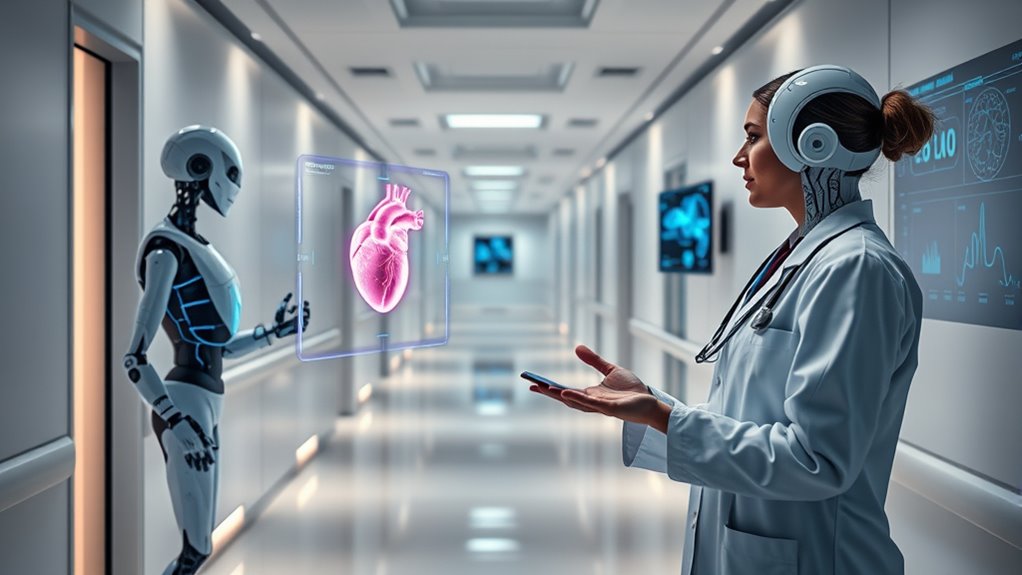

AI is transforming healthcare by speeding up diagnoses, improving accuracy, and personalizing treatments to suit individual needs. It analyzes vast amounts of data, from genetic information to medical history, to help you get targeted therapies with fewer side effects. AI also assists in early detection and automates routine tasks, allowing healthcare providers to focus more on patient care. If you want to discover how these advancements impact your health journey, keep exploring the exciting progress happening now.
Key Takeaways
- AI enables personalized treatments by analyzing genetic, lifestyle, and medical data for tailored therapies.
- It improves diagnostic accuracy by assisting in interpreting medical images like X-rays and MRIs.
- AI streamlines hospital workflows and automates routine tasks, reducing errors and increasing efficiency.
- Early detection of diseases is enhanced through AI-powered imaging and predictive analytics.
- AI advances proactive healthcare, offering precise predictions and personalized interventions throughout patients’ lives.
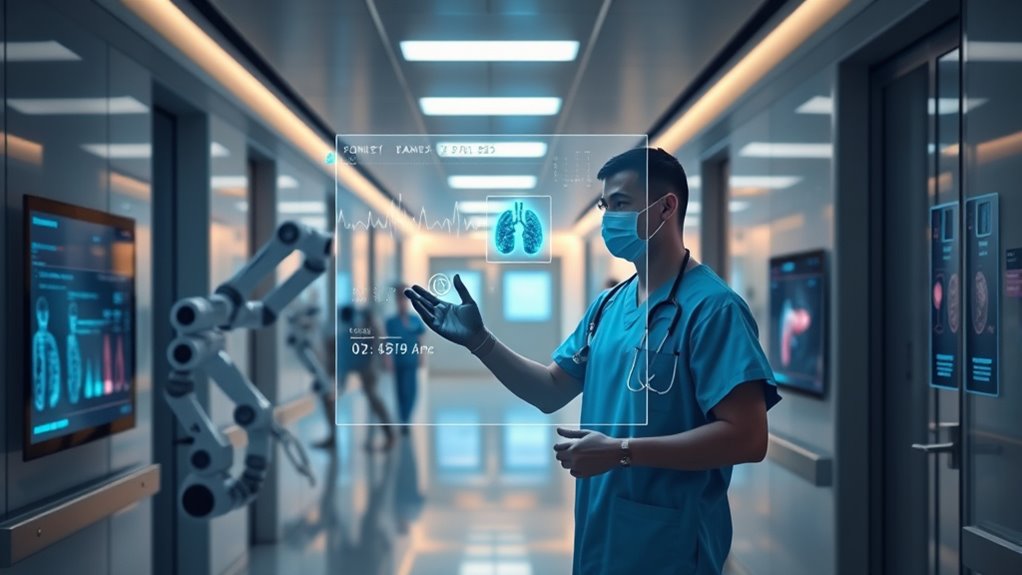
Have you ever wondered how artificial intelligence is revolutionizing healthcare? It’s transforming the way doctors diagnose, treat, and manage diseases, making care more precise and efficient. One of the most significant impacts of AI is in personalized medicine. Instead of delivering a one-size-fits-all treatment, AI analyzes vast amounts of data—genetic information, lifestyle factors, and medical history—to tailor therapies specifically for you. This approach improves outcomes because treatments are customized to your unique biology, reducing side effects and increasing effectiveness. Imagine a future where your healthcare provider can predict how you’ll respond to certain medications before you even start them. That’s the power of AI-driven personalized medicine. It accelerates the development of targeted therapies and ensures you receive the most appropriate care based on your individual profile.
AI personalizes healthcare by analyzing data to tailor treatments, improving outcomes and reducing side effects.
Another area where AI is making a profound difference is diagnostic imaging. Traditionally, interpreting X-rays, MRIs, or CT scans requires a trained radiologist to identify abnormalities, but AI tools now assist in this process with remarkable accuracy. These algorithms can analyze images faster than humans, spotting minute details that might be overlooked. For example, AI-powered diagnostic imaging can detect early signs of cancer, vascular diseases, or neurological conditions, often before symptoms appear. This early detection allows for prompt intervention, drastically improving your chances of successful treatment. Plus, AI systems continuously learn and improve, meaning their diagnostic precision gets better over time. This not only streamlines the workload for radiologists but also enhances the reliability of diagnoses, giving you greater confidence in your healthcare assessments. Additionally, integrating advanced imaging technology with AI can further refine diagnostic accuracy.
Furthermore, AI’s role extends beyond diagnostics. It helps optimize treatment plans by integrating diagnostic data with real-time monitoring, ensuring therapies adapt to your evolving condition. AI-driven tools also automate routine tasks, freeing up medical professionals to focus on patient care. In hospitals, AI-powered systems manage workflows, predict patient deterioration, and even assist in surgical procedures with robotic precision. All of these advancements reduce errors, speed up treatment, and ultimately make healthcare more accessible and effective for you.
As AI continues to evolve, its integration into personalized medicine and diagnostic imaging will become even more seamless. You’ll benefit from increasingly accurate predictions, tailored treatments, and faster diagnoses. The goal is to make healthcare more proactive rather than reactive, catching issues early and customizing interventions to your specific needs. This transformation promises a future where your health is managed with unprecedented precision, ensuring you receive the best possible care at every stage of life.
Frequently Asked Questions
How Does AI Impact Patient Privacy and Data Security?
You might worry about AI affecting your privacy, but healthcare providers use data encryption to protect your information and guarantee it’s secure. They also manage consent carefully, so you’re in control of what data is shared and used. AI systems help detect breaches quickly and improve security measures. With these protections in place, your patient privacy remains safeguarded while benefiting from AI-driven healthcare advances.
What Are Ai’s Limitations in Diagnosing Complex Diseases?
AI’s diagnostic accuracy can sometimes be a lighthouse in foggy waters, but it’s not infallible. You might find that complex diseases, like hidden puzzles, challenge algorithms, making predictions less reliable. Limited algorithm transparency means you can’t always see how decisions are made, like reading a mysterious map. So, while AI is a powerful tool, it still needs human insight to navigate the labyrinth of complex diagnoses effectively.
How Accessible Is AI Technology for Small Healthcare Providers?
AI technology is becoming increasingly accessible to small healthcare providers, but cost barriers still exist. You might find that some AI tools require substantial upfront investments, making adoption challenging. However, as technology advances and costs decrease, more small providers can integrate AI into their practice. By focusing on affordable solutions and leveraging cloud-based platforms, you can improve patient care without significant financial strain, promoting wider technology adoption.
What Training Is Required for Healthcare Professionals to Use AI Tools?
To effectively employ AI tools, you need targeted training that tackles technical tactics and clinical concepts. You’ll learn to analyze medical data, adapt to evolving clinical workflows, and navigate AI interfaces confidently. This training typically includes workshops, webinars, and hands-on practice, helping you understand algorithms, interpret insights, and guarantee seamless integration into daily practice. Ultimately, this equips you to leverage AI’s potential, improving patient outcomes and streamlining healthcare delivery.
How Does AI Affect the Doctor-Patient Relationship?
AI enhances your doctor-patient relationship by increasing telemedicine efficiency and diagnostic accuracy. You can discuss complex health issues more confidently, knowing AI supporting your doctor helps identify conditions faster and more precisely. This collaboration builds trust, as you receive quicker, data-driven insights. While AI handles data analysis, you maintain personal connection, making your experience more seamless and reassuring, ultimately strengthening the bond and improving health outcomes.
Conclusion
As you see, AI is revolutionizing healthcare by improving diagnostics and personalizing treatments. With over 86% of healthcare organizations adopting AI-powered tools, you’re part of a future where quicker, more accurate care becomes the norm. Imagine reducing diagnostic errors by up to 50%, saving countless lives and resources. Embracing AI means you’re helping shape a smarter, more efficient healthcare system—one that’s better equipped to meet everyone’s needs.