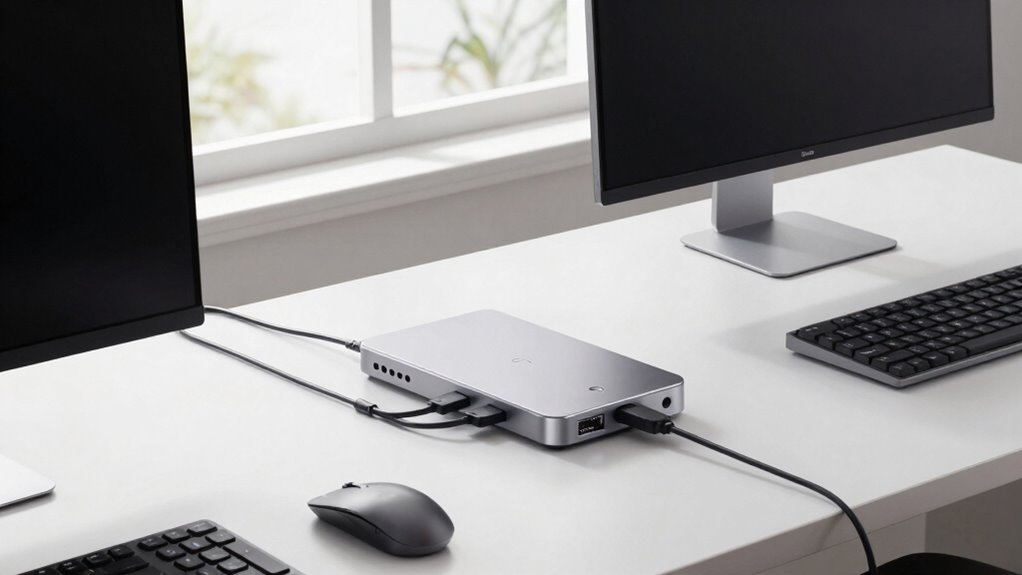

A docking station quietly boosts your AI laptop setup by providing stable, high-speed connections that reduce lag and interruptions. It centralizes your peripherals, minimizing clutter and making it easier to organize your workspace. Its ergonomic features help position your laptop comfortably, reducing strain during long sessions. Additionally, it helps prevent overheating and maintains system stability, improving overall performance. Keep exploring to discover how these features can transform your work environment even further.

Get hardware and tech essentials delivered free with Prime
- Fast, free delivery on millions of items
- Prime Video, Amazon Music and more included
- Member-only deals all year
Key Takeaways
- Enhance network stability for smooth, uninterrupted data transfer during intensive AI tasks.
- Provide ergonomic adjustments that reduce physical strain during long AI work sessions.
- Organize peripherals and cables, reducing clutter and improving workspace focus.
- Prevent overheating and improve device cooling for sustained high-performance AI processing.
- Ensure reliable connections, minimizing disruptions and maintaining consistent workflow efficiency.
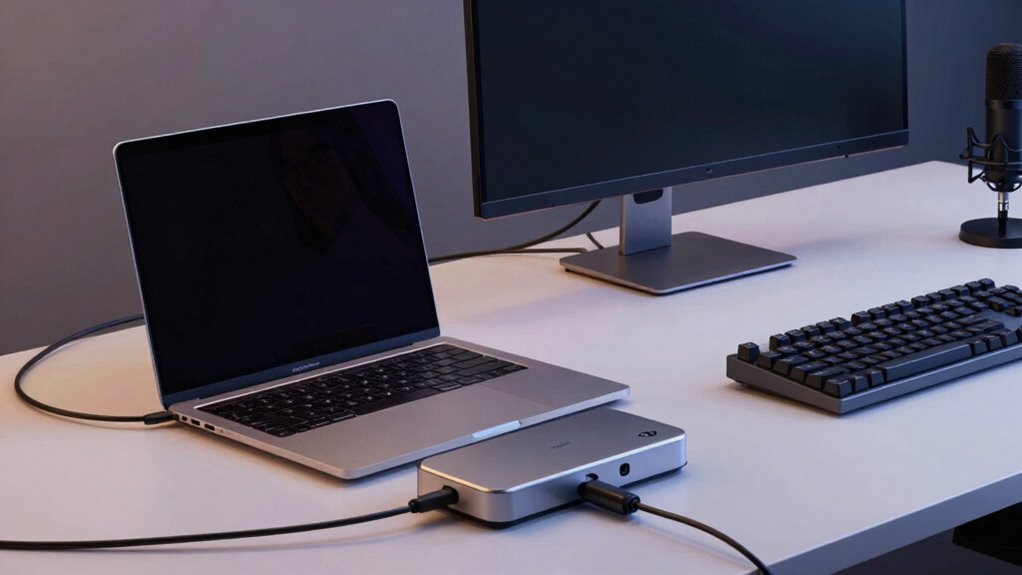
If you’re working with AI on a laptop, docking stations can considerably enhance your setup. They serve as a central hub that simplifies your workspace, allowing you to connect multiple devices effortlessly. One of the most noticeable benefits is improved wireless connectivity. With a good docking station, you can enjoy a stable, high-speed connection to your network, which is essential when handling large datasets or running intensive AI models. This stability reduces lag and interruptions, keeping your workflow smooth and uninterrupted. Many docking stations also offer integrated Wi-Fi or Bluetooth capabilities, so you can connect peripherals wirelessly without sacrificing speed or reliability. This means less clutter and more freedom to move around while maintaining a strong, consistent connection to your devices and the internet.
Beyond connectivity, the ergonomic design of modern docking stations plays a key role in enhancing your workspace. These stations are often built with user comfort in mind, featuring adjustable stands, easy-to-reach ports, and a layout that minimizes strain. When your laptop sits at an ideal height, you reduce neck and eye strain, which is especially important during long AI sessions. A well-designed docking station also declutters your desk by consolidating cables and connections into a single, organized hub. This neat setup allows you to focus on your work without the distraction of tangled wires or misplaced peripherals. Plus, many docking stations include additional features like cooling fans or ventilation slots, helping prevent your laptop from overheating during intensive tasks. Additionally, wireless connectivity plays a crucial role in maintaining a clutter-free workspace and ensuring seamless integration of peripherals. Incorporating a dedicated docking station can further improve overall stability and performance, making your AI work more efficient. Furthermore, optimizing the placement of your docking station can help improve workspace ergonomics and reduce physical strain during prolonged use. Proper workspace organization can also boost your productivity by creating a more efficient environment for quick task transitions. A well-optimized setup with a docking station can also help in enhancing productivity by reducing setup times and enabling quick transitions between tasks.
high-speed USB-C docking station for laptops
As an affiliate, we earn on qualifying purchases.
As an affiliate, we earn on qualifying purchases.
Frequently Asked Questions
Can Docking Stations Enhance AI Processing Speeds Directly?
Docking stations don’t directly boost AI processing speeds, but they improve your setup by enhancing data transfer and power delivery. With faster data transfer, your laptop can communicate more efficiently with external devices like GPUs or storage, reducing bottlenecks. Plus, reliable power delivery guarantees your laptop and peripherals stay charged during intensive tasks, allowing you to work seamlessly. So, while they don’t directly speed up processing, docking stations optimize your overall AI workflow.
Are Docking Stations Compatible With All Ai-Focused Laptops?
While docking stations may not be universally compatible with all AI-focused laptops, they often work seamlessly with many models. You’ll want to check peripheral compatibility and make certain the dock supports adequate power delivery for your device. If your laptop aligns with these features, it’ll likely integrate smoothly, enhancing your setup without any fuss. Compatibility varies, so always verify specifications before investing to keep your AI workflow running effortlessly.
Do Docking Stations Support High-Resolution AI Data Visualization?
Yes, docking stations support high-resolution AI data visualization. They enable fast data transfer, ensuring your large datasets move seamlessly between your laptop and peripherals. Additionally, they enhance display quality by supporting multiple high-resolution monitors, allowing you to visualize AI data in greater detail. This setup helps you work more efficiently, reducing lag and improving clarity, which is essential for precise AI analysis and visualization tasks.
What Security Features Do Docking Stations Offer for Sensitive AI Data?
Docking stations enhance security by offering features like data encryption and access control, ensuring sensitive AI data stays protected. You can configure secure login options and restrict device access, preventing unauthorized use. Many docking stations also support encrypted data transfer between your laptop and peripherals, reducing the risk of data breaches. Implementing these security features helps you safeguard your sensitive AI data seamlessly while maintaining efficient workflow.
How Do Docking Stations Affect AI Model Training Times?
Docking stations can speed up AI model training by providing higher power consumption and better GPU connectivity, enabling faster data processing. However, they may introduce portability concerns, as they’re often bulkier and less convenient to carry around. You might notice improved performance when connected, but weigh these benefits against the added weight and setup complexity, especially if you need a portable solution for on-the-go AI work.
ergonomic laptop docking station with adjustable stand
As an affiliate, we earn on qualifying purchases.
As an affiliate, we earn on qualifying purchases.
Conclusion
In the end, docking stations quietly transform your AI laptop setup, making it more efficient and flexible. They streamline your workspace, much like a well-organized library in the days before digital archives, ensuring you’re always ready to innovate. Embracing this tech upgrade is like discovering fire in a cave—simple yet revolutionary. So, don’t wait for the Renaissance; upgrade now and let your AI projects flourish with the silent power of a docking station.
laptop docking station with cooling fan
As an affiliate, we earn on qualifying purchases.
As an affiliate, we earn on qualifying purchases.
wireless connectivity docking station for AI laptops
As an affiliate, we earn on qualifying purchases.
As an affiliate, we earn on qualifying purchases.
Halloween Picks
halloween
As an affiliate, we earn on qualifying purchases.