
TL;DR

Get hardware and tech essentials delivered free with Prime
- Fast, free delivery on millions of items
- Prime Video, Amazon Music and more included
- Member-only deals all year
Mistral is betting on sovereignty, open weights, and efficiency to carve out a niche in AI, especially for regulated European markets. Whether this strategy is a lasting moat or a short-term advantage depends on how larger labs respond and market demand for control versus scale.
In just over a year, Mistral went from a fresh startup to a powerhouse with hundreds of millions in revenue. But what’s really behind its rapid rise? It’s not just about models or tech breakthroughs. It’s about a strategic shift toward sovereignty, control, and local deployment — especially in Europe.
This isn’t a typical AI story of scaling the biggest models. It’s about building an ecosystem where control, compliance, and independence matter more than chasing the largest possible model. Today, you’ll see whether Mistral’s approach is a clever niche or a sign it’s already lost the big game.
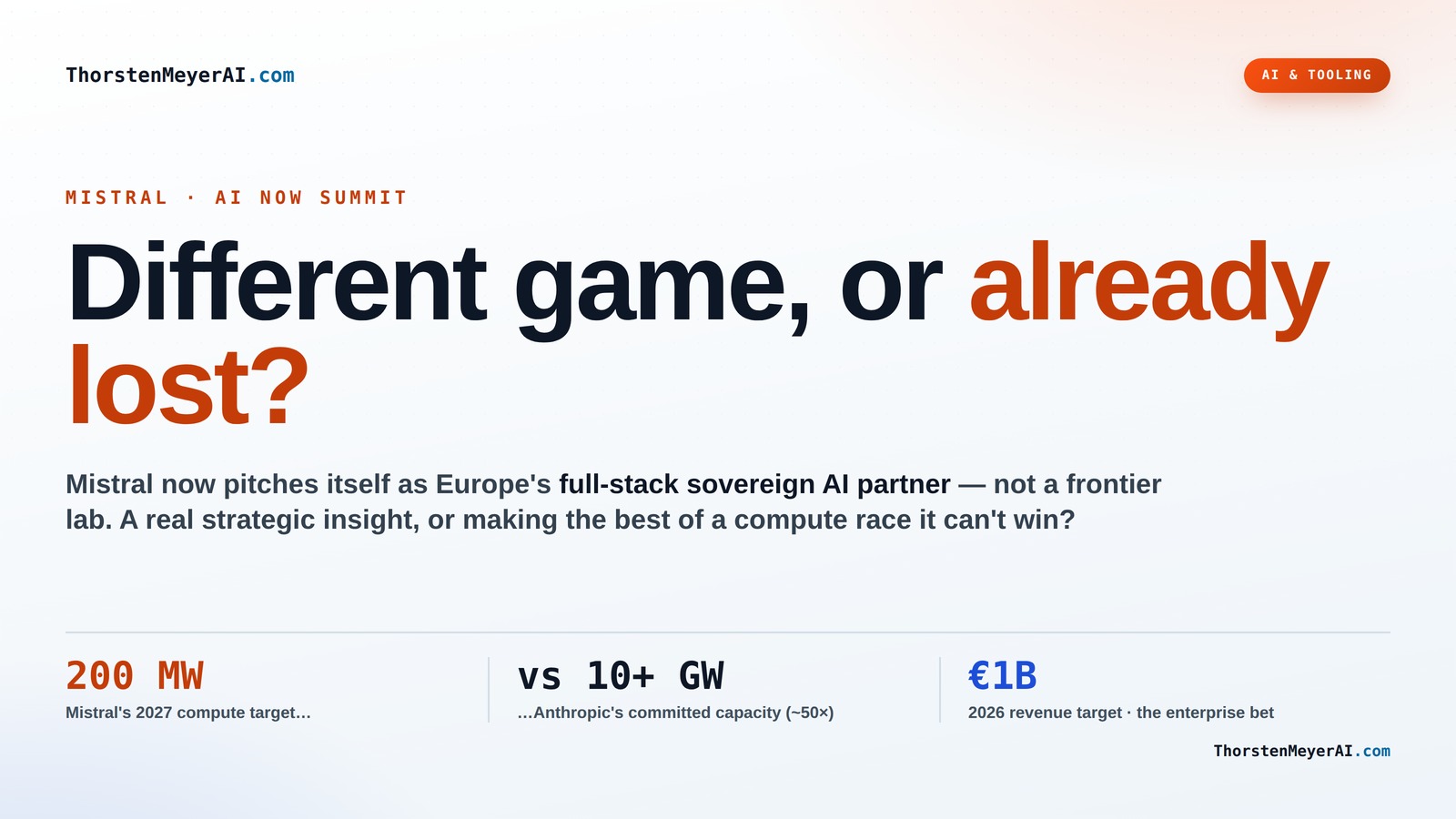
Different game, or already lost?
Mistral now pitches itself as Europe’s full-stack AI provider — compute, models, platform, consultancy — not a frontier-model lab. Is that a real strategic insight, or making the best of a race it can’t win? Both readings fit the same facts.
From model lab to full-stack provider
The clearest signal from the summit wasn’t a model — it was a posture. Heavy on enterprise logos and partnerships (ASML, BNP Paribas, Alexa+), light on new-model announcements. That absence is exactly what skeptics seized on.
Compute
40MW Paris DC + Sweden build · 200MW target by 2027
Models
Open & custom · efficient · you own and run them
Platform
Forge for custom models · Vibe for Work agent
Consultancy
Sales teams, integrators, EU provenance & support
Small & focused, or large & general?
Mistral bets on specialized small models. The claim isn’t that they win a reasoning leaderboard — they don’t. It’s that on the metrics that matter in production agent systems, a purpose-built small model wins. Flip the metric to see the case reverse.
Small specialized vs large general — by what you measure
In token-heavy agentic apps making hundreds of calls, speed/energy/cost compound. Toggle the metric.
Narrow models doing real work
Each is one model doing one thing efficiently — the tangible version of the strategy. Strong on their own terms; the open question is whether the bundle beats a free Chinese open-weight download.
On-prem KYC compliance
Mistral models run inside the bank’s walls for know-your-customer checks. Sensitive financial data never leaves. (BNP was Mistral’s first customer, 2023.)
Voxtral multilingual voice
A focused voice model powering Alexa+ across Europe — speed and efficiency over raw size.
Robostral industrial robotics
Plus a “physics AI” push (via the Emmi acquisition) into aerospace, automotive & semiconductor design and simulation.
Document AI / OCR at scale
Large-scale text extraction — the unglamorous, high-volume enterprise work small models excel at.
The strategy is downstream of the compute gap
Once you see the raw numbers, “why is Mistral behind?” answers itself — and the specialized-small-model strategy starts looking partly like a smart adaptation to a binding constraint, not a pure philosophical choice.
Compute & capital · Mistral vs a frontier leader, this same week
Not a knock — it’s the constraint that forces the efficiency-first, sovereignty-wedge strategy. Adapting intelligently to your position is what good strategy is.
“I want them to win, but I’m worried”
That ambivalence is the most accurate read of where Mistral sits. The enterprise pivot gets read two opposite ways — and both deserve airing.
On-prem, real sales teams, the Koyeb deployment acquisition, EU provenance — exactly what regulated enterprises want, and stickier than consumer mindshare. Targeting €1B revenue in 2026 with 1,000 staff, up from 15 people and one customer in 2023. US closed-API labs structurally can’t match the sovereignty axis.
“Software consultancy with a data center,” not a foundation-model moat. Enterprise B2B is where European startups go when they can’t win consumer or world-scale SaaS. Why pay Mistral on-prem when you could run Qwen free? One paying Le Chat Pro user said the quality gap with frontier labs is now hard to ignore.
Key Takeaways
- Mistral’s sovereignty focus targets regulated European markets, emphasizing control over data, models, and infrastructure.
- Open-weight models under permissive licenses give Mistral a strategic edge in local deployment and customization.
- Efficiency-driven small models excel in enterprise use cases where speed, cost, and control matter more than raw AI power.
- Europe’s push for AI independence underpins Mistral’s growth, but reliance on external chips and cloud infrastructure remains a challenge.
- The big question: Is Mistral’s niche strategy sustainable long-term, or is it a temporary advantage in a competitive landscape?
As an affiliate, we earn on qualifying purchases.
What Does 'Sovereign' Really Mean for Mistral?
Sovereignty in Mistral’s world means more than just hosting data locally. It’s about control over the entire AI stack—models, data, infrastructure, and governance. Think of a French bank running Mistral models inside its own data center, fully compliant with EU rules, avoiding US cloud dependency.
This focus appeals to governments, regulated industries, and companies wary of foreign influence. For example, BNP Paribas uses Mistral models on-prem to handle sensitive financial info—keeping it all under European jurisdiction.
In practice, sovereignty is less about absolute independence and more about agency. You want to steer your AI, not be at the mercy of external cloud giants or US-based providers. It’s a strategic shield for those who prioritize control over sheer scale.
Why this matters: True sovereignty can enable faster compliance with local laws, reduce geopolitical risks, and foster trust with customers who are increasingly concerned about data privacy. However, this approach often involves tradeoffs—like higher costs, limited access to the latest innovations, and reliance on local infrastructure that may lag behind global standards. These tradeoffs could impact Mistral’s ability to scale rapidly or innovate at the same pace as larger, more open ecosystems.

AI model deployment infrastructure
As an affiliate, we earn on qualifying purchases.
As an affiliate, we earn on qualifying purchases.
Why Open-Weight Models Give Mistral an Edge
Mistral’s open weights—like Mistral 7B and Mixtral 8x7B—are a game-changer. They’re released under permissive licenses like Apache 2.0, which means anyone can download, fine-tune, and run them on their own hardware.
Imagine a European bank customizing a model exactly for its needs, then hosting it internally. No dependencies on US cloud APIs or data-sharing agreements. That’s a level of control no closed API can match.
This open-weight approach also fuels innovation and reduces dependency on a few global giants, industry insights. It’s a strategic move to foster a local, self-reliant AI ecosystem, especially critical in Europe’s regulatory landscape.
Deepening this point: Open weights empower organizations to adapt models precisely to their unique requirements, which is crucial in regulated sectors where compliance and security are paramount. It also enables a more resilient supply chain—if one provider faces issues, organizations can switch or modify models without waiting for vendor updates. However, this approach might limit access to the most cutting-edge research and large-scale models that are often proprietary. Smaller, open models may be less capable on the edge of reasoning and generalization, creating a tradeoff between control and raw AI power.

As an affiliate, we earn on qualifying purchases.
How Mistral Uses Efficiency to Win in Production
Mistral pushes small, purpose-built models that prioritize speed, energy efficiency, and cost per token—factors that matter in real-world applications. For example, their models used by the European Patent Office for text extraction process large volumes of documents quickly and cheaply.
Unlike giant models that cost a fortune to run, these smaller models shine in scenarios like voice assistants or industrial robotics, where speed and control are king. Their mixture-of-experts architecture activates only parts of the model as needed, slashing compute costs.
This focus on efficiency isn’t just about saving money; it’s about enabling local deployment at scale—crucial for regulated sectors and companies wary of cloud reliance.
Why this matters: By optimizing for efficiency, Mistral can deliver tailored solutions that meet strict latency, privacy, and cost requirements. This approach reduces barriers to deployment in environments where cloud access is limited or undesirable, such as in defense or critical infrastructure. However, these smaller models may have limitations in handling complex reasoning tasks compared to larger, more comprehensive models. The tradeoff is a focus on practicality and immediacy over pushing the boundaries of AI capability, which aligns with specific enterprise needs but might limit competitive edge in general AI research.

As an affiliate, we earn on qualifying purchases.
Europe’s Push for AI Independence — Mistral’s Big Bet
The EU’s political climate champions AI sovereignty—less dependence on US and Chinese tech giants. Mistral’s growth aligns with this push, especially as it generates about 60% of its revenue from Europe.
By focusing on local deployment, support, and compliance, Mistral taps into the European desire for self-reliance. Its models are designed for jurisdictions with strict data laws, making them attractive for banks, governments, and defense contractors.
This isn’t just a marketing angle; it’s a strategic positioning that could give Mistral a durable advantage if Europe continues to build barriers around foreign AI dependence.
Implications: This focus on regional sovereignty could insulate Mistral from some global competitive pressures, but it also risks limiting access to broader markets and the latest global innovations. If European policy shifts or trade tensions escalate, Mistral’s reliance on regional support might become both a strength and a vulnerability—potentially restricting growth or access to international collaborations.

Can Mistral Compete on Quality or Just Flexibility?
That’s the core question. Mistral’s models aren’t yet as large or as advanced as OpenAI’s GPT-4 or Anthropic’s Claude. But their focus on specialized, efficient models means they can be deployed faster, cheaper, and with more control.
For example, a European manufacturer uses Mistral’s smaller models to automate quality checks on assembly lines. It doesn’t need the cutting-edge reasoning of GPT-4; it needs quick, reliable, local AI.
In this sense, Mistral’s strength lies in deployment flexibility and control, not necessarily in beating big labs on raw AI power.
Why this matters: While larger models may have superior reasoning and generalization abilities, many enterprise applications prioritize reliability, speed, and compliance over pushing the limits of AI research. Mistral’s targeted approach can be more effective in specific, controlled environments, especially where regulations or latency are critical. The tradeoff is that it may not be able to compete in tasks demanding the most advanced AI reasoning, but it offers a pragmatic alternative for practical deployment.

Limits and Contradictions in Mistral’s Sovereignty Approach
While Mistral’s strategy is compelling, it’s not without challenges. Sovereignty often depends on local infrastructure—power, chips, cloud access. If these remain foreign-controlled, is the control real?
For example, a French defense contractor might run Mistral models locally but still rely on foreign chips or cloud components, limiting true independence.
Plus, larger companies could simply develop similar open weights or acquire local startups. The question then becomes: is this a sustainable moat or a temporary advantage?
Deep implications: Achieving genuine sovereignty involves not just deploying models locally but also securing the entire supply chain—chips, hardware, software, and cloud. If critical components are still controlled externally, the sovereignty claim weakens, exposing vulnerabilities. Moreover, as the market matures, larger players might leverage economies of scale to develop comparable open models or acquire local talent, eroding Mistral’s first-mover advantage. The tradeoff here is between the strategic intent of independence and the practical realities of globalized infrastructure, which could limit long-term sustainability.

Is Mistral Building a Durable Niche or Just a Fad?
This is the million-dollar question. Supporters see Mistral’s focus on sovereignty, open weights, and efficiency as a real market segment—one that larger labs might struggle to dominate. The demand for local, controlled AI grows in Europe and beyond.
Skeptics warn that as cloud giants improve their compliance tools and open models, Mistral’s advantage could fade. Plus, the broader AI race still favors scale and reasoning prowess.
In the end, whether Mistral’s approach is a lasting fortress or a short-term niche depends on future policy shifts, technological breakthroughs, and enterprise demand for control. It’s a strategic gamble that hinges on the sustainability of regional regulation and the pace of innovation in open models. If these factors align, Mistral could carve out a durable position; if not, it risks becoming a transient player.
Frequently Asked Questions
What does 'sovereign' actually mean in Mistral’s case?
In Mistral’s context, sovereignty means control over AI models, data, and infrastructure within European jurisdictions, reducing dependence on foreign cloud providers and ensuring compliance with local laws.How is Mistral different from OpenAI or Anthropic?
Mistral emphasizes open weights, local deployment, and efficiency, targeting regulated markets. In contrast, OpenAI and Anthropic mainly offer closed API models focused on scale and broad accessibility.Is Mistral truly open source?
Mistral releases models like 7B and Mixtral 8x7B under permissive licenses like Apache 2.0, making them downloadable, customizable, and self-hostable—offering more control than closed APIs.Why do governments and regulated industries care so much about sovereignty?
These organizations prioritize control over sensitive data and compliance with strict local laws. Sovereign AI helps them reduce reliance on foreign infrastructure and mitigate geopolitical risks.Is Mistral building a durable moat or just a niche?
It’s a mix. The demand for control and local deployment in Europe suggests a sustainable niche, but broader market shifts toward scale and reasoning might challenge its long-term dominance.Conclusion
Mistral’s strategy isn’t about beating the biggest labs on scale—it’s about winning the control game in Europe and regulated sectors. That’s a smart move, but it’s not invincible. The real test will be whether demand for sovereignty grows fast enough to sustain this niche as larger players catch up.
For now, keep your eye on how policy, tech, and enterprise needs evolve. Sovereignty might be more than a trend—it could become the new standard for critical AI deployments.

Evergreen bestsellers Picks
bestsellers
As an affiliate, we earn on qualifying purchases.