

Agentic AI has the potential to fundamentally change how your enterprise operates by enabling autonomous decision-making and real-time workflow adjustments. As these systems grow more intelligent, they will support your teams with continuous learning and adaptive responses, making organizations more agile and efficient. But understanding the full impact requires exploring how these technologies will reshape roles, processes, and competitive advantage—topics that are just beginning to unfold.
Key Takeaways
- Agentic AI enables autonomous decision-making, making business operations faster, more efficient, and highly adaptive.
- Human-AI collaboration improves decision quality by combining machine insights with human context and ethics.
- Roles shift as humans supervise AI systems, focusing on oversight while AI automates routine and complex tasks.
- Continuous learning in AI systems enhances operational accuracy and reduces errors across various enterprise functions.
- Managing data privacy and security becomes critical as AI analyzes large datasets to inform enterprise strategies.
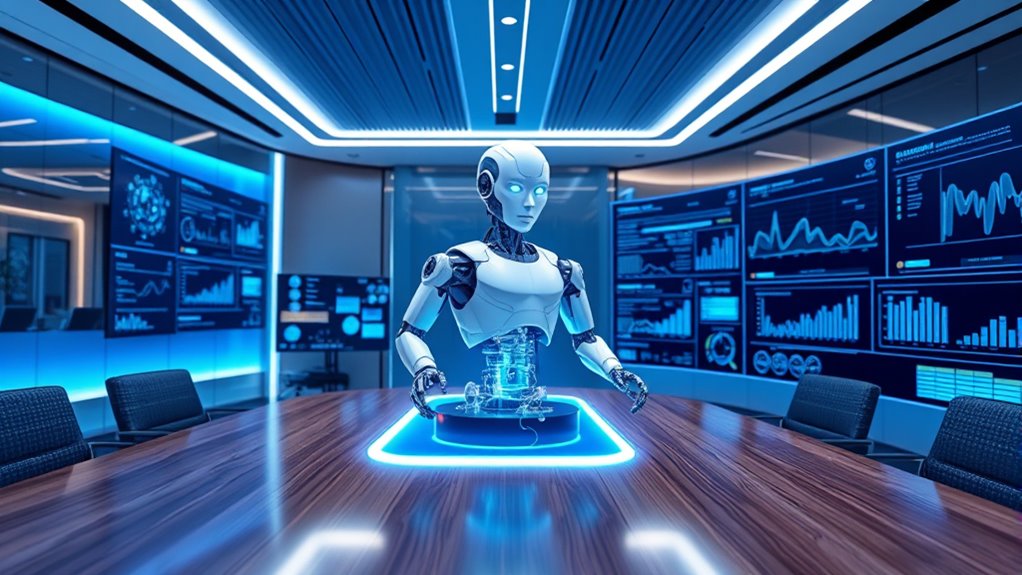
As artificial intelligence advances, agentic AI systems are increasingly transforming how enterprises operate. These systems don’t just process data; they act autonomously, making decisions that traditionally required human oversight. This shift is centered around AI-driven decision making, where intelligent algorithms analyze vast amounts of information to generate insights and execute actions with minimal human intervention. Such capabilities allow businesses to operate faster, more efficiently, and with greater precision. Instead of static tools, these AI systems become active participants in the enterprise, dynamically responding to changing conditions and optimizing workflows in real-time.
One of the most significant impacts of agentic AI is how it fosters human-AI collaboration. Rather than replacing humans, these systems augment their capabilities, enabling employees to focus on strategic, creative, or complex tasks that require human judgment. As you interact with these AI agents, you’ll notice how they serve as intelligent assistants—suggesting solutions, automating routine processes, and providing insights that were previously hard to uncover. This collaboration enhances decision quality since AI can sift through enormous datasets swiftly, revealing patterns and anomalies that might escape human eyes. In turn, humans provide context, ethical considerations, and nuanced understanding, guiding AI actions and guaranteeing that automated decisions align with organizational values and goals.
Human-AI collaboration enhances decision quality by combining AI insights with human judgment and ethical considerations.
Moreover, your role within the enterprise evolves as agentic AI takes on more decision-making responsibilities. You become a supervisor of AI systems, setting parameters, overseeing outcomes, and adjusting strategies based on AI recommendations. This partnership allows for a more agile approach to problem-solving, where decisions are not solely reliant on human intuition but are supported by data-driven insights generated in real-time. As a result, organizations become more adaptable, able to respond swiftly to market shifts or operational challenges.
In practical terms, you’ll experience AI-driven decision making in various departments—from supply chain management optimizing logistics, to customer service bots handling inquiries autonomously, to financial systems detecting fraud. These AI agents continuously learn from their environment, improving their performance over time and reducing errors. Human-AI collaboration ensures that while AI provides rapid, data-backed insights, humans retain control over critical, ethical, or sensitive decisions. This synergy maximizes efficiency while maintaining accountability.
Additionally, understanding the importance of privacy policies and how data is managed becomes crucial as these AI systems gather and analyze vast amounts of information. Ultimately, agentic AI is poised to reshape enterprise landscapes by creating a seamless blend of human expertise and machine intelligence. Instead of viewing AI as a replacement, you’ll see it as a powerful partner that enhances decision making, accelerates innovation, and drives smarter, more responsive organizations. The future of work lies in this collaboration, where human insight and AI’s capabilities work hand-in-hand to access new levels of enterprise performance.
Conclusion
As you embrace agentic AI, you’ll find it gently guiding your enterprise toward smoother, more responsive operations. It lovingly takes on routine tasks, freeing you to focus on what truly matters—innovation and human connection. By working hand-in-hand with this intelligent partner, your organization will naturally become more adaptable and resilient. Together, you’ll navigate change with confidence, enjoying a future where technology quietly empowers you to achieve excellence every step of the way.