
📊 Full opportunity report: The Heir’s Guide To Grading Financial Advice on IdeaNavigator AI — validation score, market gap, and execution plan.
TL;DR
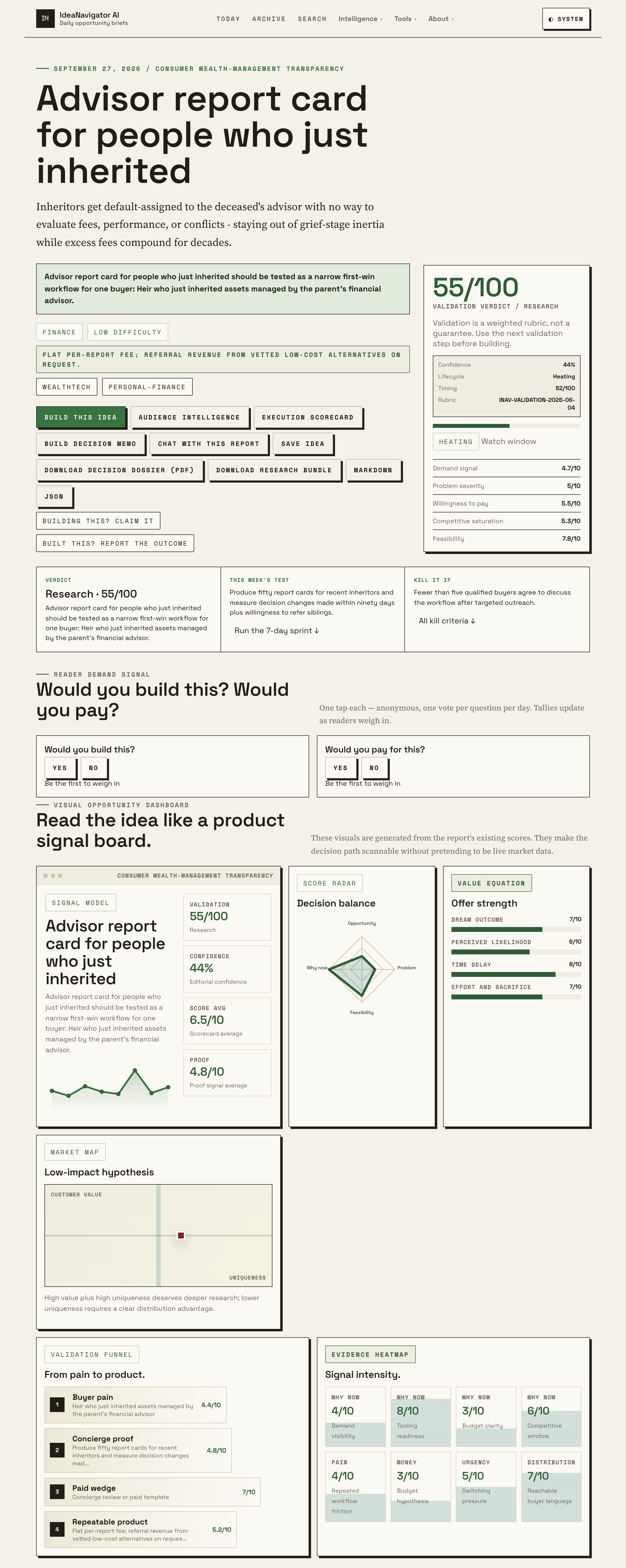
IdeaNavigator AI proposes a report card for people who inherit assets managed by a parent’s financial adviser. The concept would analyze statements and public disclosures, but it remains a proposed product; no results from a user test or evidence of consumer demand are provided.
IdeaNavigator AI has proposed testing an adviser report card for people who inherit assets managed by a parent’s financial adviser. The proposed service would use account statements and public regulatory disclosures to summarize fees, performance and conflicts, then offer guidance on whether to stay, negotiate or switch; no product launch or test results are reported.
The concept targets a specific situation: an heir receives assets that were already under a parent’s adviser and must decide whether to continue that relationship. IdeaNavigator AI describes the risk as a default handoff during a period of grief, when an heir may have little time or information to assess the adviser’s costs and incentives. That is the proposal’s account of the problem, not a finding supported here by measured data on inheritors’ decisions.
For a minimum viable product, the heir would enter the adviser’s name and upload account statements. The proposed report would gather regulatory history and disclosed conflicts, estimate all-in fees from the statements, compare the adviser with alternatives, and provide stay, negotiate or switch guidance with scripts. The proposal identifies Form ADV and fee disclosures as public records that could contribute to an evaluation, and says large language model document parsing could help automate the work. It does not describe the model’s accuracy, review process or data protections.
The proposed business model combines a flat fee per report with referral revenue if a user asks for vetted, lower-cost alternatives. The suggested validation is to produce 50 reports for recent inheritors and track whether users change advisers or their decisions within 90 days, as well as whether they refer siblings. No completed reports, conversion figures or willingness-to-pay results are included.
A Decision at a Family Handoff
If developed and validated, a report that translates account statements and regulatory disclosures into a readable comparison could give heirs a more structured starting point for a consequential financial decision. The proposal focuses on a moment when control of assets changes hands and the inherited adviser may remain in place by default. A fee review could matter over a long period, but the proposal supplies no evidence quantifying how much heirs currently pay, how often fees are excessive, or what savings the tool might produce.
The commercial design also raises a question about incentives. A service paid for each report could be separate from asset management, while referral revenue from alternative advisers could influence which options appear. The proposal says referrals would be to vetted, lower-cost alternatives, but gives no vetting criteria or explanation of how recommendations would be ranked. Those details would shape whether users can treat the report as an independent assessment.
The suggested 90-day test would track decision changes and sibling referrals. Those measures could show whether users act on the report and find it useful enough to share. They would not, on their own, establish that a recommendation was suitable or that a fee comparison accurately captured each adviser’s services and investment risk.
The Proposed Test and Its Inputs
The proposal frames its timing around a large transfer of wealth to heirs over the coming decade, but it gives no dollar estimate, cited forecast or country-specific scope. It also points to the availability of public adviser information and advances in automated document parsing as reasons the workflow may now be feasible. These are the rationale offered for exploring the product, rather than proof that automated evaluation is reliable or that a particular market is ready to adopt it.
The envisioned report combines two different kinds of information. Public regulatory records can include adviser disclosures and disciplinary history, while statements may show what a particular client paid. Comparing fees meaningfully could still depend on the account, services received, assets held and how performance is measured. The proposed outline does not specify its benchmarks or explain how it would account for differences in investment strategy, risk, taxes or service levels.
IdeaNavigator AI positions the idea within consumer wealth-management transparency and recommends starting with recent inheritors rather than a broad adviser-evaluation market. That narrow target makes the proposed test measurable: identify whether report recipients make a decision within 90 days and whether they recommend the service to siblings. The proposal does not say how participants would be recruited, how many would complete the test, or what results would count as sufficient demand.
Accuracy, Incentives and Demand
The concept has no reported launch, pilot or user results. It is not clear whether inheritors would pay a flat fee, whether the analysis could reliably extract all-in costs from varied statements, or how the service would handle incomplete or inconsistent disclosures. The proposal does not define the performance benchmarks or the evidence needed to support stay, negotiate or switch guidance.
It also remains unclear how the service would protect sensitive financial documents, review automated findings, resolve errors or present referral-funded alternatives without distorting the comparison. No specific advisers, fees, conflicts or consumer outcomes are documented. The stated concern about heirs defaulting to a parent’s adviser is presented as the problem the product aims to address, but no prevalence data are supplied.
A 50-Report Validation Test
The next step described by IdeaNavigator AI is a test involving 50 recent inheritors. The team behind the concept would measure decision changes within 90 days and willingness to refer siblings. No timetable, participant recruitment plan or threshold for judging the test successful is provided, so it is not clear when or whether the study will happen.
If the test proceeds, useful results would distinguish report delivery from action: how many heirs review the findings, negotiate or switch, and whether those decisions reflect verified fee comparisons. Details on adviser vetting, referral disclosures, data handling and human review would also clarify how the service might operate. Until such information is available, the report card remains a product proposal rather than a demonstrated way to reduce costs.
Source: IdeaNavigator AI
Key Questions
What is the proposed report card?
It is a proposed service for people who inherit assets managed by a parent’s financial adviser. It would summarize fees, regulatory history and disclosed conflicts, then offer stay, negotiate or switch guidance.
Is the service available now?
The proposal reports no launch or pilot. It outlines a minimum viable product and a possible test with recent inheritors.
How would the report assess an adviser?
The proposed workflow would use the adviser’s name, public disclosures and uploaded account statements. It is meant to estimate all-in fees and compare alternatives, but its benchmarks and accuracy have not been specified.
How would the proposed service make money?
IdeaNavigator AI suggests charging a flat fee per report and earning referral revenue when users request vetted, lower-cost alternatives. The proposal does not describe the vetting or ranking rules.
What evidence would show the idea works?
The suggested test would produce 50 reports and track decision changes within 90 days, along with referrals to siblings. No test results or success criteria are available.
Source: IdeaNavigator AI