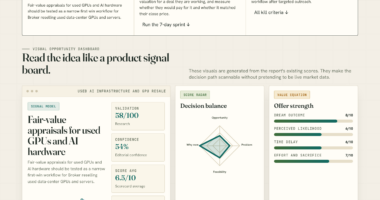

📊 Full opportunity report: The Door: Why the Interface Is Worth More Than the Model on ThorstenMeyerAI.com — validation score, market gap, and execution plan.

Get hardware and tech essentials delivered free — and shop member deals
- Fast, free delivery on millions of items
- Access to Prime Big Deal Days deals on October 6–7
- Prime Video, Amazon Music and more included
TL;DR
SpaceX bought a coding interface for $60 billion, emphasizing that the interface, not the AI model, is now the most valuable asset. Control over the user interface determines routing, habits, and data flow in AI ecosystems.
SpaceX’s recent $60 billion purchase of a coding interface marks a pivotal shift in AI industry dynamics, emphasizing that the interface — the surface where developers and users interact — is now more valuable than the underlying models. This move highlights the importance of control over the user experience and data flow, which can determine the dominant players in AI deployment.
In June 2024, SpaceX acquired Cursor, a leading coding interface built on top of multiple AI models, for approximately $60 billion. Unlike models, which are increasingly commoditized and driven by hardware costs and open weights, the interface serves as the primary point of interaction for developers and end-users. SpaceX’s purchase underscores a strategic focus: owning the interface means controlling the default routing of AI demand, user habits, and the data that feeds back into the ecosystem.
This transaction exemplifies a broader industry trend where the surface—the interface—is becoming more valuable than the models themselves. Anysphere, the original creator of Cursor, had built a platform generating around $4 billion annually, rebuffing competitors like OpenAI and Microsoft before being acquired by SpaceX. The interface’s value lies in its ability to channel user demand and data, rather than the raw AI models underneath.
Furthermore, recent developments in web interfaces and browsers, such as OpenAI’s Atlas and Perplexity’s Comet, demonstrate that control over the interface can determine which models are used, how users engage, and what data is collected. Major tech companies like Google and Microsoft are integrating AI features directly into their OS-level interfaces, reinforcing the importance of the surface layer in AI distribution.
The Door: Worth More Than the Model
SpaceX paid $60B for a coding tool — not a model. As the model commoditizes, the surface the human touches captures the value: the default, the habit, the data, and the choice of which model gets called.
Perplexity
The most valuable chokepoint — and, strangely, the most winnable. You can’t bootstrap a gigawatt or a 555K-GPU cluster, but a small team can still build the door (Cursor was a few founders on rented models). Own the interface and the user relationship even if you rent everything underneath — and never let a platform’s default be your only door to your users.
Why Interface Control Is the New AI Power Play
The purchase signifies that controlling the interface—the point where users engage with AI—is now more strategically valuable than owning the models. This shift impacts how demand is routed, how user habits are formed, and how data is collected, creating a new chokepoint in AI dominance. Companies that own the interface can influence which models are called, shape user behavior, and extract more value from the data generated. This redefines the competitive landscape, making the interface the most critical asset in AI deployment.
As an affiliate, we earn on qualifying purchases.
Industry Shift Toward Interface Dominance
For years, the AI industry focused on developing more powerful models, with the assumption that the model’s intelligence was the key to success. However, as hardware costs decrease and open weights become more accessible, models are becoming commodities. Meanwhile, the interface—be it a browser, API, or app—serves as the primary gateway for users and developers. Recent launches like OpenAI’s Atlas and integrations by Google and Microsoft show that control over these surfaces is now central to capturing value and influence in AI ecosystems. The $60 billion valuation of Cursor by SpaceX underscores this shift, illustrating that the real battleground is the interface layer, not the models beneath.
“Our investment in Cursor reflects our belief that the interface is the most valuable asset in AI today.”
— SpaceX spokesperson
As an affiliate, we earn on qualifying purchases.
What Aspects of the Acquisition Are Still Unclear
Details about how SpaceX plans to leverage Cursor beyond the acquisition are still emerging. It remains unclear whether SpaceX will develop its own AI models or primarily focus on controlling the interface and routing demand. Additionally, the broader impact on existing AI ecosystems and competitors’ strategies is still uncertain, as the industry adapts to this shift in value from models to interfaces.
As an affiliate, we earn on qualifying purchases.
Expected Developments Following the Acquisition
In the coming months, observers will watch how SpaceX integrates Cursor into its broader AI and hardware ecosystem. The company may develop new features to enhance demand routing and data collection, potentially influencing the competitive landscape. Industry analysts will also monitor whether other major players accelerate their efforts to own or develop dominant interfaces, signaling a new phase in AI distribution and control.
As an affiliate, we earn on qualifying purchases.
Key Questions
Why is owning the interface more valuable than owning the AI model?
Because the interface determines the default model used, captures user habits, and controls the flow of data and demand, making it the critical point of influence in AI ecosystems.
What does SpaceX’s $60 billion purchase imply for the AI industry?
It signals a strategic shift where control over the user interface becomes more valuable than the models themselves, potentially reshaping competitive dynamics.
Will this change how AI models are developed or distributed?
Yes, companies may focus more on building or acquiring interfaces that can steer demand and data, rather than solely competing on model performance.
Is this trend likely to continue with other tech giants?
Likely, as control over interfaces and distribution channels offers a significant strategic advantage in the AI ecosystem.
What are the risks of focusing on interfaces rather than models?
It could lead to monopolization of access points, increased dependence on certain platforms, and potential regulatory scrutiny over control and data privacy issues.
Source: ThorstenMeyerAI.com
Fall Picks
fall essentials
As an affiliate, we earn on qualifying purchases.