
📊 Full opportunity report: AI Signals And Trends Suggest A Move Toward Data Center REIT-like Structures on IdeaNavigator AI — validation score, market gap, and execution plan.

Get hardware and tech essentials delivered free with Prime
- Fast, free delivery on millions of items
- Prime Video, Amazon Music and more included
- Member-only deals all year
TL;DR
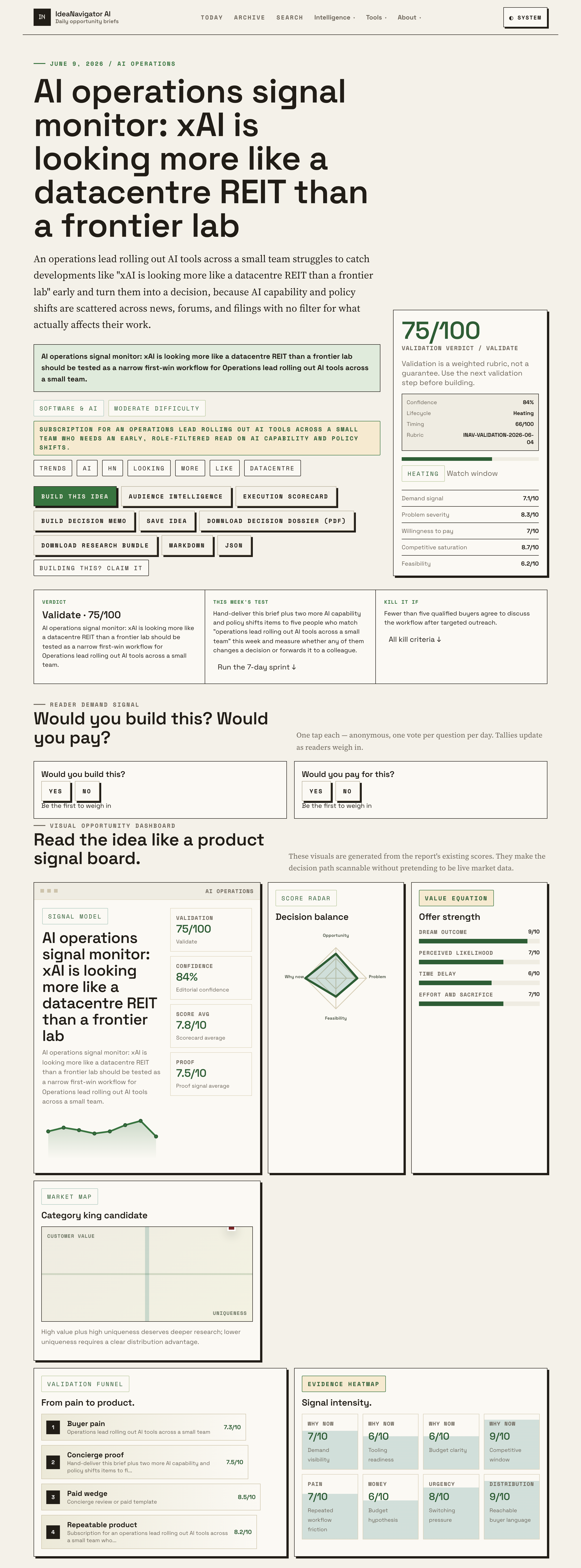
Recent AI capability and policy signals indicate a trend toward data center REIT-like structures in AI infrastructure. This shift could influence investment and operational strategies, with early signs observed in AI monitoring tools.
Emerging AI capability and policy signals suggest a shift toward data center REIT-like structures in AI infrastructure, a development that could reshape investment and operational approaches in the sector. These signals, identified through targeted monitoring of AI news and forums, indicate a possible trend toward consolidating AI infrastructure under models similar to real estate investment trusts (REITs).
Recent analysis from IdeaNavigator AI highlights that AI operations signals, such as discussions on Hacker News, point to a growing resemblance between AI infrastructure management and data center REIT models. Specifically, the signals include references to AI companies, like xAI, appearing to adopt structures akin to REITs, emphasizing scalable, asset-heavy models focused on infrastructure deployment rather than frontier research. These developments are driven by the need for efficient capital deployment and operational scalability in rapidly expanding AI workloads.
Experts note that the trend is still emerging, with no official industry-wide shift confirmed. The signals are primarily based on online discussions and filings that suggest a strategic pivot in how AI companies may approach infrastructure investments—favoring models that resemble real estate investment trusts, which are characterized by stable, income-generating assets. This could lead to a new class of AI-focused REIT-like entities that prioritize infrastructure assets over pure research or software development.
Implications for AI Infrastructure Investment
This potential shift toward data center REIT-like structures is significant because it could alter how AI infrastructure is financed, owned, and operated. Investors may see new opportunities for stable, income-generating assets within the AI sector, similar to traditional REITs in real estate. For AI companies, adopting these models could mean more predictable capital costs and operational efficiencies, enabling faster scaling of AI capabilities. Overall, this trend might redefine the landscape of AI infrastructure investment and management, affecting stakeholders across technology, finance, and real estate sectors.
Products Worth Considering

Sonos Era 100 Wireless Smart Speaker, Black

Jackery Solar Generator 1000 V2 with 200W Solar Panel

Sony WH-1000XM4C Wireless Noise-Cancelling Headphones, Black
As an affiliate, we earn on qualifying purchases.
Emerging Signals in AI Infrastructure Trends
The idea of AI infrastructure resembling REIT models has gained traction through recent signals on platforms like Hacker News, where discussions highlight companies and initiatives moving toward asset-heavy, scalable models. Historically, AI infrastructure has been managed through cloud providers and specialized data centers, but the recent signals suggest a strategic pivot toward more asset-focused, income-generating structures. Industry insiders point to the increasing capital requirements for AI workloads and the desire for more predictable, stable investment vehicles as driving factors behind this evolution.
While no formal industry-wide adoption has been announced, the pattern of signals indicates a possible trend that could accelerate with further developments. The concept aligns with broader trends of infrastructure commoditization and financialization, where physical assets become key investment vehicles in high-growth tech sectors.
“The signals we’re observing suggest a move toward infrastructure models that resemble REITs, focusing on asset-heavy deployment rather than pure R&D.”
— an anonymous researcher
Unconfirmed Industry-Wide Adoption of REIT Models
It is still unclear whether the observed signals will lead to widespread adoption of data center REIT-like structures across the AI industry. No official statements or industry standards have been announced, and the trend remains in the early stages of development. Further signals and industry consensus are needed to confirm whether this is a temporary pattern or a fundamental shift.
Monitoring for Formal Industry Shifts and Investment Patterns
Next steps include tracking official filings, company announcements, and investment activity related to AI infrastructure. Industry analysts will also watch for further signals on platforms like Hacker News and relevant forums. If the trend persists, we may see the emergence of dedicated AI infrastructure REITs or similar investment vehicles, which could influence market dynamics and capital allocation strategies in the sector.
Key Questions
What exactly are data center REIT-like structures?
They are investment models similar to real estate investment trusts (REITs) that focus on owning and managing physical infrastructure assets like data centers, providing stable income streams and scalable deployment options for AI infrastructure.
Why are AI companies considering these models?
AI companies seek scalable, predictable, and efficient ways to finance and operate large-scale infrastructure. REIT-like models offer stable capital deployment, operational efficiency, and potential for steady income, which are attractive in a high-capital, asset-heavy industry.
Are any companies currently adopting these models?
There are no official announcements yet, but signals from online discussions and filings suggest some companies, like xAI, may be exploring or hinting at adopting such structures. Further developments are expected in the coming months.
Could this trend impact AI research and innovation?
Potentially, yes. If infrastructure becomes more asset-focused and financially stable, it could free up resources for research and innovation. However, the primary impact appears to be on infrastructure management and investment strategies.
What are the risks of this shift?
Risks include over-reliance on asset-heavy models that may limit flexibility, potential market bubbles if valuations become inflated, and uncertainty about long-term industry acceptance of REIT-like structures in AI.
Source: IdeaNavigator AI