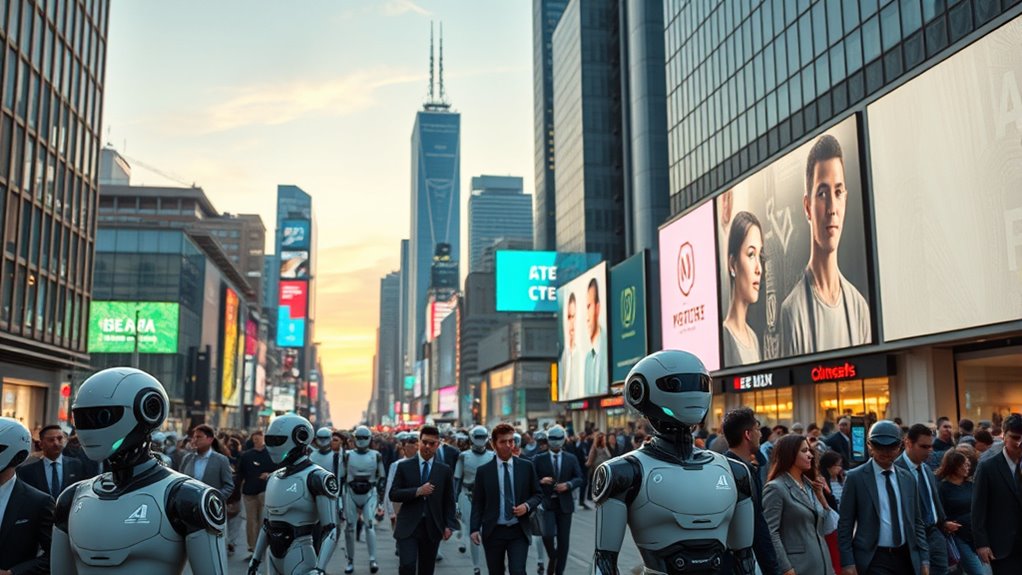

As the digital landscape shifts like a tide, AI communities are reshaping the shoreline of employment. These networks foster innovation and skill-building, making traditional jobs feel like relics of the past. But what does this mean for your role in an increasingly automated world? The answer lies in understanding how these vibrant groups are not just changing careers—they’re rewriting the very definition of work itself.
Key Takeaways
- AI communities facilitate skill sharing, enabling workers to adapt to automation and reduce reliance on traditional roles.
- Increased AI integration automates routine jobs, leading to the decline of certain manual and administrative employment.
- Community-driven learning supports upskilling, helping workers transition into AI-augmented or new industry roles.
- Traditional employment models are shifting towards hybrid work, emphasizing human-AI collaboration over sole human labor.
- Continuous education and community engagement are vital for staying relevant amid the decreasing demand for some traditional jobs.

As artificial intelligence continues to evolve, communities centered around AI are reshaping how traditional jobs operate. You’re likely noticing that AI collaboration has become a key part of daily work routines across various industries. Instead of replacing humans outright, AI tools now serve as partners that enhance productivity and decision-making. In many workplaces, you see teams integrating AI systems to streamline tasks, analyze data faster, and generate insights that previously took hours or days. This shift is pushing organizations toward job automation, where repetitive or routine tasks are handled by machines, freeing up human workers to focus on more complex, creative, or strategic responsibilities.
As you observe these changes, you might feel both excited and apprehensive. The rise of AI communities—online forums, professional networks, and collaborative platforms—facilitates knowledge sharing and skill development. You can participate in discussions about AI integration, learn new tools, and stay updated on the latest advancements. These communities also serve as support networks, helping you adapt to new roles or shift your career path in response to automation trends. The emphasis on AI collaboration means you’re encouraged to develop skills that complement machine capabilities, such as critical thinking, emotional intelligence, and complex problem-solving, which are less susceptible to automation.
Meanwhile, job automation is steadily transforming industries like manufacturing, customer service, and data analysis. Tasks that once required human oversight are now performed by AI-powered systems, reducing the need for manual labor. For example, in retail, AI chatbots handle customer inquiries, while in finance, algorithms execute trades at lightning speeds. As a result, some traditional roles are becoming obsolete or markedly reduced, prompting you to reconsider your career trajectory. You might find yourself upskilling or reskilling to stay relevant, often through AI-focused training programs offered within communities. These groups emphasize the importance of understanding AI tools and how they can augment your work rather than threaten your job.
You also recognize that AI collaboration is not just about technology; it’s about reshaping work culture. The communities around AI promote a mindset of continuous learning and adaptability. You’re encouraged to embrace change, leverage AI to boost your productivity, and explore new roles that arise from this technological evolution. As automation takes over routine tasks, human expertise becomes more valuable in areas that require nuance, empathy, and strategic thinking. The future of work is shifting toward a hybrid model, where AI and human skills coexist, driven by the collaborative spirit of AI communities. This environment challenges you to stay proactive, curious, and open to ongoing education to thrive amid these transformative changes. Additionally, understanding mindfulness can help you manage the stress and uncertainty associated with these rapid technological shifts, supporting a balanced approach to personal and professional growth.

AI in Action: Faculty Strategies for Teaching Online Graduate Courses
As an affiliate, we earn on qualifying purchases.
As an affiliate, we earn on qualifying purchases.
Conclusion
Just like a river reshapes its banks, AI communities are transforming your job landscape. As traditional roles fade like footprints in sand, you’ll find new opportunities through collaboration, continuous learning, and adaptability. Embracing these vibrant networks isn’t just about surviving—it’s about thriving in a future where skills and innovation flow together. Stay connected, stay curious, and let these communities be your compass in steering through the ever-changing world of work.
The Future of Work: Mastering AI Tools for Remote Collaboration
As an affiliate, we earn on qualifying purchases.
As an affiliate, we earn on qualifying purchases.

ChatGPT & Generative AI for Corporate Training Programs: Workforce Enablement, Adoption, and Measurable Impact (ChatGPT & Generative AI: Professional Applications Series)
As an affiliate, we earn on qualifying purchases.
As an affiliate, we earn on qualifying purchases.

Hands-On AI Trading with Python, QuantConnect, and AWS
As an affiliate, we earn on qualifying purchases.
As an affiliate, we earn on qualifying purchases.