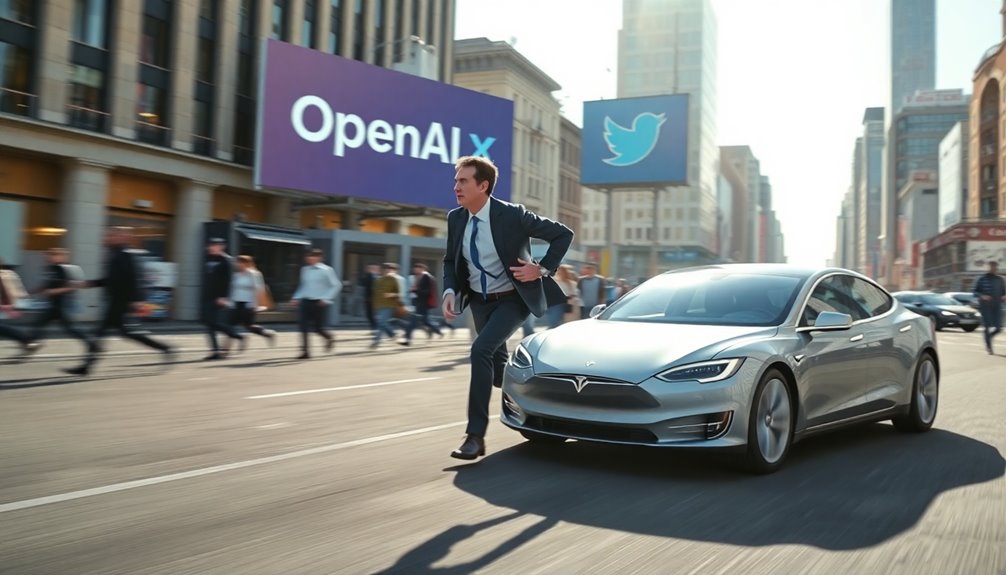

As Tesla's top executive actively pursues OpenAI, you're witnessing a potential shift in the AI landscape. With OpenAI seemingly favoring Twitter, it raises questions about strategic alliances in the tech world. What does this mean for Tesla's ambitions in AI and robotics? The interplay between these giants could redefine the future of autonomous technologies. You're left to consider the implications of these moves as the industry evolves.

Get hardware and tech essentials delivered free with Prime
- Fast, free delivery on millions of items
- Prime Video, Amazon Music and more included
- Member-only deals all year
As Tesla and OpenAI navigate their complex relationship, the future of AI innovation hangs in the balance. You see, Elon Musk co-founded OpenAI but stepped away due to fundamental disagreements over its direction and structure.
Now, Tesla's focusing on developing its own AI capabilities, including a humanoid robot named Optimus, which aims to compete directly with OpenAI's advancements. This competition is significant, especially considering Tesla's high market valuation, which gives Musk substantial financial leverage, including a staggering $97.4 billion bid for OpenAI.
However, the dynamics aren't straightforward. While Musk's vision for AI diverges from OpenAI's current path, this divergence leads to a power struggle. You might recall that OpenAI has formed strategic partnerships, notably with Microsoft, to bolster its capabilities and expand its reach.
Meanwhile, OpenAI is transitioning to a for-profit model, a move that complicates governance and raises questions about its future. The success of ChatGPT has propelled OpenAI into the spotlight, yet Musk's counteroffer to acquire OpenAI signals a desire to reclaim influence in the AI landscape.
This bid isn't just a financial maneuver; it represents a broader power struggle between Musk and OpenAI's CEO, Sam Altman. If Musk were to gain control of OpenAI, you'd see potential synergies with Tesla's AI ambitions, particularly in autonomous driving technology, especially as OpenAI has also acted as an investor in Figure AI.
However, the challenges are immense. OpenAI's non-profit status poses significant legal and structural hurdles for Musk's acquisition, complicating what would otherwise seem like a straightforward business transaction.
The implications of this struggle extend beyond personal ambitions. The outcome could significantly impact the AI market landscape, influencing not only Tesla and OpenAI but also their competitors.
The race for AI innovation pushes both entities to explore new frontiers in robotics and autonomous technologies, redefining the competitive landscape. As Tesla's focus on robotics and AI advancements intensifies, it serves as a reminder of the global competition for leadership in the AI sector.
In the end, both Tesla and OpenAI are pivotal players in this ongoing AI innovation race. The decisions made today will shape the future of AI technology, and as you watch this drama unfold, it's clear that the stakes couldn't be higher.
The question remains: how will Musk's ambitions clash with OpenAI's strategic interests, and what'll that mean for the future of AI? Only time will tell.
As an affiliate, we earn on qualifying purchases.
As an affiliate, we earn on qualifying purchases.
As an affiliate, we earn on qualifying purchases.
OpenAI GPT-4 compatible accessories
As an affiliate, we earn on qualifying purchases.
As an affiliate, we earn on qualifying purchases.
Halloween Picks
halloween
As an affiliate, we earn on qualifying purchases.