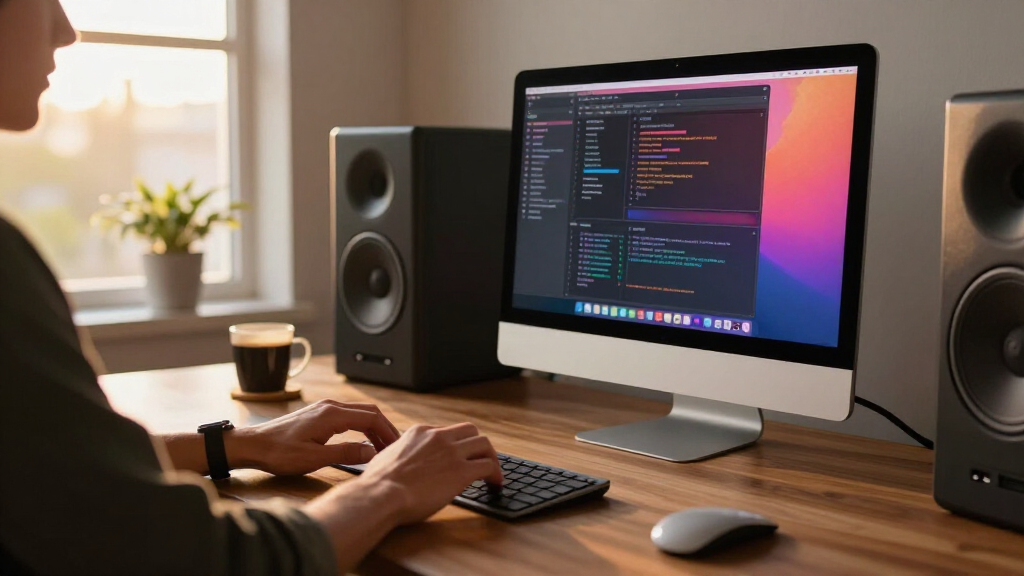

📊 Full opportunity report: The Impact Of 512GB Storage On AI Workflows In The M5 Ultra Mac Studio on ThorstenMeyerAI.com — validation score, market gap, and execution plan.
TL;DR
Apple’s upcoming M5 Ultra Mac Studio will feature a 512GB memory option, enabling larger AI models to run locally with improved performance. This development marks a notable shift in AI hardware capabilities for individual users and small teams.
Apple is set to release a Mac Studio featuring a 512GB memory configuration, a move that significantly expands the capabilities for local AI model deployment. This new configuration is expected to enable users to run larger models more efficiently, marking a substantial enhancement over previous models with lower memory capacities. The development is confirmed by sources familiar with Apple’s upcoming product lineup and reflects a strategic focus on AI workflows.
The 512GB memory option for the M5 Ultra Mac Studio will arrive in late October, with pricing estimated to be in the mid-teens of thousands of dollars, though official prices are yet to be announced. This configuration leverages a high-bandwidth unified memory architecture at 1,200 GB/s, which is crucial for AI inference tasks that are memory-bound. The M5 Ultra’s design allows it to handle large language models (LLMs) and other AI workloads that previously required multi-GPU setups or specialized hardware.
Compared to the M5 Max, which offers 128GB of memory with significantly lower bandwidth (614 GB/s), the 512GB M5 Ultra provides a much larger capacity and higher bandwidth, enabling it to load and process models with billions of parameters more effectively. Industry experts note that this configuration will allow individual users and small teams to run models that previously only large institutions or data centers could handle, without the need for multiple GPUs or cloud services.
Capacity decides what you can load. Bandwidth decides how fast it runs. Collapse them into one and every take on local-AI hardware goes wrong. Hold them apart and the field sorts itself.
Transformative Impact on Local AI Model Deployment
The introduction of a 512GB memory configuration for the Mac Studio represents a major shift in how AI workloads can be handled on personal and small-scale hardware. It bridges the gap between high-end workstations and enterprise data centers, making it feasible for individual researchers, developers, and small teams to run large models locally. This could reduce reliance on cloud-based inference, lower operational costs, and improve data privacy. Additionally, the high bandwidth ensures faster inference speeds, making AI workflows more responsive and practical for real-time applications.
As an affiliate, we earn on qualifying purchases.
Evolution of AI Hardware and Mac Studio Capabilities
Historically, running large language models (LLMs) locally required multi-GPU setups or specialized hardware like NVIDIA's high-end cards, which are costly and complex to manage. Apple’s transition to custom silicon with the M5 Ultra introduces a unified memory architecture that combines high capacity with substantial bandwidth, tailored for AI workloads. Prior to this, the highest memory capacity in the Mac Studio was 128GB, which limited the size of models that could be run efficiently. The move to 512GB marks a significant evolution, aligning Mac hardware more closely with AI-centric systems used in research and industry.
Industry analysis indicates that this development could position Apple as a more serious contender in the AI hardware space, especially for users seeking high-performance, all-in-one solutions without the complexity and expense of multi-GPU systems. The timing aligns with increasing demand for accessible AI infrastructure for smaller organizations and individual developers.
As an affiliate, we earn on qualifying purchases.
Remaining Questions About Performance and Pricing
While the hardware specifications are confirmed, details about the final pricing, exact availability date, and performance benchmarks remain unconfirmed. It is also unclear how the 512GB configuration will compare in real-world AI workloads against dedicated GPU setups or cloud services, as comprehensive testing is still pending. Additionally, the impact on power consumption and thermal management at this high memory capacity is yet to be fully evaluated.
As an affiliate, we earn on qualifying purchases.
Expected Launch and Performance Benchmarks
Apple is expected to announce the official release date and pricing details in the coming weeks. Industry experts anticipate that early benchmarks will soon emerge, providing clearer insights into how the 512GB M5 Ultra Mac Studio performs with large-scale models. Users and developers should monitor Apple’s official channels for updates and initial reviews to assess its real-world capabilities and cost-effectiveness for AI workflows.
professional external GPU enclosure
As an affiliate, we earn on qualifying purchases.
As an affiliate, we earn on qualifying purchases.
Key Questions
What types of AI models can the 512GB Mac Studio run effectively?
It is expected to handle large language models (LLMs) with hundreds of billions of parameters, especially those quantized to 4-bit or 8-bit formats, which require significant memory capacity and bandwidth.
How does the 512GB configuration compare to previous Mac Studio models?
The 512GB model offers more than four times the memory capacity and nearly double the bandwidth of earlier configurations, enabling larger models and faster inference.
Will the new Mac Studio replace dedicated GPU workstations for AI?
While it significantly enhances local AI capabilities, it may still fall short of multi-GPU setups for extremely large models and training tasks, but it offers a compelling all-in-one solution for inference and smaller-scale development.
What is the expected price range for the 512GB Mac Studio?
Pricing is estimated to be in the mid-teens of thousands of dollars, but official figures will be announced upon product release.
When will the 512GB Mac Studio be available for purchase?
Apple has indicated it will be available in late October, with exact dates to be confirmed soon.
Source: ThorstenMeyerAI.com