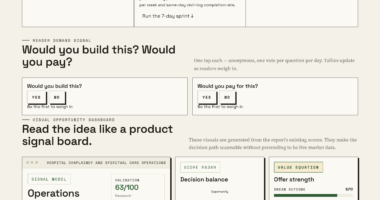

📊 Full opportunity report: Outcome-First Decisions: Keep, Change, or Kill on ThorstenMeyerAI.com — validation score, market gap, and execution plan.
TL;DR
Outcome-First Decisions is a framework that helps organizations evaluate ongoing initiatives based on current outcomes, not past investments. It promotes pruning by making the ‘kill’ option easier to justify, aiming to improve portfolio efficiency.
The Outcome-First Decisions framework, designed to improve portfolio management by focusing solely on current outcomes, has been made publicly available as open source. It provides a structured way for organizations to decide whether to keep, change, or kill initiatives based on their present value and future potential, rather than past investments or emotional attachment.
The framework introduces the ‘Worth Filter,’ a decision mechanism that evaluates ongoing initiatives solely on their current outcomes relative to ongoing costs. It returns three verdicts: keep, change, or kill. The primary goal is to eliminate the long tail of projects that continue consuming resources without producing meaningful results, often justified by sunk costs or identity.
Unlike traditional backward-looking assessments, Outcome-First emphasizes forward-looking judgment, making it easier to justify ending initiatives that no longer justify their costs. The framework is provider-agnostic, runs on local compute, and is licensed under AGPL-3.0, ensuring openness and transparency. It aims to close the decision loop in portfolio management, enabling organizations to routinely prune ineffective projects and free capacity for new or more valuable initiatives.
However, experts warn that outcome measurement can be gamed or misjudged, and the framework cannot replace emotional or cultural resistance to killing projects. It is designed to support, not replace, human judgment in complex decisions.
Outcome-First Decisions — keep, change, or kill
The hardest decision isn’t what to start — it’s what to stop. Judge every initiative by the outcome it produces now, not the effort already spent.
Independent commentary, produced with AI assistance under human editorial oversight. The views are the author’s own and may change. Outcome-First Decisions is open source under AGPL-3.0, provided “as is” without warranty; see the repository LICENSE. The framework’s verdicts are reasoning aids based on the inputs given and may be wrong — decision support, not decisions; verify independently before acting. Product and company names are trademarks of their respective owners; mention does not imply endorsement.
Why Outcome-First Decisions Reshape Portfolio Management
This framework addresses a common challenge in organizations: the tendency to continue supporting initiatives that no longer provide value. By making the decision to kill easier and more systematic, it promotes more efficient use of resources, reduces hidden costs of maintenance, and frees capacity for new growth. The open-source nature encourages transparency and adaptability, potentially influencing how companies manage their project portfolios and prioritize strategic focus.
portfolio management decision software
As an affiliate, we earn on qualifying purchases.
As an affiliate, we earn on qualifying purchases.
The Evolution of Decision-Making in Portfolio Management
Traditional portfolio management often struggles with the ‘long tail’ of ongoing projects that are neither successful nor terminated. The tendency to justify continuation based on past effort or sunk costs leads to resource drain and opportunity loss. The Outcome-First approach builds on recent trends toward outcome-based evaluation and local-first, provider-agnostic tools, responding to the need for more disciplined pruning. It is part of a broader movement toward more transparent and outcome-oriented decision frameworks in organizational management.
“The hardest decision in any portfolio isn’t what to start. It’s what to stop.”
— Thorsten Meyer, creator of the framework
As an affiliate, we earn on qualifying purchases.
Limitations and Risks of Outcome-First Judgments
It is still unclear how effectively the framework can be applied across diverse organizational contexts, especially where outcome measurement is complex or subjective. There is also concern that the bias toward killing can lead to premature termination of slow-start initiatives, which may have long-term value. Additionally, the framework relies on accurate outcome data, which can be manipulated or misinterpreted, and it cannot replace the emotional and cultural factors influencing decisions.
outcome-based decision making software
As an affiliate, we earn on qualifying purchases.
As an affiliate, we earn on qualifying purchases.
Next Steps for Adoption and Testing of the Framework
Organizations interested in Outcome-First Decisions are encouraged to review the open-source implementation on GitHub and pilot it within their portfolios. Further research and case studies are expected to emerge, assessing its effectiveness in different industries and organizational sizes. Stakeholders will likely monitor how well the framework balances objective decision-making with the nuanced realities of project management.
As an affiliate, we earn on qualifying purchases.
Key Questions
How does Outcome-First Decisions differ from traditional portfolio reviews?
It focuses solely on current outcomes and ongoing costs to decide whether initiatives should continue, change, or be terminated, rather than relying on past investments or effort-based justifications.
Is the framework suitable for all types of projects?
While designed to be provider-agnostic and flexible, its effectiveness depends on how accurately outcomes can be measured and interpreted in specific contexts.
Can this framework prevent organizations from prematurely killing valuable initiatives?
It reduces the emotional and cognitive bias toward continuation but cannot fully eliminate the risk of premature termination, especially for slow-start projects with long-term potential.
Is the framework available for public use?
Yes, it is open source under the AGPL-3.0 license and available on GitHub for organizations to review and implement.
Source: ThorstenMeyerAI.com