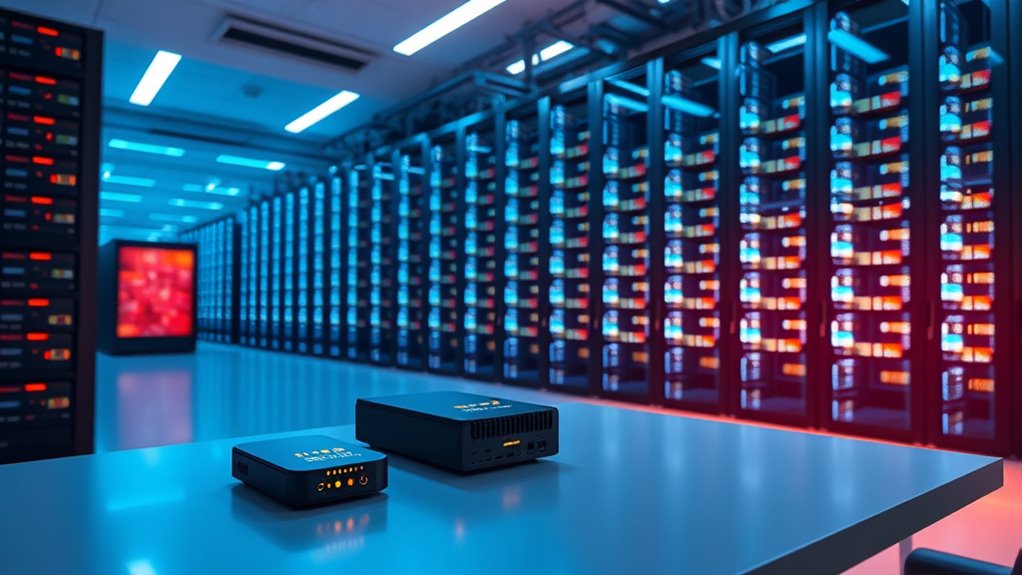

In simple terms, with Edge AI, computing happens right on your devices or nearby sensors, keeping data local and fast. With Cloud AI, data travels over the internet to remote servers for processing, offering more power but adding latency. Your choice depends on speed, privacy, and hardware. Curious how this impacts real-world applications? Keep exploring to see how these differences shape technology today.

Get hardware and tech essentials delivered free with Prime
- Fast, free delivery on millions of items
- Prime Video, Amazon Music and more included
- Member-only deals all year
Key Takeaways
- Edge AI processes data locally on devices, while Cloud AI transmits data to remote servers for processing.
- Edge AI offers low latency and real-time responses, ideal for time-sensitive applications.
- Cloud AI provides scalable computing power suitable for large data volumes and complex tasks.
- Data privacy is enhanced with Edge AI by keeping sensitive information within local environments.
- Cloud AI generally involves higher ongoing costs due to data transfer and storage requirements.

Have you ever wondered whether processing AI data locally or in the cloud is better? When it comes to making that decision, understanding the key differences can help you choose what’s right for your needs. One major factor to consider is data privacy. Processing data locally, which is what edge AI does, keeps sensitive information on your device or within your organization. This approach minimizes the risk of data breaches or leaks because the data never leaves your secure environment. On the other hand, cloud AI relies on transmitting data to remote servers, which increases exposure to potential security vulnerabilities. If protecting user privacy is a top priority, edge AI offers a clear advantage by limiting data movement and storage outside your control. Additionally, the hardware capabilities of edge devices influence their ability to handle complex AI tasks effectively.
Another critical aspect is network latency, which directly impacts how quickly your AI system responds. Edge AI processes data right at the source—on devices like sensors, cameras, or smartphones—so there’s minimal delay. This instant processing is essential for applications requiring real-time responses, such as autonomous vehicles, industrial automation, or medical devices. With cloud AI, data must travel over the internet to reach data centers, introducing delays that can range from milliseconds to several seconds. For use cases where speed is a must, relying on cloud AI could hinder performance and effectiveness. High network latency can disrupt operations, especially when rapid decision-making is indispensable.
Cost is also a factor in your choice. Processing data locally with edge AI can reduce bandwidth consumption and cloud storage fees since less data needs to be uploaded or stored remotely. Conversely, cloud AI often involves ongoing expenses for data transfer, storage, and computational resources. While cloud solutions are scalable and easier to manage for large-scale operations, they can become costly over time, especially if high data volumes are involved. Edge AI might require more upfront investment in hardware but can pay off through lower ongoing costs and increased control over data.
Frequently Asked Questions
How Does Latency Differ Between Edge AI and Cloud AI?
You’ll notice that latency is lower with edge AI because it enables real-time processing right at the source, reducing delays. Cloud AI, however, depends on network connectivity, which can introduce delays due to network dependency. This means edge AI is ideal for applications needing instant responses, while cloud AI might experience higher latency if network conditions aren’t preferable. Your choice depends on your real-time processing needs and network reliability.
What Are the Cost Implications of Deploying Edge AI Versus Cloud AI?
While the financial landscape varies, deploying edge AI often involves higher hardware costs due to specialized devices, whereas cloud AI typically reduces deployment expenses through scalable, shared infrastructure. You might find edge solutions more costly initially, but they can save money long-term by minimizing data transmission and latency issues. Cloud AI offers flexibility and lower upfront investments, yet ongoing operational expenses could grow with increased data processing needs.
Which AI Approach Offers Better Data Privacy and Security?
You’ll find that Edge AI generally offers better data privacy and security because it processes data locally, reducing exposure. With edge devices, you can implement data encryption and access controls directly on the device, minimizing risks. In contrast, cloud AI involves transmitting data over networks, which can increase vulnerability. So, if privacy is your priority, Edge AI’s localized processing and security measures make it a stronger choice.
How Scalable Are Edge AI and Cloud AI Solutions?
You can think of scalability as a double-edged sword. Cloud AI solutions typically scale easily, handling data integration and growth without much fuss, but they face scalability challenges with latency and bandwidth. Edge AI, on the other hand, offers limited scalability due to device constraints, but excels in real-time processing. Your choice depends on balancing these factors to meet your needs for expansion and efficiency.
What Are the Maintenance Challenges for Each AI Deployment?
You face maintenance challenges with both AI deployments. For Edge AI, hardware maintenance can be tricky since devices are often in remote or hard-to-reach locations, and software updates may require physical access. Cloud AI simplifies updates and maintenance but demands ongoing management of server infrastructure and security patches. In either case, keeping hardware and software current is vital, but the logistics differ markedly between edge and cloud environments.
Conclusion
Ultimately, choosing between edge AI and cloud AI depends on your needs. If speed and privacy matter most, edge AI puts the processing right at your fingertips. On the other hand, cloud AI offers vast resources and scalability. Remember, it’s not about putting all your eggs in one basket—sometimes, a hybrid approach works best. Know your priorities, weigh your options, and pick what helps you stay ahead of the curve.
Halloween Picks
halloween
As an affiliate, we earn on qualifying purchases.