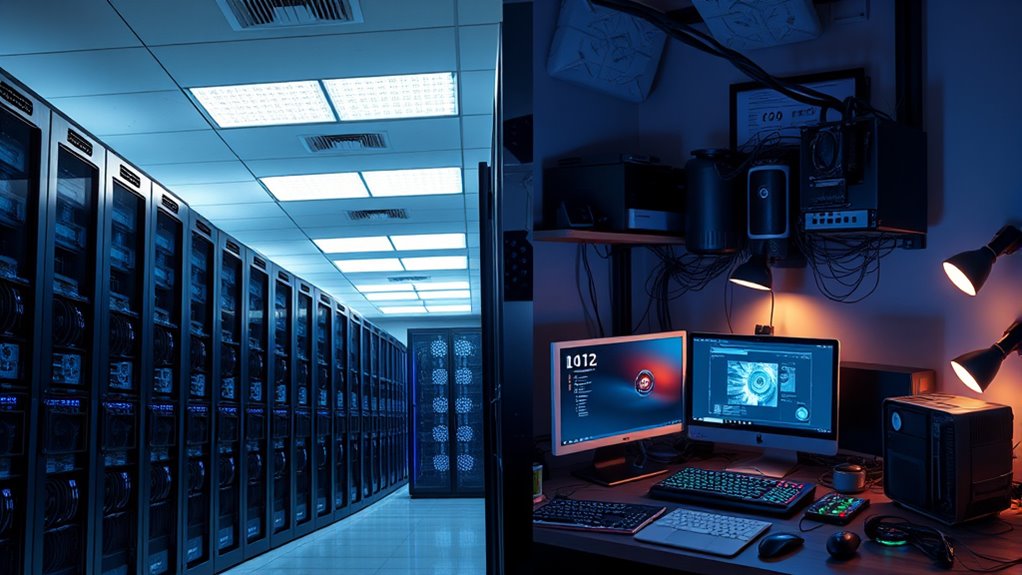

Choosing between cloud mining and home mining depends on your budget, skills, and priorities. Home mining gives you full control and potentially higher rewards but involves high upfront costs, high energy use, noise, and hardware maintenance. Cloud mining offers convenience, lower start-up costs, and easier scalability, but you rely on third-party providers whose reliability and fees can affect your profits. To understand which option suits your goals best, consider the detailed pros and cons ahead.
Key Takeaways
- Home mining offers full control and rewards but involves high upfront hardware costs and ongoing energy expenses.
- Cloud mining eliminates hardware setup and maintenance, providing ease of use but depends on provider reliability.
- Energy consumption is significant in home mining, increasing costs and environmental impact; cloud mining’s energy use is less transparent.
- Home mining faces noise and heat challenges, while cloud mining reduces physical disruption but involves trust risks.
- Cloud mining offers scalability and predictable costs but may reduce profit margins due to provider fees and market fluctuations.
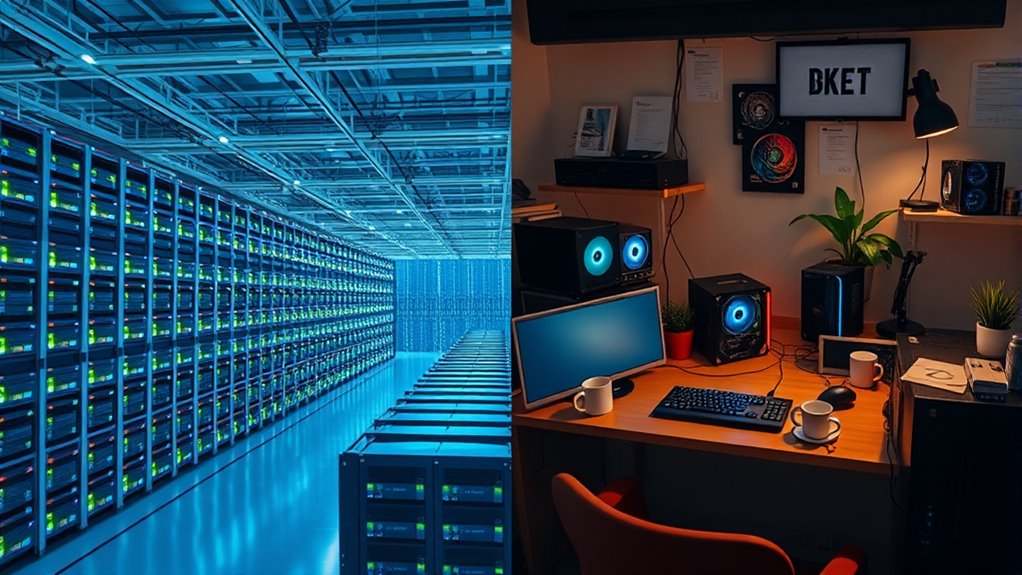
Deciding between cloud mining and home mining depends on your resources, technical skills, and risk tolerance. If you’re contemplating home mining, you’ll need to invest in dedicated mining hardware, such as ASICs or high-performance GPUs. These machines are designed specifically for mining cryptocurrencies and can offer higher hash rates, but they come with significant upfront costs. Plus, you’ll need to account for ongoing energy consumption, which can be substantial. Mining hardware consumes a lot of electricity, and as mining difficulty increases, so does the energy required to maintain profitable operations. This means you’ll want to think about local energy rates and the potential impact on your electricity bills. If your electricity costs are high, mining at home may become less cost-effective, especially over time. Additionally, the hardware produces heat and noise, which could be disruptive in a residential setting, and you’ll need to manage cooling solutions to keep your equipment running efficiently. Proper ventilation and noise reduction measures can improve your setup.
Home mining requires significant upfront hardware investment and high energy costs.
On the other hand, cloud mining offers a different set of advantages and disadvantages. With cloud mining, you don’t need to buy or maintain any physical hardware; instead, you rent mining power from a provider. This means you avoid the upfront costs associated with mining hardware and the ongoing energy expenses. Since the provider manages the equipment, you’re free from the technical challenges of hardware setup, maintenance, and troubleshooting. Cloud mining also offers the flexibility to scale your mining activities without worrying about physical space or power constraints. However, this convenience comes with risks—most significantly, trust issues with providers and potential scams. You’re relying on their honesty and financial stability, and many cloud mining contracts turn out to be less profitable than initially promised. Plus, some providers may not disclose the true energy consumption of their operations, making it harder to assess sustainability or environmental impact. The lack of transparency can be a concern for environmentally conscious miners.
In terms of profitability, home mining might initially seem more appealing because you keep all the rewards, but the high energy costs and hardware depreciation can quickly eat into your gains. Cloud mining, meanwhile, offers predictable costs and less hassle, but your profit margins depend heavily on the provider’s fees and the current market conditions. If the cryptocurrency market takes a downturn, both methods can become less profitable, but the risks are different: home miners face hardware obsolescence and energy bills, while cloud miners risk losing their investments if the provider collapses or breaches their contract. When evaluating your options, consider the initial investment, ongoing costs, and your ability to manage or trust the infrastructure involved.
Ultimately, your choice hinges on your available resources and how much risk you’re willing to accept. If you have the technical know-how and cheap energy, home mining might be worth the effort. If you prefer convenience and lower initial investment, cloud mining could be a better fit.

Bitcoin Mining with Bitaxe: Complete Guide to Open‑Source ASIC Mining at Home
As an affiliate, we earn on qualifying purchases.
As an affiliate, we earn on qualifying purchases.
Frequently Asked Questions
What Are the Long-Term Cost Differences Between Cloud and Home Mining?
You’ll likely spend less long-term on cloud mining because it eliminates hardware costs and maintenance expenses. With home mining, you face ongoing hardware upgrades, repairs, and high electricity bills, which add up over time. Cloud mining typically involves a fixed fee or subscription, making it easier to predict expenses. So, if you want predictable, potentially lower costs in the long run, cloud mining could be more cost-effective.
How Does Electricity Cost Impact Profitability for Both Methods?
Electricity expenses critically impact your profitability in both cloud and home mining. Higher electricity costs reduce your overall profit margin, making cost efficiency essential. If you’re mining at home, you directly pay for electricity, so choosing locations with lower rates boosts your gains. In cloud mining, electricity costs are bundled into service fees, but they still influence your profitability. Managing electricity expenses helps maximize your mining returns regardless of the method.
Are There Any Legal or Regulatory Concerns for Cloud Mining?
Like a ship steering stormy waters, you must stay vigilant about legal compliance and regulatory oversight in cloud mining. While it offers convenience, cloud miners face legal and regulatory concerns, such as jurisdictional restrictions and evolving laws. Ignoring these can lead to penalties or shutdowns. By proactively understanding and adhering to regulations, you safeguard your investments and keep your operations sailing smoothly through the legal seas.
What Are the Environmental Impacts of Each Mining Approach?
You should consider that cloud mining generally has a lower environmental impact because it often uses renewable energy sources and centralized infrastructure, reducing electronic waste. In contrast, home mining can lead to higher energy consumption, especially if powered by non-renewable sources, and generates electronic waste from outdated or broken equipment. Both approaches impact the environment, but cloud mining tends to be more sustainable if managed responsibly.
How Secure Is My Investment in Cloud Mining Compared to Home Mining?
Your investment in cloud mining might seem like walking a tightrope—exciting but risky. Security concerns are significant, as you rely on third-party providers, which can increase vulnerability. However, reputable cloud mining services often offer investment transparency, making it easier to verify operations. While home mining keeps you in control, cloud mining’s security depends on the provider’s reputation and safeguards, so choose wisely to minimize risks.

High-Performance Computing with C++26 and CUDA 13: A Practical Guide to GPU Programming, Parallel Computing, and Scalable Systems for AI and Machine … engineering and programming books)
As an affiliate, we earn on qualifying purchases.
As an affiliate, we earn on qualifying purchases.
Conclusion
Ultimately, whether you choose cloud mining or home mining depends on your goals and resources. Cloud mining offers convenience, but at what cost? Home mining gives you control, yet demands effort and upfront costs. Remember, the true power lies in understanding what suits your needs best—because in the world of mining, knowledge is your greatest asset. Don’t just follow the crowd; forge your own path, and let your choice be the key to your success.

8GPU Mining Rig Complete Crypto Miner with Windows10,Including 8GPU Mining Motherboard 2000W Power Supply,CPU,SSD,4G RAM, 8 GPU Mining Case for ETC/LTC/XHV/Monero/Ravencoin(Without GPU)
Effortless Setup in Minutes: With high-quality mining hardware and Win10 English operating system (not activated), this GPU miner…
As an affiliate, we earn on qualifying purchases.
As an affiliate, we earn on qualifying purchases.

Google Cloud Platform for Data Science: A Crash Course on Big Data, Machine Learning, and Data Analytics Services
As an affiliate, we earn on qualifying purchases.
As an affiliate, we earn on qualifying purchases.