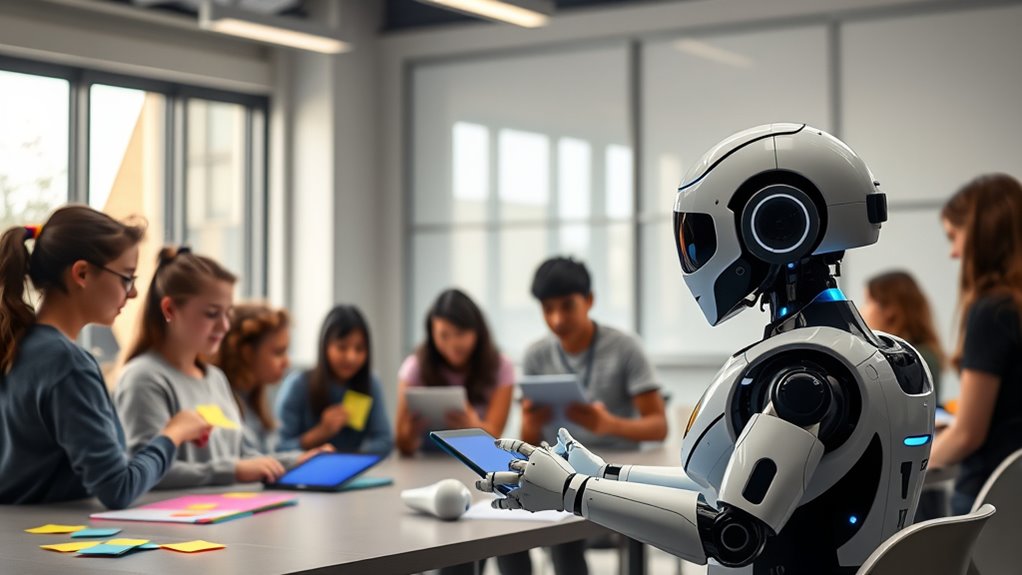

To train your mind to complement—rather than compete with—artificial intelligence, focus on developing skills like creativity, ethical decision-making, and adaptability. Embrace ongoing learning and stay informed about AI advancements to see where your human intuition and emotional insight add value. Shift your mindset from viewing AI as a threat to seeing it as a partner. Keep cultivating these capabilities, and you’ll discover ways to work seamlessly alongside AI and open new potential.

Get hardware and tech essentials delivered free with Prime
- Fast, free delivery on millions of items
- Prime Video, Amazon Music and more included
- Member-only deals all year
Key Takeaways
- Foster a growth mindset that views AI as a collaborative tool rather than a competitor.
- Develop ethical decision-making skills to ensure human values guide AI integration.
- Enhance creativity and emotional intelligence to leverage AI for innovative problem-solving.
- Prioritize continuous learning to stay adaptable and understand AI’s evolving role.
- Build future-ready skills through ongoing training in collaboration, ethics, and human-centered design.

As artificial intelligence continues to advance, the key to thriving in this new landscape is training your mind to complement rather than compete with these technologies. Instead of viewing AI as a threat, see it as an opportunity to enhance your skills and expand your potential. One of the most essential areas where this mindset makes a difference is in ethical decision making. As machines take on more complex tasks, your ability to navigate moral dilemmas becomes even more critical. You need to develop a clear understanding of ethical principles and learn to apply them thoughtfully in situations where AI outputs may not cover all moral considerations. This means questioning the data, algorithms, and outcomes produced by AI and ensuring that your choices uphold human values. Cultivating this skill helps you stay accountable and responsible, positioning you as a unique contributor in a world dominated by automation.
Equally important is fostering creative collaboration. AI excels at processing vast amounts of data and generating solutions based on patterns, but it lacks human intuition and emotional insight. Your role is to leverage AI as a tool that amplifies your creative efforts rather than replaces them. By working alongside AI, you can brainstorm innovative ideas, refine concepts, and solve problems more effectively. Collaborating creatively means not just accepting AI-generated suggestions but critically evaluating and building upon them. Your ability to think outside the box, add nuance, and introduce new perspectives turns AI into a partner rather than a competitor. This approach encourages a symbiotic relationship where human creativity drives progress, and AI handles repetitive or data-heavy tasks.
To truly train your mind in this way, you need to embrace continuous learning and adaptability. Stay informed about technological advancements and understand their implications for your work. Develop a mindset that values ethical considerations and creative experimentation. Practice making decisions that prioritize human-centered outcomes, and seek out collaborative opportunities where AI can serve as a partner rather than a substitute. Over time, you’ll find that your capacity for ethical decision making and creative collaboration becomes a defining strength, allowing you to thrive amid rapid technological change. By doing so, you’re not only future-proofing your skills but also shaping a more responsible and innovative future where human and artificial intelligence work hand in hand.
Frequently Asked Questions
How Can Educators Integrate AI Understanding Into Their Curricula?
You can integrate AI understanding into your curriculum by incorporating lessons on AI concepts and ethical considerations. Focus on skill development through projects that encourage problem-solving with AI tools and critical thinking about technology’s impact. Use real-world examples to make lessons engaging, and foster collaborative learning to help students adapt to technological advances. This approach guarantees students develop essential skills while understanding AI’s role, preparing them for future challenges.
What Are the Ethical Considerations in Ai-Human Collaboration?
You should prioritize bias mitigation and address privacy concerns when collaborating with AI. Guarantee your AI tools are transparent and fair, reducing biases that could harm individuals or groups. Protect user data by implementing strict privacy measures, so trust remains intact. By actively considering these ethical aspects, you create a responsible partnership where human judgment guides AI use, fostering respectful and equitable AI-human collaboration.
How Does AI Influence Future Workforce Skills Development?
AI acts as a catalyst, transforming your future skills development like a river shaping the landscape. You’ll need to adjust quickly to automation challenges, embracing continuous learning. As AI automates routine tasks, your focus shifts to developing skills like critical thinking, creativity, and emotional intelligence. Staying flexible and open to new training guarantees you remain valuable in the evolving workforce, turning challenges into opportunities for growth and innovation.
What Psychological Impacts Does AI Adaptation Have on Learners?
When adapting to AI, you might experience psychological impacts like increased cognitive resilience as you learn to navigate new tools and workflows. Emotional adaptation becomes vital, helping you manage anxiety or frustration during change. You develop flexibility and problem-solving skills, strengthening your mental agility. Embracing AI encourages a growth mindset, empowering you to see technology as an opportunity rather than a threat, ultimately boosting confidence and resilience in your evolving work environment.
How Can Policymakers Support Ai-Human Partnership Initiatives?
You can support AI-human partnership initiatives by advocating for policy incentives that promote collaboration and innovation. Encourage governments to fund programs that develop skills for working alongside AI and create public awareness campaigns highlighting the benefits of AI-human synergy. By fostering an environment that values cooperation, you help guarantee policies align with technological advancements, making it easier for individuals and organizations to embrace AI as a complementary tool rather than a competitor.
Conclusion
By training your mind to work alongside artificial intelligence, you open doors to endless possibilities. Instead of fighting against technology, embrace it as a partner that can elevate your skills. Remember, it’s better to bend than break under pressure. When you learn to complement AI, you not only stay relevant but also thrive in this new era. So, seize the opportunity and turn the tide—your future depends on it.
Halloween Picks
halloween
As an affiliate, we earn on qualifying purchases.