
Thesis: Google’s Agent Payments Protocol (AP2) solves the trust and authorization problem for machine‑initiated payments, while Coinbase’s x402 solves the settlement problem. Together they turn agent conversations into agent commerce—with traceable intent, interoperable flows, and programmatic payments suited for both traditional rails and stablecoins. Google Cloud+1
What just launched (and why it matters)
- AP2 (Agent Payments Protocol). An open protocol from Google that standardizes how agents prove authority to pay and how merchants verify authenticity of a buyer’s intent—designed to be payment‑method agnostic (cards, real‑time transfers, and stablecoins). AP2 can be used alongside the Agent2Agent (A2A) protocol and MCP so agents can converse and then transact within a consistent rulebook. Google says 60+ organizations (networks, processors, wallets, fintechs) are collaborating. Google Cloud
- x402. An HTTP‑native payment protocol from Coinbase that revives the
402 Payment Requiredstatus to enable per‑request payments. A server can challenge with402, the client returns a signed payment in anX‑PAYMENTheader, and settlement completes on‑chain—today with USDC on Base via a hosted facilitator (verify/settle). Coinbase Developer Docs+1 - How they connect. Google and Coinbase published an A2A ↔ x402 extension so AP2‑authorized agent purchases can settle over stablecoins when that rail is chosen. Google Cloud+1
Bottom line: AP2 secures who is allowed to pay and for what; x402 provides a fast, programmable rail so agents can actually move money. Google Cloud+1
The core idea: a “chain of evidence” for agent payments
AP2 introduces Mandates—tamper‑resistant, cryptographically signed Verifiable Credentials (VCs) that travel with a transaction:
- Intent Mandate — captures the user’s rules/limits (“buy when ticket price ≤ $120”).
- Cart Mandate — the exact items and price the user approved.
- Payment Mandate — signals the context to payment networks/rails for execution.
This Intent → Cart → Payment sequence creates an auditable trail answering Authorization, Authenticity, and Accountability—problems that traditional checkouts assume are solved by a human click. AP2 generalizes those guarantees for agent‑led flows. Google Cloud
Why this matters for merchants and platforms: you can accept agent‑originated orders with clearer liability and dispute posture, and you can support multiple rails behind one protocol surface (cards now; stablecoins/RTP growing). Google Cloud
How x402 actually moves money
x402 bakes payments into HTTP:
- Challenge: Server returns HTTP 402 with payment requirements.
- Pay: Client re‑submits the same request with an
X‑PAYMENTheader containing a signed payment payload. - Verify/Settle: The resource server verifies locally or via a facilitator and then settles on‑chain; response includes
X‑PAYMENT‑RESPONSEwith settlement details. Coinbase Developer Docs
Coinbase’s hosted facilitator offers fee‑free USDC payments on Base (at launch), so sellers don’t run nodes or craft transactions; they hit /verify and /settle endpoints and the facilitator handles on‑chain submission and confirmation. Coinbase Developer Docs+1
Under the hood: x402 favors tokens implementing EIP‑3009 (transferWithAuthorization) so transfers can be signature‑based and gasless (facilitator sponsors gas), removing a major UX barrier for micropayments. Coinbase Developer Docs
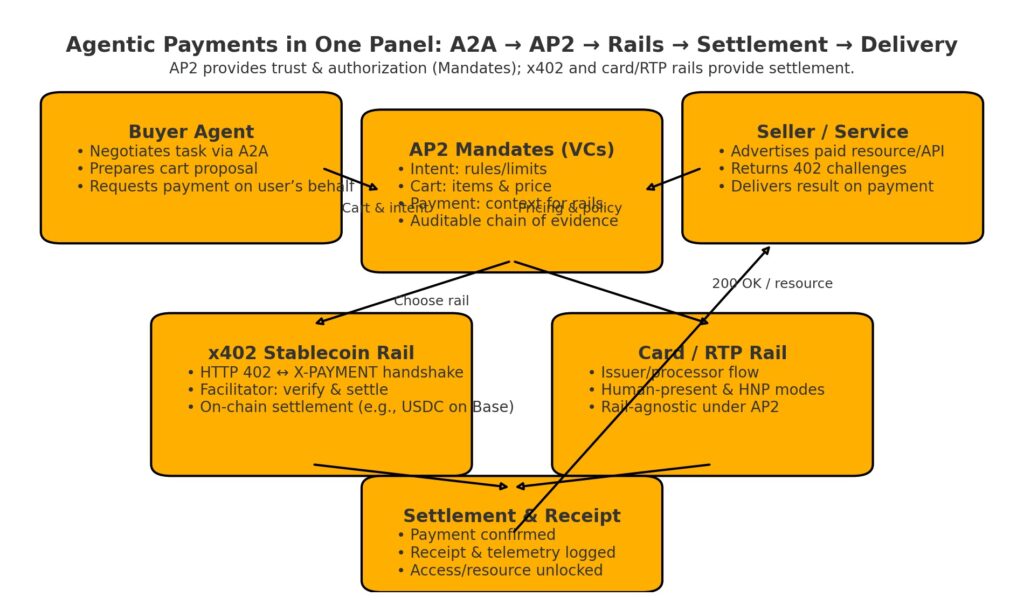
End‑to‑end: A2A → AP2 → x402
- Agents negotiate a task using A2A, a Linux Foundation project for cross‑vendor agent interoperability. Linux Foundation
- AP2 captures trust via Mandates (Intent/Cart/Payment) so the buyer agent’s request is verifiably tied to the user’s instructions. Google Cloud
- x402 settles if the parties choose stablecoins; the A2A ↔ x402 extension provides the glue. GitHub
Example: In a Google–Coinbase demo for Lowe’s Innovation Lab, an agent diagnoses a DIY task, assembles a SKU‑aware cart, gets a one‑tap approval, and settles in USDC—a simulated experience meant to illustrate the flow (Lowe’s does not currently accept crypto). Coinbase
Why this is a big deal (for builders, operators, and the post‑labor economy)
- Micropayments become routine. The
402 → X‑PAYMENThandshake fits low‑value, high‑frequency actions: paid API calls, per‑document crawls, per‑inference charges, and agent‑to‑agent micro‑tasks—things traditional card rails handle poorly at small amounts. Coinbase Developer Docs - A unified model for multi‑rail commerce. AP2’s mandate layer is rail‑agnostic. You can start on cards, add stablecoins later, or run both—without re‑inventing authorization semantics. Google Cloud
- Governance signals are strong. A2A now sits under the Linux Foundation, and AP2 ships with a public GitHub repo under Apache‑2.0—good signs for neutral stewardship and ecosystem contribution. Linux Foundation+1
Implementation snapshot (two tracks)
Track A — Traditional rails with AP2 (human‑present)
- Integrate Mandate capture into your agent UX: show cart, obtain Cart Mandate, and bind the resulting Payment Mandate to the chosen instrument.
- Pilot with a small SKU catalog or subscription add‑ons; measure dispute rates vs. your current checkout. Google Cloud
Track B — Stablecoin rails with x402
- Wrap one endpoint (e.g., “extract table from URL”) behind a
402challenge. - Use Coinbase’s facilitator to avoid node ops; accept USDC on Base; surface receipts via
X‑PAYMENT‑RESPONSE. - List the endpoint in the x402 Bazaar for discovery by agents. Coinbase Developer Docs+2Coinbase Developer Docs+2
Dev note: If you’re coordinating multiple services, use A2A; stamp payable hops with AP2 Mandates; settle with x402 where appropriate. The A2A x402 Extension repository provides types and reference flows. GitHub
Risks and open questions (a sober view)
- Finality & latency. x402 aims for rapid acknowledgment and on‑chain settlement on Base, but your merchant policy (confirmations required, fraud posture) will define when you “deliver.” Instrument for p50/p95 times and make high‑value content wait for firmer finality. Coinbase Developer Docs
- Disputes & reversals. Stablecoin rails reduce chargebacks; that pushes resolution upstream to Mandates and downstream to refunds. AP2’s audit trail helps, but design clear reversal logic for hallucinated or mis‑scoped agent purchases. Google Cloud
- Security & UX. Agents that can spend must be least‑privilege: spend ceilings, expiry windows, domain pinning for cart UIs, and strong logging. Mandates reduce ambiguity; they don’t eliminate prompt‑injection or phishing‑like UI risks. Google Cloud
- Ecosystem maturity. AP2/x402 are early yet rapidly evolving. Favor feature flags, sandbox toggles, and kill‑switches as specifications and facilitators harden. Google Cloud+1
Quick glossary
- A2A (Agent2Agent): Open protocol for agents to interoperate across vendors; now hosted by the Linux Foundation. Linux Foundation
- AP2: Open, rail‑agnostic protocol to capture Intent → Cart → Payment via VCs (“Mandates”), giving merchants and issuers a legible proof of user authorization. Google Cloud
- x402: HTTP‑native payments (
402/X‑PAYMENT) with on‑chain settlement; Coinbase’s facilitator supports USDC on Base. Coinbase Developer Docs+1
Developer sidebar: the x402 handshake (at a glance)
# 1) Client asks for a paid resource
GET /report/latest

# 2) Server challenges
HTTP/1.1 402 Payment Required
Content-Type: application/json
{
  "scheme": "x402:eip-3009",
  "amount": "0.25",
  "asset": "USDC",
  "network": "base-mainnet",
  "payTo": "0xSeller..."
}

# 3) Client resubmits with signed payload
GET /report/latest
X-PAYMENT: eyJ2ZXJzaW9uIjoxLCJzaWduYXR1cmUiOiJ..."
Server verifies locally or via /verify, settles via /settle, and responds 200 OK with X‑PAYMENT‑RESPONSE.
For DreamRidiculous readers: who should act now?
- Product & Growth: Pilot per‑request monetization for high‑value APIs and data feeds; compare conversion vs. monthly subscriptions.
- CFO/FinOps: Model fraud/chargeback deltas and auth‑to‑settlement times; set Mandate‑based spend tiers.
- CTO/Platform: Establish an agent spending policy (scopes, ceilings, expiries), and add AP2 Mandate capture and x402 to your architectural runway.
Sources & further reading
- Google Cloud: “Powering AI commerce with the new Agent Payments Protocol (AP2)” (Sept 17, 2025). Partners, mandate model, A2A/MCP context, x402 extension. Google Cloud
- Coinbase: “Google Agentic Payments Protocol + x402: Agents Can Now Actually Pay Each Other” (Sept 16, 2025). Demo context (Lowe’s POC), “Bazaar” discovery. Coinbase
- Coinbase Docs: x402: Welcome (concept), How it Works (402/headers/flow), Facilitator (verify/settle, USDC on Base), Network Support (EIP‑3009). Coinbase Developer Docs+3Coinbase Developer Docs+3Coinbase Developer Docs+3
- GitHub: A2A x402 Extension (bridge repo). GitHub
- Governance: Linux Foundation press on A2A project (June 23, 2025). Linux Foundation
- GitHub: AP2 repository (Apache‑2.0; samples/specs). GitHub
- Coinbase: x402 Bazaar launch (discovery layer for agents). Coinbase