
Imagine a world where learning happens entirely through immersive games. While these digital environments can make education more engaging, they often lack the social and emotional connections that traditional schools provide. Can game-based methods truly replace the holistic experience of classroom learning, or is there something missing? As technology advances, the question becomes more complex, making you wonder whether games could someday fully take over education—or if schools still hold essential value.
Key Takeaways
- Games can enhance engagement and critical thinking but cannot fully replicate social interactions and mentorship provided by schools.
- Traditional schools develop social skills, teamwork, and emotional intelligence that games alone cannot substitute.
- Game-based learning is most effective when combined with face-to-face instruction, not used as a complete replacement.
- Technology and games serve as valuable supplements but lack the experiential and hands-on elements of in-person education.
- A hybrid model integrating games and traditional methods offers the most comprehensive approach to modern education.
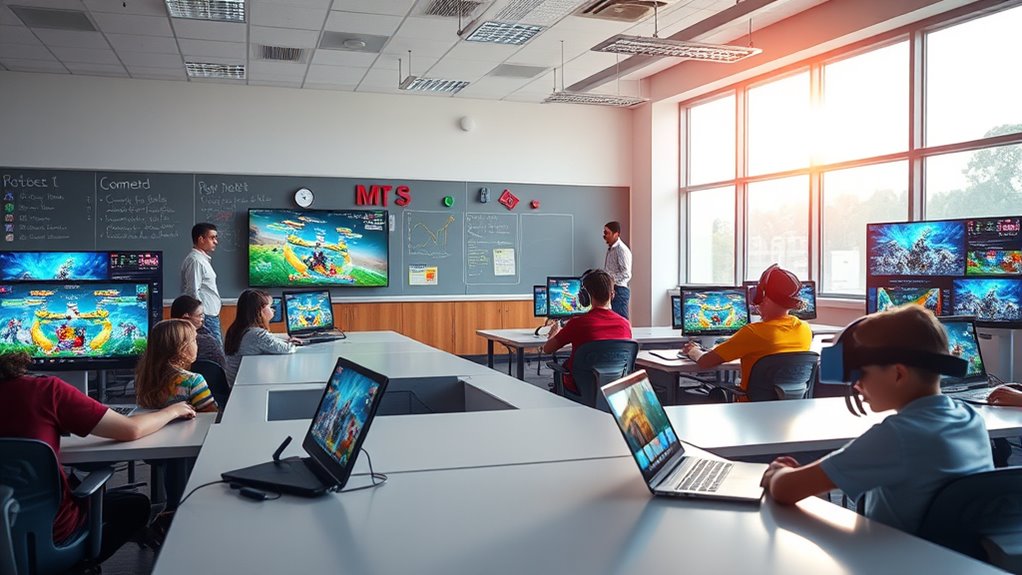
Many people wonder whether games could someday replace traditional schools, especially as technology advances and digital learning becomes more widespread. While the idea of substituting classrooms with game-based learning might sound futuristic, it’s rooted in the growing role of educational technology that aims to make learning more engaging and interactive. Instead of relying solely on textbooks and lectures, you can imagine a future where students explore concepts through immersive digital environments, solving problems, and collaborating with peers within a game. This approach leverages game-based learning to boost motivation, deepen understanding, and personalize education to match individual needs.
Game-based learning isn’t just about entertaining students; it’s about transforming how they absorb knowledge. When you incorporate educational technology into lessons, you create dynamic experiences that foster critical thinking, creativity, and adaptability. For example, rather than passively listening to a teacher explain history, you could virtually walk through ancient civilizations, making history come alive. This method appeals to different learning styles, especially for digital natives who thrive on interactive content. As a result, students are more likely to retain information because they’re actively participating rather than passively receiving information.
However, while game-based learning offers numerous benefits, it’s unlikely to fully replace traditional schools anytime soon. Schools provide more than just academic instruction—they’re social spaces where students develop important life skills such as teamwork, communication, and emotional intelligence. Educational technology can supplement these experiences but might fall short of replicating the social interactions and mentorship that a physical school environment fosters. Furthermore, not every subject lends itself equally well to gamification; some concepts require hands-on experiments or direct human guidance that digital platforms can’t fully emulate. Additionally, the effectiveness of game-based learning can be enhanced by understanding the best airless paint sprayers, which exemplify how proper tools and techniques improve outcomes—highlighting the importance of combining innovative approaches with reliable technology in education.
That said, integrating game-based learning into traditional education can enhance its effectiveness. It’s about finding a balance where technology complements face-to-face instruction rather than replacing it. Many educators are already experimenting with virtual labs, educational apps, and interactive simulations to make lessons more engaging. These tools help students develop a love for learning and can prepare them better for a tech-driven world. In the end, the future of education may lie in blending traditional methods with innovative digital solutions, creating a richer, more adaptable learning environment that harnesses the best of both worlds.

The Gamification of Learning and Instruction: Game-based Methods and Strategies for Training and Education
As an affiliate, we earn on qualifying purchases.
As an affiliate, we earn on qualifying purchases.
Conclusion
While games can boost engagement and teach valuable skills, they can’t replace the heart of a school. Think of education as a garden—you can’t rely on just one flower to make it bloom. Instead, you need a mix of nurturing, guidance, and growth. So, embrace game-based learning as a helpful tool, but remember, the true magic happens when tradition and innovation work together to shape well-rounded minds.

Abacus Brands Virtual Reality ESPN Gift Box – Illustrated Interactive VR Book and STEM Learning Activity Set
EXPERIENCE SPORTS IN VIRTUAL REALITY! Dive into the world of sports like never before with immersive experiences in…
As an affiliate, we earn on qualifying purchases.
As an affiliate, we earn on qualifying purchases.

Modelling International Collaborations in Art Education (IB – Artwork Scholarship: International Perspectives in Education)
As an affiliate, we earn on qualifying purchases.
As an affiliate, we earn on qualifying purchases.

Paycheck to Billionaire: Master Financial Freedom – Smart Investing & Cost Management Board Game – Ideal for Game Night, Educational Play – Perfect for Boys and Girls Ages 8+, Adults and Family
🎓 Educational & Fun for All Ages: Dive into financial freedom with "Paycheck to Billionaire," a strategic board…
As an affiliate, we earn on qualifying purchases.
As an affiliate, we earn on qualifying purchases.